On this page
How does the egg block extra sperm?
When a sperm fertilises an egg, the egg must immediately shut its doors. If a second sperm enters—a fatal condition known as polyspermy—the embryo receives too many chromosomes and fails to develop. But how does a single cell sitting in the ocean know exactly when to raise its shields?
Marine biologist Ernest Everett Just spent decades at the Marine Biological Laboratory in Woods Hole studying this exact moment in sea urchins and other marine animals. He insisted on observing living cells in conditions that mirrored their natural environment, arguing that the cell surface was an active, excitable system rather than a passive boundary. Through his careful observations, he identified two distinct stages that protect the egg: a fast block and a slow block. (For a look at what happens next in humans, see our guide, From fertilisation to implantation: the first week of pregnancy).
What is the fast block to polyspermy?
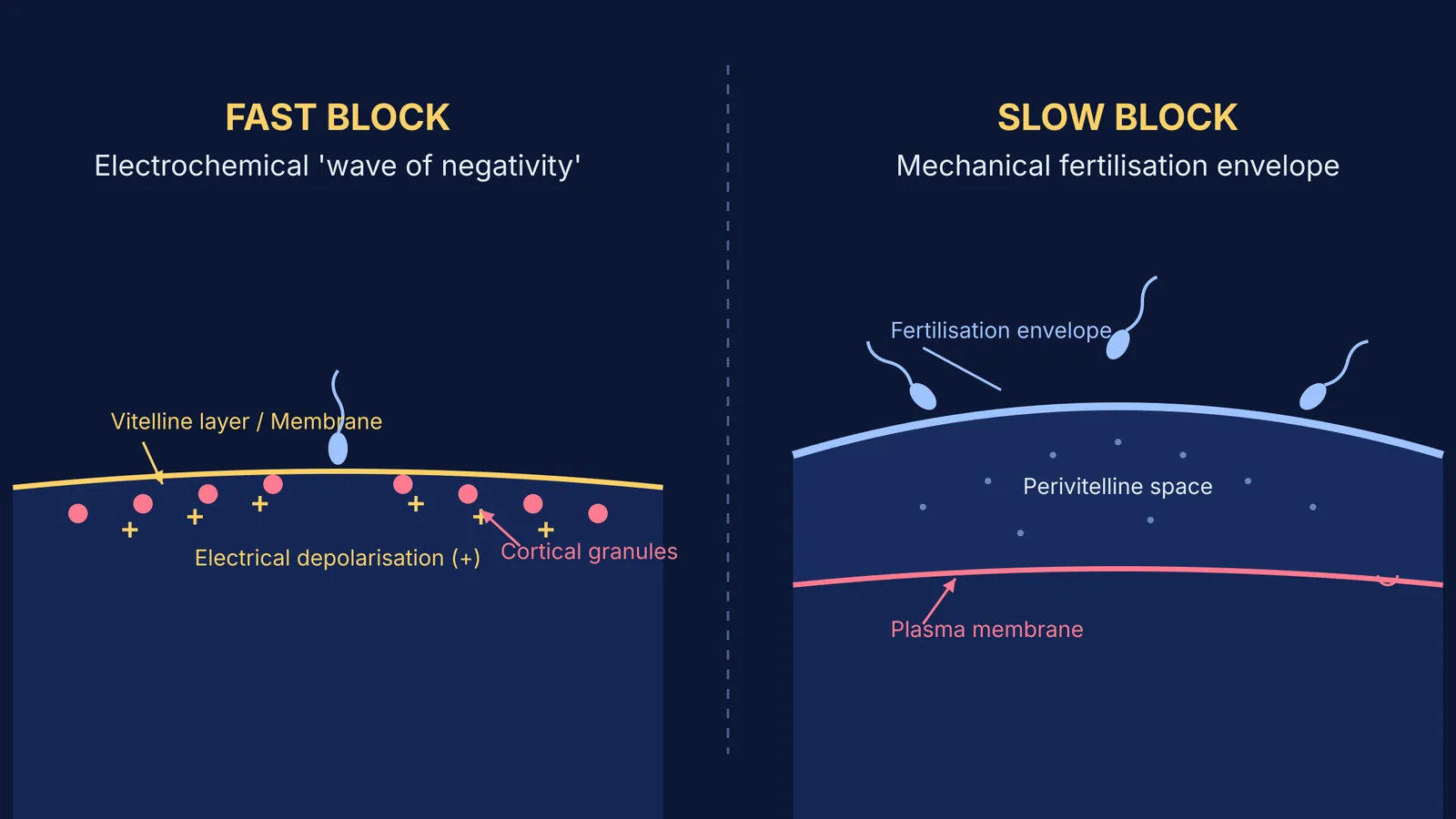
Just observed that the instant a successful sperm attaches to the egg, a rapid change sweeps across the entire cell surface. In 1919, he published his findings describing a "wave of negativity" that spreads over the egg immediately upon sperm entry.
He realised that this initial response happened far too quickly to be a physical barrier. Instead, it was an electrical one. Modern science has confirmed Just's insight: the egg membrane's electrical potential suddenly shifts (depolarisation) (National Institutes of Health). For a brief period, this electrochemical change makes the egg surface unreceptive, preventing any other sperm from fusing with the membrane while the cell prepares a more permanent defence.
What is the slow block to polyspermy?
The electrical shield buys the egg time to build a physical wall. Just documented how the egg executes this "slow block" by lifting a protective layer called the fertilisation envelope.
Just observed that as the initial wave passes, the egg pushes the vitelline membrane away from the cell surface. As this envelope lifts, it physically pushes away any other sperm that have attached to the outside, creating a permanent mechanical barrier. This careful management of the cell surface ensures the embryo begins with exactly the right amount of genetic material. (While animal eggs go to great lengths to control fertilisation, some plants use apomixis and polyembryony to produce seeds without fertilisation at all).
What challenges did Just face in his career?
Despite his brilliant experimental design and profound insights, Just's career was severely hindered by systemic racism. As an African American scientist in the early twentieth century, he faced intense prejudice from the American scientific establishment. He was frequently denied funding, excluded from faculty positions at major research universities, and his holistic views on cell biology were often marginalised in favour of the increasingly popular, gene-centric approach championed by his contemporaries.
Just served as a professor at Howard University and earned the NAACP's first-ever Spingarn Medal in 1915 for his achievements. However, the persistent professional hostility in the United States eventually drove him to self-imposed exile. He spent much of his later career working at prestigious research institutions in Europe, where he found that his scientific contributions were evaluated with greater respect.
A holistic view of the cell
During a time when many biologists focused exclusively on the nucleus and its genes, Just argued that the entire cell works as a unified system. His precise work on the fast and slow blocks to polyspermy remains a cornerstone of developmental biology, proving that the egg actively manages the start of new life.
If you are preparing for biology exams and find yourself memorising organelle functions in isolation, the Fermi Concept Library can help you connect these ideas. It shows how the cytoplasm, membrane, and nucleus interact dynamically across the cell, giving you a clearer picture of the whole system.