On this page
In July 1842 a report reached Parliament with a blunt message: Britain's poor were dying young because of where they lived, and much of that death was preventable. Its author was Edwin Chadwick, and the full text of the 1842 report is free to read today.
Who was Edwin Chadwick?
Chadwick was born in Manchester on 24 January 1800, began a career in law and worked as a literary assistant to the philosopher Jeremy Bentham, according to a 2024 review in the journal Cureus. The same review says he was appointed to the Poor Law Commission in 1832 and later became its secretary. The survey behind the report was carried out by assistant commissioners and published under Chadwick's name, the UK National Archives notes.
What did Chadwick's 1842 sanitary report find?
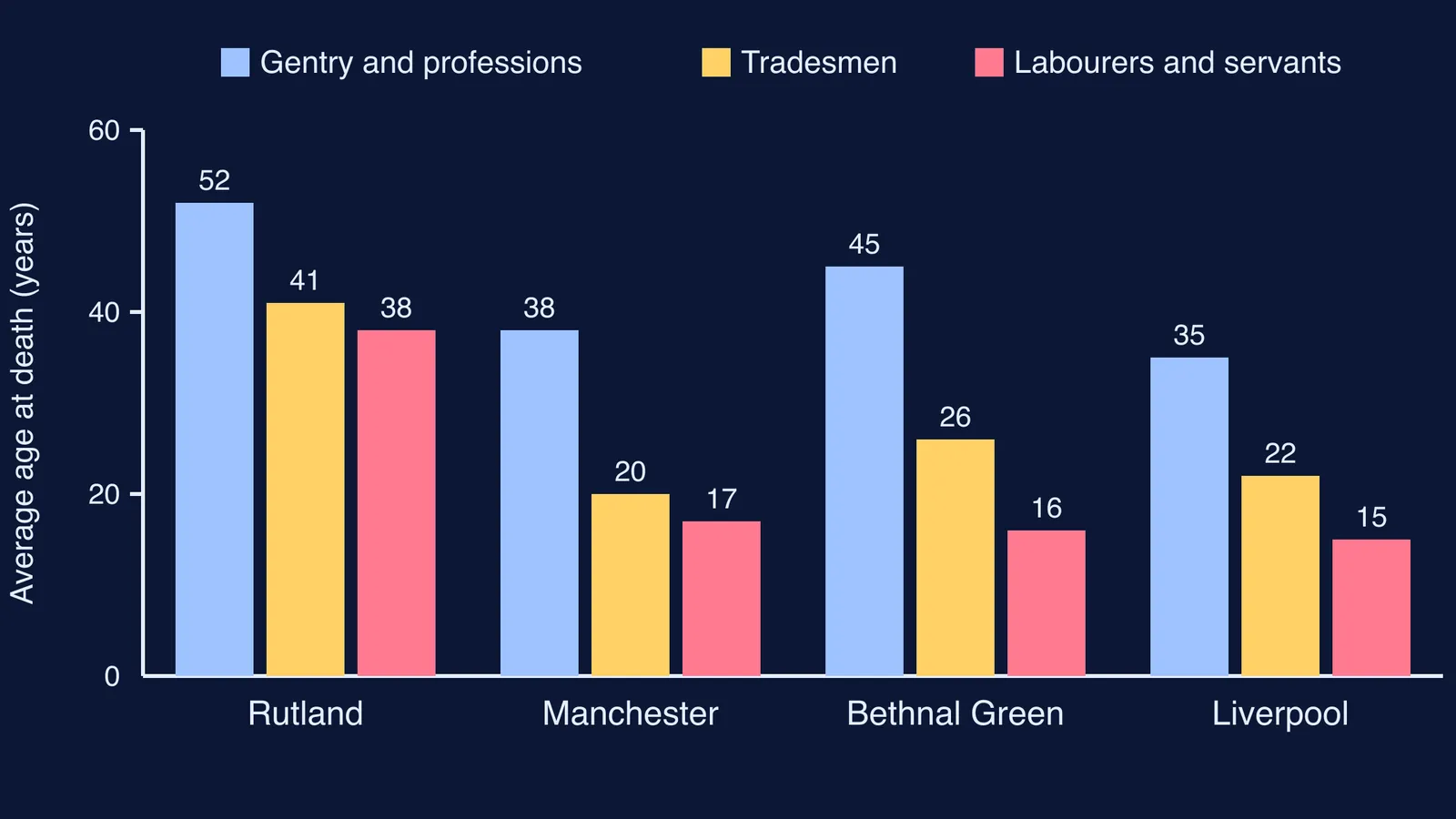
The numbers came from death registration returns, sorted by social class. In Bethnal Green in 1839, the average age at death was 45 years for “gentlemen and persons engaged in professions”, 26 for tradesmen and 16 for “mechanics, servants, and labourers”, according to the report itself. In Liverpool in 1840 the figures were 35, 22 and 15. Labourers' families in rural Rutland averaged 38 years, more than twice the 17 recorded in Manchester.
His main conclusion was that disease “caused, or aggravated, or propagated chiefly amongst the labouring classes by atmospheric impurities produced by decomposing animal and vegetable substances, by damp and filth, and close and overcrowded dwellings” was found across the whole country. Where those conditions were fully removed, he wrote, such disease “almost entirely disappears”.
Then he named the fix: “The primary and most important measures... are drainage, the removal of all refuse of habitations, streets, and roads, and the improvement of the supplies of water.” He wanted waste carried away by water through “improved and cheaper sewers and drains”, with new public works run by officers with “the science and skill of civil engineers”.
Why did Chadwick blame filth before germs were known?
Chadwick believed in miasma, the idea that diseases such as cholera spread through “foul air” from rotting matter, as the Cureus review explains. His report says almost all its evidence points to “atmospheric impurity” as the main cause of epidemic disease.
That theory was wrong. In 1854 John Snow traced a London cholera outbreak to contaminated water from the Broad Street pump, the same review notes. But removing sewage from homes and supplying cleaner water also helped cut the routes by which waterborne microbes spread.
What changed after the report?
The Public Health Act 1848 set up a General Board of Health for five years. Where the average death rate exceeded 23 per 1,000, the Board could create a local board of health itself, according to the National Archives. The General Board was reconstituted in 1854 and abolished in 1858. Chadwick was knighted in 1889, the Cureus review records.
Does an average age at death of 16 mean adults died at 16?
No, and this is the report's most useful lesson for a student. In Liverpool, 62 per cent of the deaths among the labouring classes were of children under five, and in Manchester more than 57 per cent of children born to labouring families died before their fifth birthday, as Chadwick's tables show.
Here is a worked example with made-up round numbers. Imagine 10 deaths in one street: 6 babies who die at age 1, and 4 adults who die at 35.
Add the ages: 6 × 1 + 4 × 35 = 146 years.
Divide by the 10 deaths: the average age at death is 14.6 years.
Yet nobody in the street died at 14. The people who survived childhood lived to 35.
So a low average age at death mostly measured how many young children died. If mean and median still feel shaky, the Fermi Concept Library has a lesson for each concept in mathematics and biology, so you can check a definition before you trust a number.
How do you read an old data table like a scientist?
Ask these four questions of Chadwick's tables, or of any statistic in a news story:
What exactly was counted? Here: deaths registered in one year, grouped by the family's class.
What does the average hide? Here: child deaths pull it far down.
What else differs between the groups? Income, food and work differ, not just housing. The report records that wages in Manchester were nearly double those in Rutland, yet people there died younger.
When the suspected cause is removed, does the outcome change? Chadwick pointed to places where drainage and cleansing had cut disease.
When a mean-versus-median question turns up in a test, the Fermi Problem Library has worked problems with a step-by-step solver that explains the reasoning rather than printing an answer.
To follow the story forward, read how William Farr turned causes of death into vital statistics, how John Leal's 1908 water chlorination in Jersey City went after the microbes Chadwick could not see, and the NCERT Class 12 table of diseases and the organisms that cause them.