On this page
In the 1760s a farmer's son near Philadelphia, who had taught himself mathematics and clockmaking, built scientific instruments better than any made in America before. David Rittenhouse is remembered for two of them: a geared model of the solar system, and the telescope he pointed at the Sun on the afternoon Venus crossed it in 1769.
Who was David Rittenhouse?
Rittenhouse was born on 8 April 1732 near Germantown, Pennsylvania, and died in Philadelphia on 26 June 1796, according to the Dictionary of Scientific Biography entry by Brooke Hindle. He grew up on a farm in Norriton, north of Philadelphia, largely self-taught, and made clocks and surveying instruments for a living. Later he became the first director of the US Mint (1792 to 1795) and followed Benjamin Franklin as president of the American Philosophical Society.
What did Rittenhouse's orrery show?
An orrery is a mechanical model of the solar system: you turn a crank, and gears move each planet round the Sun at its correct relative speed. Rittenhouse built two. The first was bought in 1771 by John Witherspoon, president of the College of New Jersey (now Princeton), for about £220, according to Princeton's University Archives. It is still on display in the lobby of Peyton Hall.
The second went to the College of Philadelphia, now the University of Pennsylvania. A Penn Libraries article by David N. McKnight says the first orrery was begun in 1767 at Provost William Smith's request, and describes the Penn one as "comprised of hundreds of gears and driven by a crank", conceived to show the motion of the planets for 5,000 years. The same article notes that, unlike designers of other orreries, Rittenhouse displayed the elliptical paths of the planets.
According to Penn Libraries' collection page, a side panel showed the Moon's motion and eclipses, and Provost William Smith claimed it "will not vary a Degree from the Truth in less that Six Thousand Years".
Why did the 1769 transit of Venus matter?
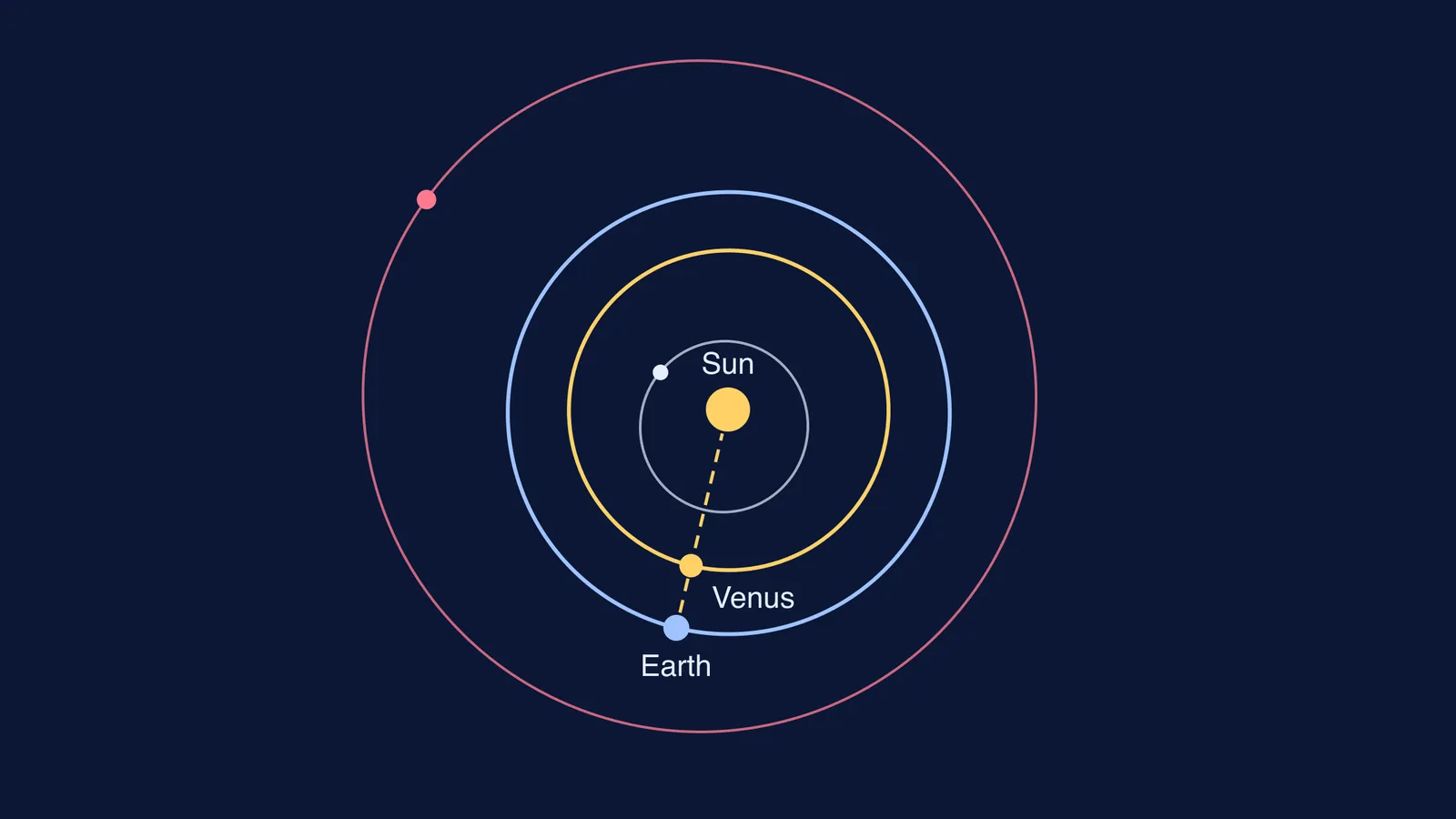
A transit of Venus happens when Venus passes directly between Earth and the Sun and appears as a small black dot crossing the Sun's face. Edmond Halley showed that if observers far apart on Earth timed the crossing exactly, the small differences in their timings would reveal the Sun's parallax, and from it the Earth–Sun distance. As the Ohio State University astronomy notes explain, Halley hoped that, with timings good to about 2 seconds, this would give the distance to an accuracy of 1 part in 500.
Kepler's laws already gave the relative sizes of the orbits (Venus orbits at 0.723 times Earth's distance, per the NASA Venus fact sheet), so one real distance would set the scale of the whole solar system. Practise that ratio reasoning with our guide to comparing orbital periods with Kepler's third law.
Expeditions set out for the transits of 1761 and 1769. In 1769, more than 150 observations were recorded, and the range of values for the Earth–Sun distance was narrowing to between 94 and 96 million miles, according to the Smithsonian Libraries exhibition Chasing Venus. For comparison, Earth's average distance from the Sun is 149.598 million km, about 93 million miles, per the NASA Earth fact sheet.
What happened at Norriton on 3 June 1769?
The American Philosophical Society sent a committee of Rittenhouse, William Smith, John Lukens and John Sellers to observe from Norriton, near Rittenhouse's home, and built a second observatory in the State House garden in Philadelphia, according to the Encyclopedia of Greater Philadelphia. Their report was published in the Royal Society's Philosophical Transactions, volume 59. The Dictionary of Scientific Biography says Rittenhouse made many of the instruments himself and contributed to the best American calculation of the parallax.
How accurate do an orrery's gears need to be?
This calculator exercise shows why a 5,000-year claim is ambitious. The periods come from NASA's Venus and Earth fact sheets.
Venus orbits in 224.701 days and Earth in 365.256 days, so the Venus arm must turn 365.256 ÷ 224.701 = 1.62552 times for each turn of the Earth arm.
A simple pair of gears with 13 and 8 teeth gives 13 ÷ 8 = 1.625.
The error is 0.00052 turns per year, or about 0.19° per year.
After a century the model's Venus is about 19° out of place. After 5,000 years it would be more than two full orbits wrong.
Check your physics: the time between one Venus–Earth line-up and the next is 1 ÷ (1/224.701 − 1/365.256) = 583.9 days, which matches NASA's synodic period of 583.92 days.
So a model meant to stay true for centuries needs gear ratios far closer than one small pair can give. If orbits are hard to picture on paper, the Fermi Simulation Lab has interactive simulations for ideas that are easier to see than to read. If Kepler's laws or parallax are still shaky, each one has its own lesson in the Fermi Concept Library.
To feel the sizes of those orbits, try building a solar system scale model at home with a toilet roll and a lane. Eight years before Rittenhouse, another observer watched Venus closely: read how Lomonosov spotted the atmosphere of Venus in 1761.