

On this page
In 1716, Edmond Halley urged astronomers in the *Philosophical Transactions of the Royal Society* to observe the 1761 and 1769 transits of Venus to determine the astronomical unit via solar parallax. When Venus crossed the Sun on June 6, 1761 (May 26 in the Julian calendar), dozens of international expeditions prepared their clocks across Europe, Asia, and southern oceans.
In St. Petersburg, Russian polymath Mikhail Lomonosov—who had previously tested the conservation of mass in sealed flasks—observed from his home observatory on the Moika River. While Jeremiah Horrocks's 1639 transit observation had recorded Venus as an inert silhouette, Lomonosov scrutinized the planet's perimeter through a 4.5-foot refractor telescope with a focal length of approximately 1.37 metres.
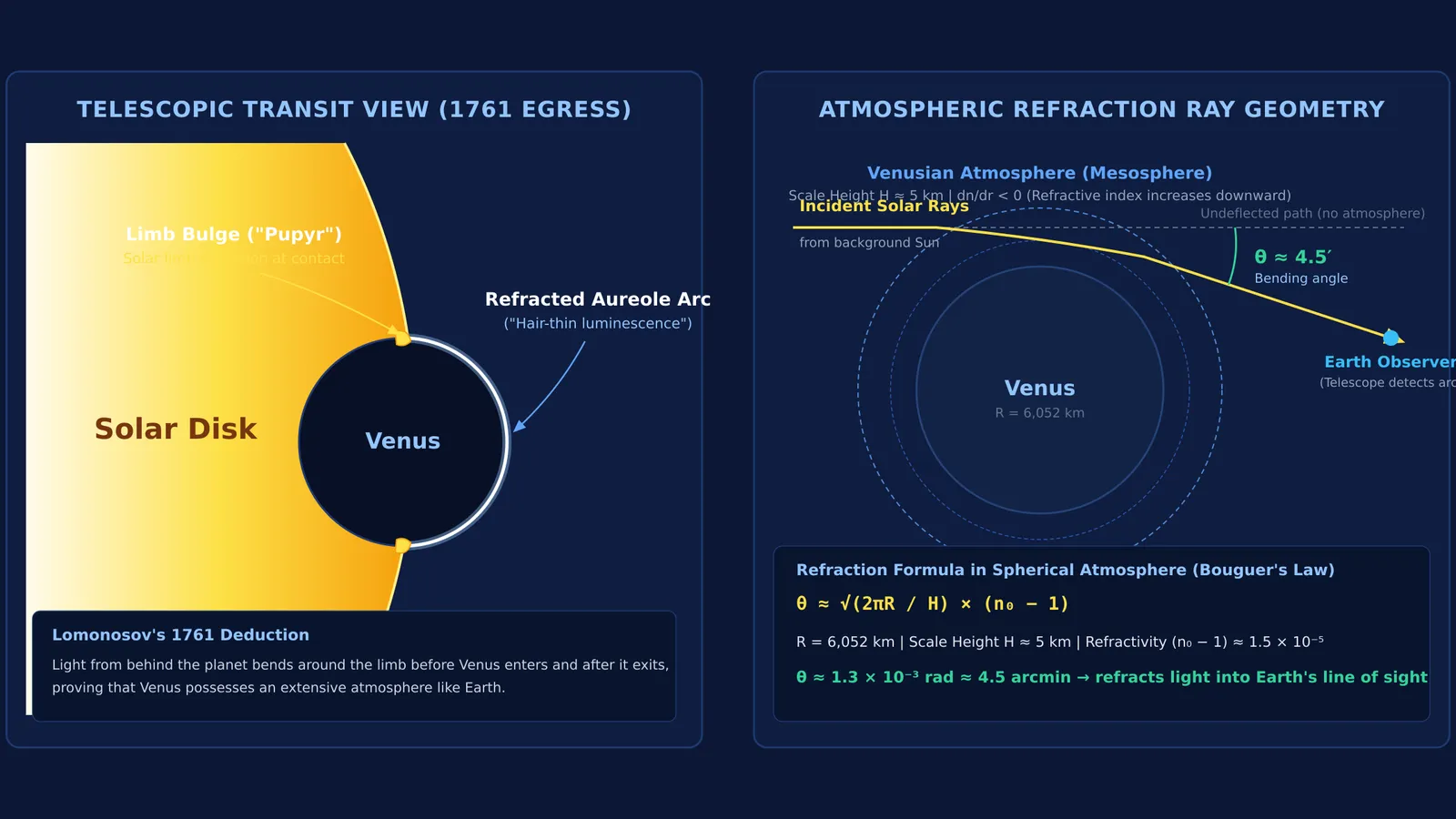
As Venus entered the solar disk at ingress, Lomonosov spotted a hair-thin luminous arc (*volosyanaya svetlost'*) completing the planet's circular silhouette before it had fully moved onto the Sun. Later, as the planet neared the solar edge at egress, he observed a prominent bulging blister (*pupyr'*) on the Sun's limb reaching out toward Venus, followed by the luminous fringe reappearing off the solar disk. In his July 1761 monograph, *The Appearance of Venus on the Sun*, Lomonosov applied geometric optics to conclude that sunlight was refracting around the globe: "the planet Venus is surrounded by a significant air atmosphere, similar to (if not even greater than) that which surrounds our earthly globe."
How does atmospheric refraction create Lomonosov's arc?
As analyzed by the American Physical Society, Lomonosov was the first to recognize that the luminous halo—now known as the Venus aureole—arises from the principles of atmospheric refraction:
Density gradient: Venus's atmosphere grows denser toward the surface. Because the refractive index n exceeds 1 and increases downward, light rays travel slower at lower altitudes.
Inward curvature: According to Snell's law in spherical coordinates, light passing through this gradient bends toward the planet's center.
Aureole formation: Solar rays grazing the upper mesosphere bend by several arcminutes toward Earth, forming a bright fringe along the planet's dark limb.
This halo differs completely from the "black drop effect." The black drop is an internal optical artifact caused by Earth's atmospheric turbulence and telescope diffraction, which stretches the planet into a dark teardrop at contact. Lomonosov's arc is a genuine physical halo produced by planetary refraction outside the solar disk.
Why did other European astronomers miss the atmosphere?
More than 120 transit observation stations across the globe tracked the 1761 transit, yet almost none recognized Venus's atmosphere. Lomonosov succeeded because of distinct observational choices:
Filter density: Most European astronomers used heavily smoked or dark amber glass to avoid solar eye damage, which unintentionally blocked the faint refracted light of the aureole.
Lomonosov's light filter: Lomonosov documented using a lightly smoked glass filter (*ves'ma negusto kopchenoe steklo*). This allowed the faint arc to be seen, while Lomonosov rested his eyes frequently.
Observational focus: Most astronomers focused strictly on recording contact timestamps for Halley's parallax calculations, overlooking physical details along the limb.
Historians long debated whether Lomonosov's optics could truly resolve the aureole. During the June 5–6, 2012 transit, physicists tested this question directly. Using antique 18th-century Dollond refractors with apertures of 50 to 67 millimetres (2 to 2.6 inches) and replicas of Lomonosov's light filter, researchers verified that the aureole is easily visible to the human eye, as documented in Physics Today.
How is atmospheric ray deflection calculated for Venus?
Students can model the angular deviation of grazing rays using ray optics in a spherically symmetric medium:
The Bouguer invariant: Snell's law in spherical coordinates states n(r) × r × sin φ = b, where b is the impact parameter and φ is the ray's angle to the radius vector.
Deflection formula: Integrating along the grazing path gives total angular deflection θ:
θ ≈ √(2 × π × R / H) × (n₀ - 1)
Venus mesosphere numbers: At an altitude of 100 kilometres, Venus has scale height H ≈ 5 kilometres, planetary radius R ≈ 6,052 kilometres, and refractivity (n₀ - 1) ≈ 1.5 × 10⁻⁵:
θ ≈ √(2 × 3.1416 × 6052 / 5) × (1.5 × 10⁻⁵) ≈ 87.2 × (1.5 × 10⁻⁵) ≈ 1.3 × 10⁻³ radians ≈ 4.5 arcminutes.
Visibility threshold: This deflection of 4.5 arcminutes easily bends background solar rays into Earth-based telescopes, explaining the bright arc Lomonosov witnessed.
What does Lomonosov's discovery teach modern physics students?
Lomonosov's achievement highlights the value of investigating unexpected anomalies rather than dismissing them. While others treated edge distortions as nuisances, Lomonosov investigated their physical origin.
Modern spacecraft have verified the scale of Venus's atmosphere. As documented in NASA planetary data, Venus maintains a surface pressure of 93 bar (93 times Earth's sea-level pressure) and an average temperature of 467°C beneath an atmosphere that is 96.5% carbon dioxide. Lomonosov's 1761 observation provided humanity's first glimpse of this atmosphere.
When students struggle to visualize how density gradients bend light in planetary atmospheres, interactive models make ray paths intuitive. The Fermi Simulation Lab provides interactive simulations for the ideas that are easier to see than to read. To build strong foundations across Snell's law, wave optics, and celestial mechanics, the Fermi Concept Library covers every concept in physics, chemistry, biology, mathematics and computing, each with its own lesson and its place in the map.


