

On this page
On a clear morning in Paris, French physicist Claude Pouillet set a slender brass instrument on a tripod aimed directly at the Sun. For centuries, natural philosophers had felt sunlight's heat, but none had measured its radiant power in objective physical units. On July 9, 1838, Pouillet presented his memoir to the French Academy of Sciences (Pouillet 1838 on Gallica), introducing the term "solar constant" (*constante solaire*) to define the radiant power delivered by sunlight per unit area outside Earth's atmosphere.
What is Claude Pouillet's pyrheliometer?
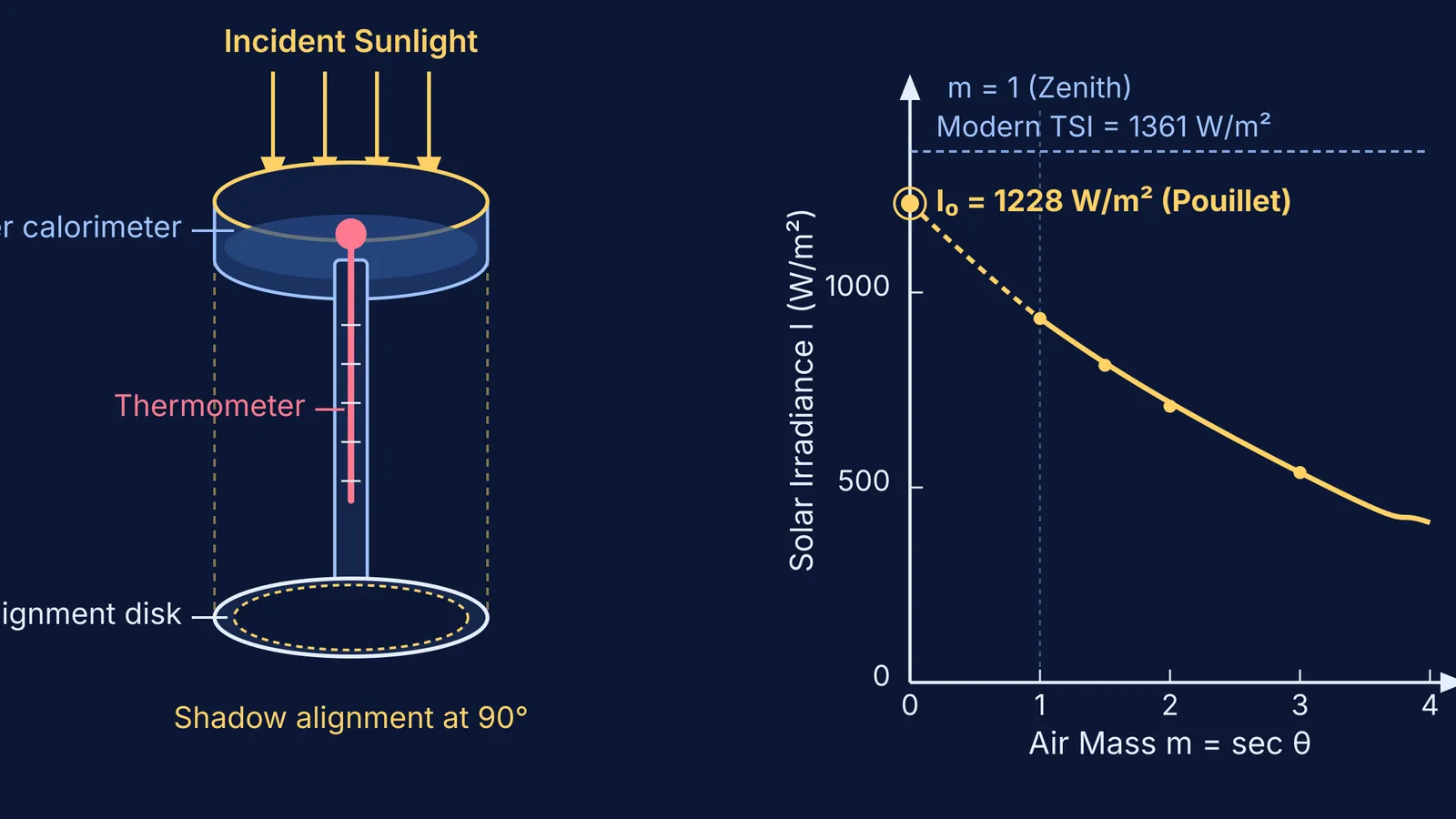
Pouillet invented the pyrheliometer—detailed in his 1838 Academy memoir—from the Greek *pyr* (fire), *helios* (sun), and *metron* (measure) as a specialised water calorimeter. At its top sat a shallow, silver-plated cylinder containing roughly 100 grams of water. Pouillet coated the upper circular face with lampblack, creating a near-ideal black surface that absorbed virtually all incident sunlight as heat. A sensitive thermometer bulb dipped into the water, while its graduated stem extended downward through a protective central tube.
Rotating the central tube with a knurled base knob kept the water stirred for uniform temperature readings. Across the English Channel, astronomer Sir John Herschel conducted parallel actinometer tests in 1838 at the Cape of Good Hope using a chemical solution, but Pouillet's water calorimeter provided a direct, verifiable energy balance.
How did Pouillet measure the solar constant from ground level?
Pouillet used a three-interval cycle to isolate solar radiation from environmental heat exchange. First, he held the instrument in the shade for five minutes to measure background cooling or heating (ΔT_shade1). Next, he exposed the blackened face perpendicular to direct sunlight for five minutes (ΔT_sun). Finally, he returned the instrument to the shade for five minutes (ΔT_shade2). Subtracting the mean shade rate from ΔT_sun gave the true temperature rise produced by sunlight alone.
Because Earth's atmosphere scatters and absorbs solar energy, ground measurements underestimate incoming space flux. The optical path length depends on the solar zenith angle θ, defining the relative air mass m ≈ sec(θ) = 1 / cos(θ). Applying Pierre Bouguer's transmission law, ground irradiance follows I(m) = I₀ · p^m, where I₀ is the solar constant and p is the zenith transmission coefficient. By recording data across different air masses from morning to noon, Pouillet calculated that a clear atmosphere transmits about 76% of zenith sunlight, and extrapolated back to m = 0. In his 1838 memoir, he derived a solar constant of 1.7633 calories per square centimetre per minute, or approximately 1,228 W/m².
How do you calculate solar flux with a water calorimeter?
Here is how Pouillet's calorimeter method works with modern SI numbers, applying the vessel dimensions recorded in his 1838 memoir:
Parameters: Water mass m_w = 0.100 kg, specific heat c_w = 4,184 J/(kg·K), and silver vessel equivalent C_vessel = 16 J/K yield total heat capacity C_total = 434.4 J/K.
Exposure: A blackened circular plate of radius r = 0.050 m (area A ≈ 0.007854 m²) is exposed for t = 300 s (5 minutes).
Temperature rise: Sun exposure produces ΔT_sun = +4.80 °C, while average shade cooling is ΔT_shade = -0.26 °C. Net rise is ΔT_net = 4.80 - (-0.26) = 5.06 °C.
Ground irradiance: Absorbed heat Q = 434.4 × 5.06 ≈ 2,198 J. Ground flux is I_ground = Q / (A · t) = 2,198 / (0.007854 × 300) ≈ 933 W/m².
Atmospheric correction: At zenith angle θ = 35° (air mass m ≈ 1.22) and zenith transmittance p = 0.76, the solar constant is I₀ = 933 / (0.76^1.22) ≈ 1,303 W/m².
When students practice multi-concept numericals connecting calorimetry to radiation, the Fermi Problem Library provides worked problems with a step-by-step solver that explains the reasoning rather than printing an answer.
How does Pouillet's 1838 value compare to modern physics?
Pouillet's 1,228 W/m² was within 10% of today's accepted value. The International Astronomical Union's Resolution B3 (Prša et al. 2016) defines the nominal solar constant as S_Nom = 1,361 W/m². That standard relies on satellite radiometry from the Total Irradiance Monitor aboard NASA's SORCE mission (Kopp and Lean 2011), which eliminated internal scattered-light errors in earlier detectors.
Pouillet's solar constant also guided early radiation physics. In 1879, Josef Stefan used Pouillet's solar constant when deducing his fourth-power radiation law; see our article on how Josef Stefan found the fourth power radiation law. Applying Stefan's law to solar flux yielded a surface temperature of 5,700 K, correcting Pouillet's earlier estimate of roughly 1,761 °C from the older Dulong-Petit rule. You can explore these calculations further in our articles on estimating the Sun's surface temperature from the solar constant and estimating Earth's temperature from radiation balance.
For visualizing thermal radiation and atmospheric absorption curves, the Fermi Simulation Lab offers interactive simulations for the ideas that are easier to see than to read. To connect these principles into a structured syllabus roadmap, the Fermi Concept Library organizes every concept in physics, chemistry, biology, mathematics and computing, each with its own lesson and its place in the map.


