On this page
One of the simplest parts for holding a voltage steady carries the name of a physicist who never set out to build an electronic component. Clarence Zener's contribution was an idea about why insulators suddenly stop insulating.
Who was Clarence Zener?
Clarence Melvin Zener was born in Indianapolis on 1 December 1905 and died on 2 July 1993, according to the National Academy of Sciences biographical memoir written by his former student John B. Goodenough. He struggled to read before age 10, yet entered Stanford at 16 and earned a Harvard PhD in physics under Edwin Kemble in 1929.
He then spent postdoctoral years at Princeton and at the University of Bristol, where he worked with N. F. Mott and H. Jones (NAS memoir). He was elected to the National Academy of Sciences in 1959.
What did Zener discover in 1934?
In July 1934 Zener published "A theory of the electrical breakdown of solid dielectrics" in the Proceedings of the Royal Society A, volume 145, pages 523–529 (Crossref record of the paper). The question: why does an insulator suddenly pass a large current once the field crosses a critical value?
As the paper's abstract explains, in band theory an insulator has energy bands that are completely full and higher bands that are almost empty, so ordinary fields move almost no charge. One suggested route was an avalanche, like a spark in a gas: a fast electron knocks another loose, and the count grows exponentially.
The route that carries Zener's name is different. A strong enough field lets electrons tunnel straight from the full band into the empty one, without being knocked there. Today this is called the Zener effect: in a reverse-biased p-n junction, the field enables tunnelling of electrons from the valence band to the conduction band, which sharply raises the reverse current (Zener effect, Wikipedia).
Who invented the Zener diode, then?
Not Zener himself. His 1934 studies were mainly theoretical and about insulators, and his work later led to the Bell Labs implementation of the effect as an electronic device (Zener diode, Wikipedia). In 1951 Physical Review published "Observations of Zener current in germanium p-n junctions" by McAfee, Ryder, Shockley and Sparks (Crossref record), a title that already used his name for current in junctions.
The twist: many "Zener" diodes do not use the Zener effect. Toshiba's engineering notes explain that below about 6 V, tunnelling dominates and the breakdown voltage falls as temperature rises, while above about 6 V, avalanche dominates and the voltage rises with temperature (Toshiba semiconductor FAQ).
How does a Zener diode regulate voltage?
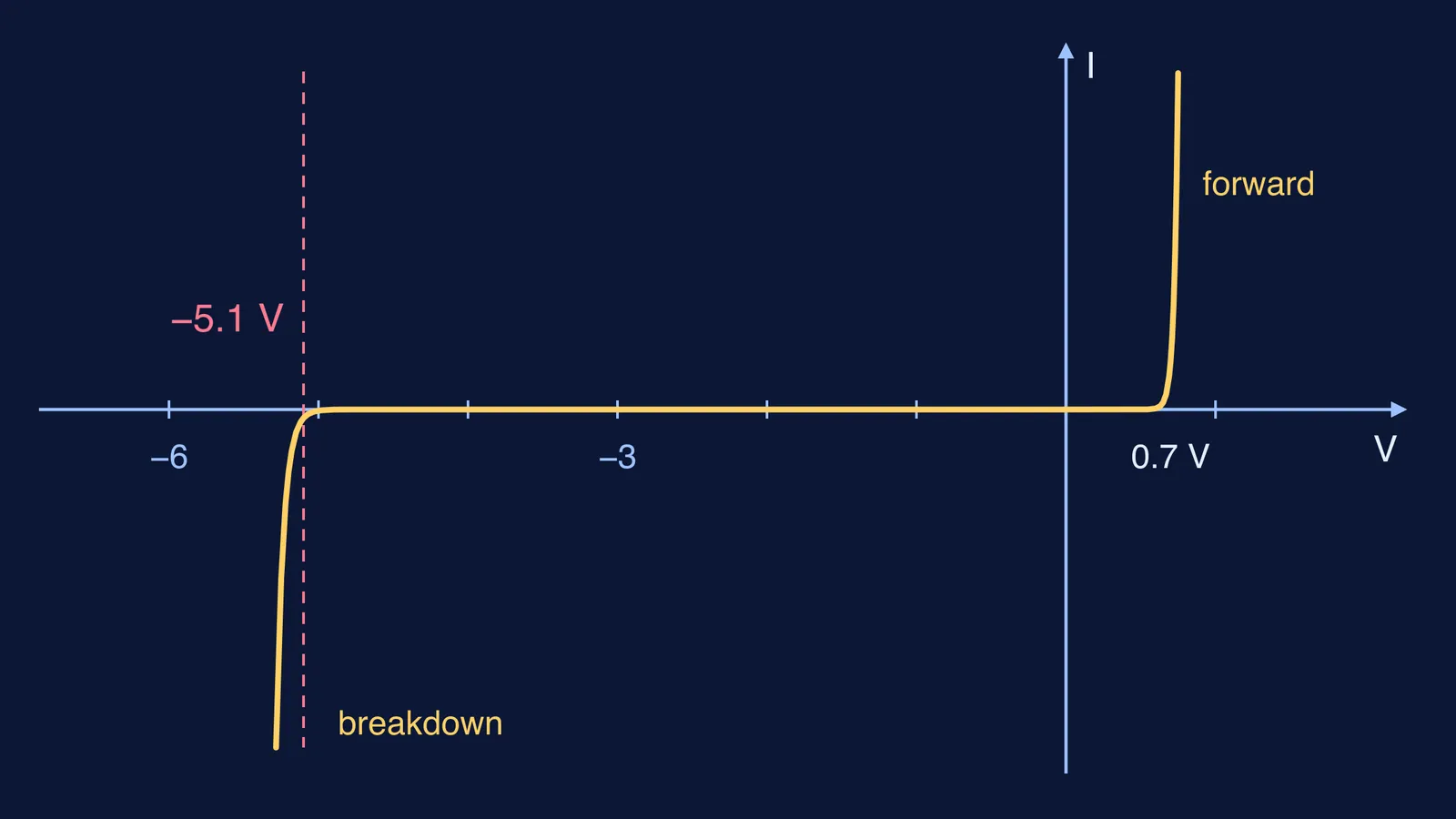
Look at the curve at the top of this post. In reverse bias almost no current flows until breakdown; after that, the current can change while the voltage across the diode stays close to its breakdown voltage (Zener diode, Wikipedia). Put the diode in parallel with a load, with a resistor in series with the supply, and the diode takes whatever current the load does not need.
Worked example: a 5.1 V rail from a 9 V supply
You need 5.1 V for a circuit drawing 20 mA from a 9 V supply, and you choose to keep at least 5 mA through the Zener so it stays in breakdown.
Voltage across the series resistor: 9 − 5.1 = 3.9 V.
Current through the resistor: 20 mA (load) + 5 mA (Zener) = 25 mA.
Resistor: R = 3.9 V ÷ 0.025 A = 156 Ω. The nearest common value below it is 150 Ω.
Check with 150 Ω: 3.9 ÷ 150 = 26 mA, so the Zener carries 26 − 20 = 6 mA. It regulates.
Worst case, load unplugged: all 26 mA flows through the Zener, which dissipates 5.1 × 0.026 ≈ 0.13 W. Pick a diode rated well above that.
Lowest supply that keeps your 5 mA margin: 5.1 + 150 × 0.025 = 8.85 V. Below about 5.1 + 150 × 0.020 = 8.1 V, the Zener current falls to zero and the output sags.
Steps 5 and 6 are where numericals hide their traps: students find R and stop, without checking the extremes.
If the reverse curve feels abstract, the Fermi Simulation Lab has interactive simulations for ideas that are easier to see than to read. If your regulator answers keep coming out wrong, the Fermi Problem Library has worked problems with a step-by-step solver that explains the reasoning rather than printing an answer.
What did Zener leave behind?
The diode is only one item. Goodenough's memoir lists it alongside internal friction in metals, stronger steel for the US Army, double exchange in magnetic oxides and an optimisation method called geometric programming, and closes by saying Zener "pioneered the building of bridges between physics, materials science, and engineering" (NAS memoir).
That sharp bend on your reverse-bias graph began as a question about why insulators fail.