On this page
Cicely Saunders thought dying patients should not have to wait for pain to come back before they got relief. She gave pain relief on a regular schedule, recorded what happened, and in 1967 founded St Christopher's Hospice in London. The patterns of care that grew from her work have since been adopted widely around the world.
Who was Cicely Saunders?
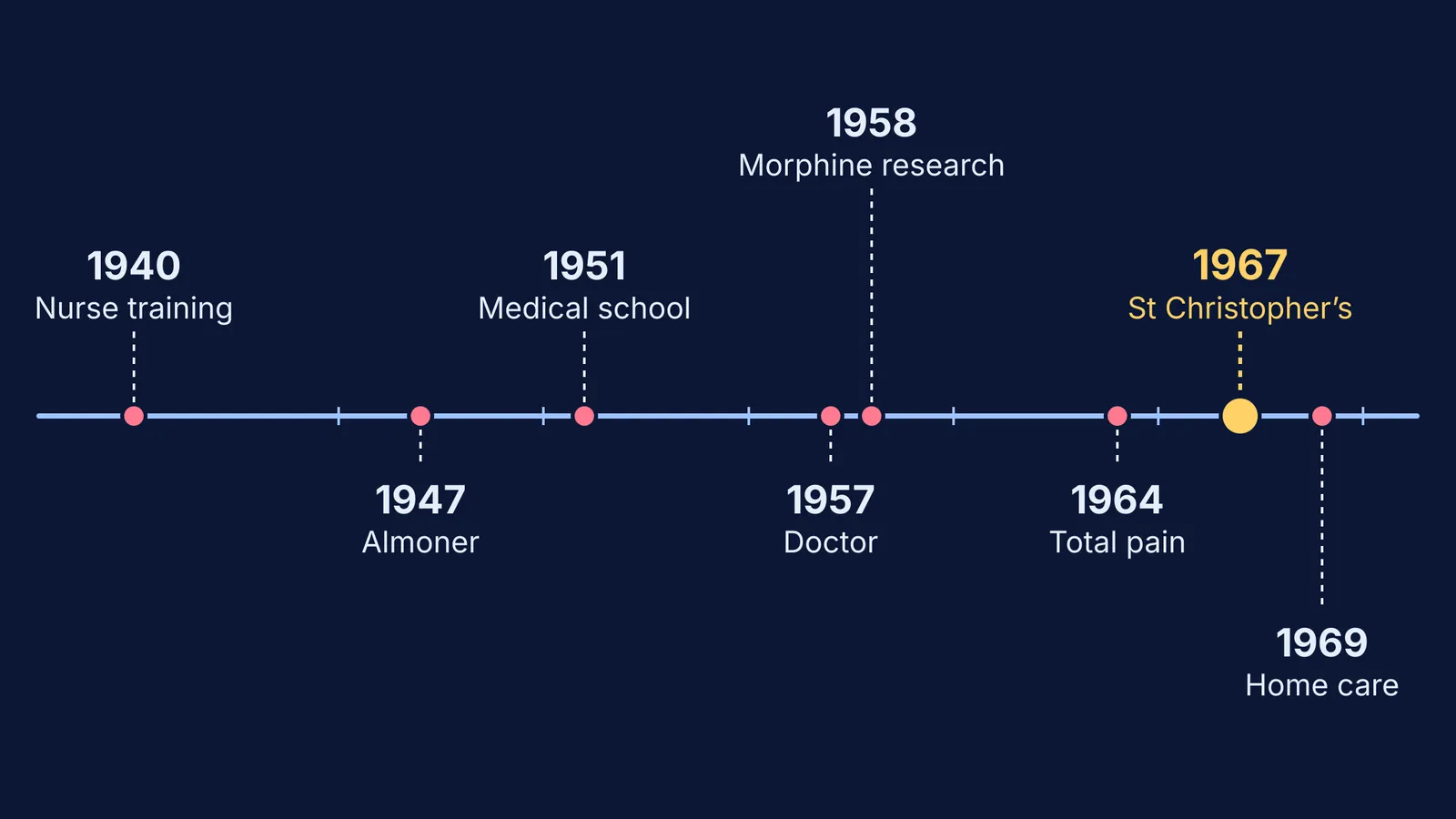
According to St Christopher's Hospice, Saunders was born in Barnet on 22 June 1918 and died at St Christopher's on 14 July 2005. She trained three times over:
nurse, at the Nightingale School of Nursing at St Thomas's Hospital, from 1940 to 1944
medical social worker (then called an almoner), qualifying in 1947
doctor, at St Thomas's Hospital Medical School, from 1951 to 1957
The same page says she was involved in the care of patients with terminal illness from 1948. She was not the first woman to push into British medicine; read how Elizabeth Garrett Anderson became Britain's first woman doctor.
In her own account in the Journal of the Royal Society of Medicine (2001), Saunders wrote that in 1948, while working as a social worker, she met a Polish patient whose few words "proved a powerful catalyst of a new world-wide movement". His statement "I will be a window in your Home", she wrote, "gave a challenge to openness of all kinds".
What did Cicely Saunders discover about pain relief?
From 1958 Saunders spent seven years in clinical care and research at St Joseph's Hospice, as she described in her 2001 paper. She introduced "the detailed recording of an oral and regular regimen" of pain relief, and the paper reports that small regular doses of oral morphine worked. The next dose came on schedule rather than after pain returned.
She listened to patients, tape-recorded them, and analysed 1100 cases on a punch-card system, according to the same paper. A nun at St Joseph's summed up the change as patients going "from painful to pain free".
Morphine itself was not new; you can read how Friedrich Sertürner isolated morphine, the first alkaloid. What Saunders changed was the timing and the measuring.
What is "total pain"?
Saunders saw that pain at the end of life was rarely only physical. Her idea of total pain, her 2001 paper says, was defined in 1964 as including "not only physical symptoms but also mental distress and social or spiritual problems".
St Christopher's says she saw "the dying person and the family as the unit of care", and that in 1969 she pioneered the first home care team.
What happened at St Christopher's Hospice in 1967?
St Christopher's opened in 1967 with a building for 54 patients, "for inpatient and home care and for research into the relief of distress", Saunders wrote in the Journal of the Royal Society of Medicine. The hospice describes itself as the first hospice linking expert pain and symptom control, compassionate care, teaching and clinical research. In the same paper she noted that three patterns of care that followed, home-care teams, hospital-care teams and consulting units in teaching hospitals, had been "adopted widely around the world".
The World Health Organization estimates that 56.8 million people need palliative care each year, and only about 14% of them receive it.
India shows why access matters. In the seven years after the 1985 drug law, morphine use in India fell by 97%, and the morphine the country used in 2008 was enough for just 4% of advanced cancer patients who needed it, Human Rights Watch reported. In February 2014 parliament approved amendments to the Narcotic Drugs and Psychotropic Substances Act so that a single licence covers buying morphine and other strong opioid medicines, the same report says.
What can you take from her work?
If someone in your family is seriously ill, their doctors and nurses lead the care, but you can help the team see the whole picture. Here is a total-pain checklist, built on Saunders' four parts, for your next talk with them:
Physical: "Does the pain come back before the next dose is due? Can we write down the times?"
Emotional: "They seem frightened at night. Who can talk with them about it?"
Social: "Money and who will look after the family are worrying them. Is there a social worker we can meet?"
Spiritual: "They want to talk about meaning, faith or their life. Can someone sit with them?"
Place: "Is palliative or home care available near us?" Organisations such as Pallium India list centres across the country.
For students, the lesson is her method: notice a problem everyone accepts, change one thing, record carefully, and count. If you want to understand how painkillers act on nerves and the brain, the Fermi Concept Library gives every concept in biology and chemistry its own lesson and its place in the map.