On this page
In 1839 Carl Gustaf Mosander showed that ceria, the cerium oxide of his day, was hiding a second element. His story is also a clear way into a Class 12 question: why are the lanthanoids so hard to tell apart?
Who discovered lanthanum?
Carl Gustaf Mosander (1797-1858) was a Swedish chemist who succeeded Jöns Jacob Berzelius as professor of chemistry and pharmacy at the Karolinska Institute in 1832 (Carl Gustaf Mosander, Wikipedia). He studied under Berzelius and, for a time, he and his wife lived in Berzelius's house, according to Sheldon J. Kopperl's entry in the Dictionary of Scientific Biography (Encyclopedia.com).
Ceria itself was found in 1803, when Berzelius and Wilhelm Hisinger isolated a new oxide from the Swedish mineral cerite; Martin Heinrich Klaproth isolated it independently in Germany (Lanthanum, Wikipedia). More on Mosander's teacher: how Berzelius discovered selenium, cerium and silicon.
In 1839 Mosander found that ceria contained a new element, which he named lanthanum (Encyclopedia.com). In 1843 he summarised his rare-earth work in the Philosophical Magazine, in a paper titled "On the new metals, lanthanium and didymium, which are associated with cerium; and on erbium and terbium, new metals associated with yttria" (Mosander 1843, DOI record).
Why does the name lanthanum mean hidden?
Lanthanum is named from the Ancient Greek lanthanein, "to lie hidden", because its properties differed only slightly from cerium's and it occurred with cerium in its salts (Lanthanum, Wikipedia). Accounts differ on who coined it: Berzelius's 1839 announcement credits Mosander with the name, while other histories say Berzelius suggested it (Carl Gustaf Mosander, Wikipedia).
It was not the only thing hiding. In 1841 Mosander identified a second new component of ceria and called it didymium, "twin", because it was so closely related to lanthanum (Encyclopedia.com). Didymium was itself a mixture, split in 1885 into praseodymium and neodymium, and relatively pure lanthanum metal was first isolated only in 1923 (Lanthanum, Wikipedia).
How did Mosander separate lanthanum from cerium?
He partially decomposed cerium nitrate by roasting it in air, then treated the oxide with dilute nitric acid (Lanthanum, Wikipedia). A yellow residue of true ceria stayed behind, and he named the dissolved part lanthana, according to Kopperl's entry (Encyclopedia.com).
Your Class 12 textbook hints at why this could work. NCERT notes that the formation of Ce(IV) is favoured by its noble gas configuration (NCERT Class 12 Chemistry, Unit 4: The d- and f-Block Elements). Lanthanum, whose La³⁺ ion is already 4f⁰, has no such option. Heating in air could give cerium a different chemistry from its neighbour, and the acid could work on that difference.
Why were rare earths so hard to separate?
NCERT puts it plainly: the lanthanoids "resemble one another more closely than do the members of ordinary transition elements in any series", and they have only one stable oxidation state (NCERT Class 12 Chemistry, Unit 4).
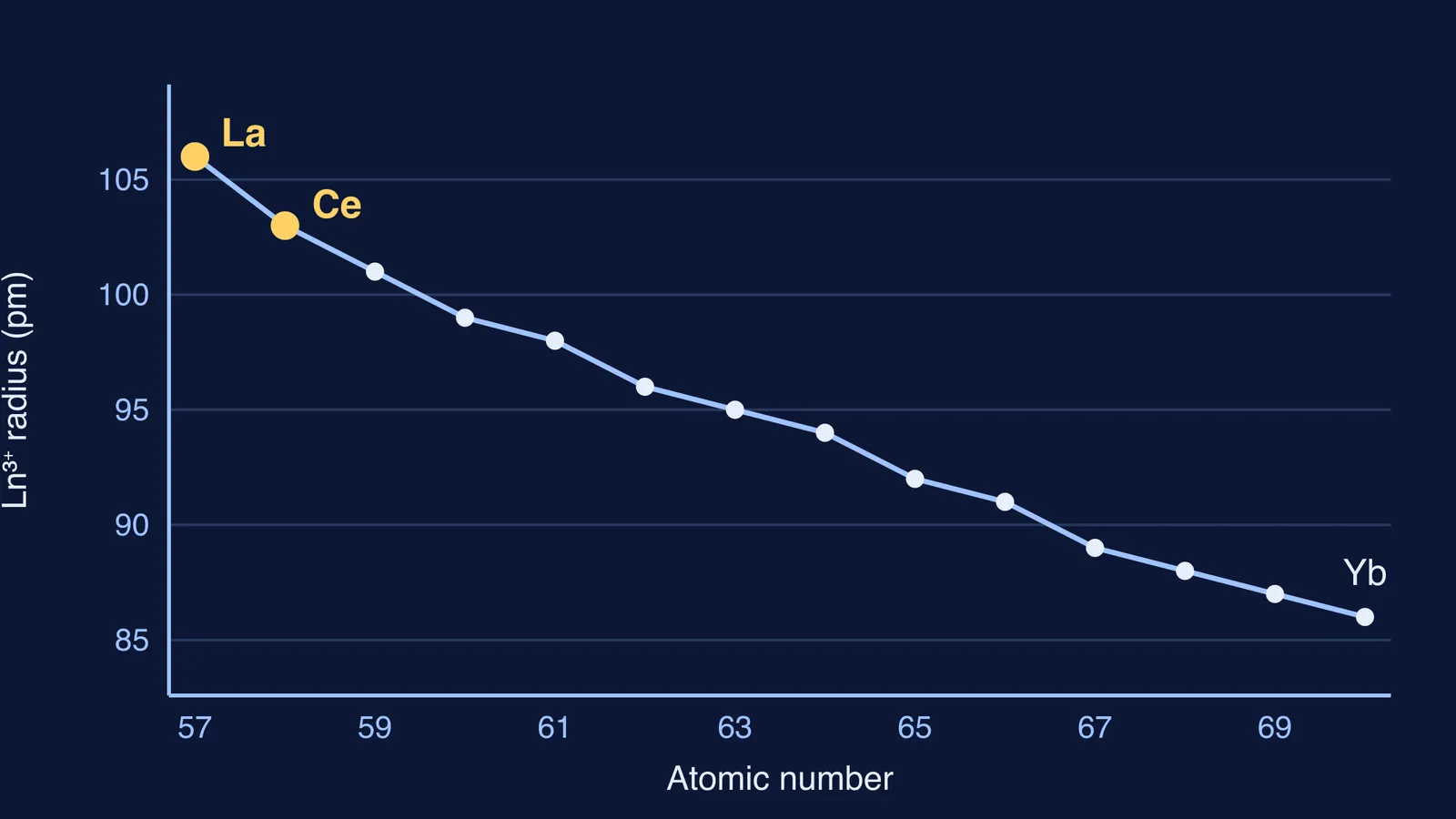
Lanthanoid contraction is the overall decrease in atomic and ionic radii from lanthanum to lutetium; NCERT attributes it to the imperfect shielding of one 4f electron by another as nuclear charge rises (NCERT Class 12 Chemistry, Unit 4).
The steps are tiny. NCERT's Table 4.9 lists La³⁺ at 106 pm, Ce³⁺ at 103 pm and Pr³⁺ at 101 pm, falling to Yb³⁺ at 86 pm (NCERT Table 4.9). Neighbours differ by 1 to 3 pm and carry the same 3+ charge, so they travel together through most reactions.
The effect reaches beyond the f-block. Zr (160 pm) and Hf (159 pm) have almost identical radii, which NCERT says accounts for their occurrence together in nature and the difficulty in separating them (NCERT Class 12 Chemistry, Unit 4). Our explainers on lanthanoid contraction and its consequences and why lanthanoids are difficult to separate go further.
How do you use Mosander's story in a Class 12 answer?
Take a typical question: "Why are the lanthanoids difficult to separate? Name one lanthanoid that behaves differently, and say why." Build the answer in four lines.
Definition: lanthanoid contraction is the steady decrease in size from La to Lu.
Cause: 4f electrons shield each other poorly, so effective nuclear charge rises across the series.
Consequence: the Ln³⁺ ions have the same charge and very similar radii (La³⁺ 106 pm, Ce³⁺ 103 pm), so their chemistry is nearly identical.
Exception: cerium can be oxidised to Ce(IV), which has a noble gas configuration, so its chemistry differs from the +3 ions around it.
Before you write, check: did you name the cause, not just the trend? Did you give a number or the Zr-Hf pair? Did you link size to chemistry?
If "imperfect shielding" still feels like a phrase you learned by heart, the Fermi Concept Library gives every chemistry concept its own lesson and its place in the map, so you can trace the contraction back to shielding and forward to Zr and Hf. To practise, the Fermi Problem Library has worked problems with a step-by-step solver that explains the reasoning rather than printing an answer.
Next time you see La at the start of the f-block, remember it took a furnace and a patient chemist to find it.