

On this page
If you look at the periodic table, the lanthanoids—the 14 elements from cerium to lutetium—are tucked into a single block at the bottom. In nature, they almost always occur together in ores like monazite and bastnäsite. For decades, separating them was considered one of the hardest practical problems in chemistry. The difficulty comes down to two properties: they all prefer a +3 oxidation state, and their ionic sizes are almost exactly the same.
Why are lanthanoids difficult to separate?
The chemistry of any ion is largely decided by its size and its electrical charge. For the d-block transition metals, oxidation states vary wildly, giving each element a completely distinct set of chemical reactions. But the f-block lanthanoids almost exclusively form +3 ions (NCERT Class 12 Chemistry). Because they have the same valence electron configuration when reacting, they undergo the exact same chemical reactions. You cannot easily use standard fractional crystallisation or precipitation to pull one out while leaving the others behind.
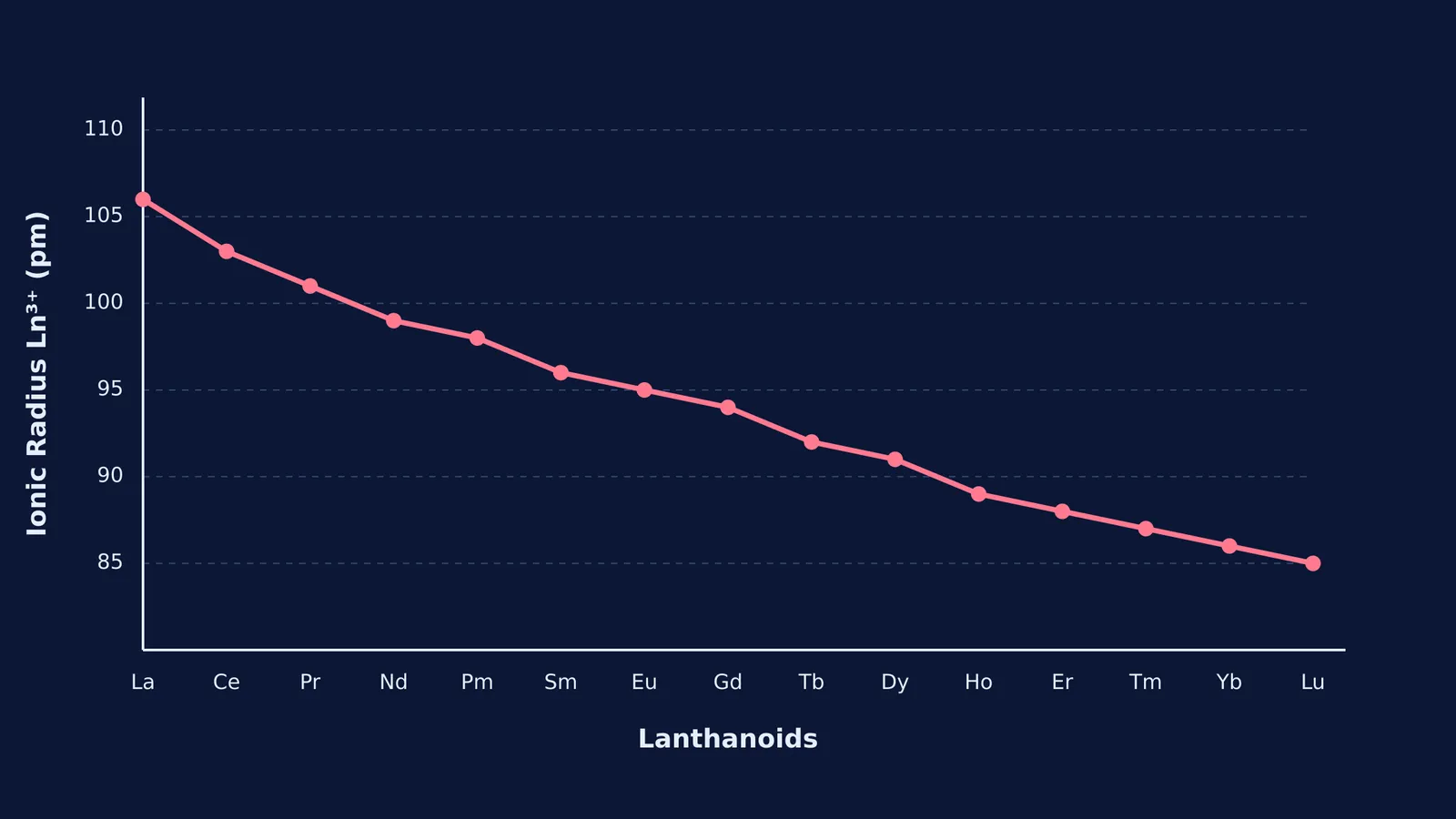
This identical chemistry is compounded by the lanthanoid contraction. As you move from lanthanum (La) to lutetium (Lu), the nuclear charge steadily increases, but the new electrons are being added to the deep, inner 4f subshell. These 4f electrons shield the outer electrons very poorly from the growing pull of the nucleus. As a result, the nucleus pulls the entire electron cloud inward, shrinking the atom. However, the overall shrinkage is incredibly tiny: the ionic radius decreases from 106 pm for La³⁺ to 85 pm for Lu³⁺ (NCERT Class 12 Chemistry). That is a drop of just 21 pm across the entire series.
How does ion-exchange chromatography separate them?
Because standard chemical reactions cannot easily tell one lanthanoid from another, chemists rely on physical separation techniques. Today, the modern standard method is ion-exchange chromatography. It works because it takes advantage of the one thing that does reliably change across the series: that slight 21 pm difference in bare ionic radius (NCERT Class 12 Chemistry).
The process starts by dissolving the mixture of lanthanoid ions and pouring the Ln³⁺ solution through a long glass column packed with a solid cation-exchange resin.
Hydration size: In a water solution, smaller bare ions attract water molecules much more strongly because of their higher concentrated charge density. So, lutetium (the smallest bare ion at 85 pm, according to NCERT Class 12 Chemistry) gathers the thickest and most tightly bound shell of water, making it the largest *hydrated* ion in the mixture.
Binding to the resin: The resin contains negatively charged groups that catch the positive ions. The bulky, heavily hydrated Lu³⁺ cannot get as close to these groups, so it cannot bind as tightly to the resin as the lighter, less hydrated La³⁺.
Elution: A complexing agent, typically a solution of citric acid or EDTA, is continuously washed through the column. This agent forms stable complexes with the metal ions. Because Lu³⁺ binds weakly to the resin and forms a highly stable complex with the eluting agent, it gets washed out (eluted) first.
If you are stuck visualising the electronic configuration of ions or figuring out why zinc is not a transition element, the Fermi Concept Library can help you map the trends. Fermi's AI tutor works out what you already know and builds a plan for the session, writing on a board and checking your understanding as it explains the periodic table.
What is the elution order of lanthanoids?
In ion-exchange chromatography, the lanthanoids elute in strictly decreasing order of atomic number. The heaviest element, lutetium (Lu, atomic number 71), comes out first. The sequence follows the reverse order of the periodic table, ending with the lightest element, lanthanum (La, atomic number 57), which comes out last.
This reverse order happens because the smallest bare ions form the most stable complexes with the eluting agent, spending the least time stuck to the resin column. While the tiny 21 pm difference in size (NCERT Class 12 Chemistry) makes bulk chemistry impossible, it provides just enough contrast for a chromatography column to tease the elements apart one by one.
This is not just theory for textbooks. The exact same ion-exchange principles are used in industry today to purify the neodymium needed for electric vehicle motors and the europium used in smartphone screens. Without understanding how the lanthanoid contraction affects hydration, we would not have the modern rare-earth magnets that power today's technology.


