On this page
Mathematics is filled with abstract concepts that can seem entirely detached from everyday life. Yet, some of the most profound theorems in topology—the study of shapes and spaces—can be demonstrated with something as ordinary as your morning cup of coffee.
How does the coffee stirring analogy work?
If you pour yourself a cup of coffee and stir it with a spoon, the liquid swirls around the mug. Once the liquid comes to rest, you might assume that every single particle has moved to a new location. However, topology dictates otherwise. The mathematics behind this guarantees that no matter how violently you stir—provided you do not splash the liquid out of the cup or create bubbles that tear the fluid—there will always be at least one point in the coffee that ends up in the exact same mathematical spot where it began (Wikipedia).
This surprising conclusion is a direct consequence of a topological rule. For the analogy to hold, the fluid must remain within its original boundaries, and the movement of every point must be a continuous function of its starting position.
What did L.E.J. Brouwer actually prove?
The rule governing the coffee cup is the Brouwer fixed-point theorem. While other mathematicians studied earlier cases, the Dutch mathematician Luitzen Egbertus Jan Brouwer published the definitive proof for the general case in 1911 in the journal *Mathematische Annalen* (Wikipedia).
The theorem states that for any continuous function mapping a compact, convex set (like a solid disc or a three-dimensional ball) to itself, there must be at least one point that the function maps to itself. This unchanged coordinate is known as a "fixed point."
According to mathematical folklore, Brouwer was inspired to formulate the theorem while observing a cup of coffee, noticing that a point on the surface always seemed to remain motionless as he stirred.
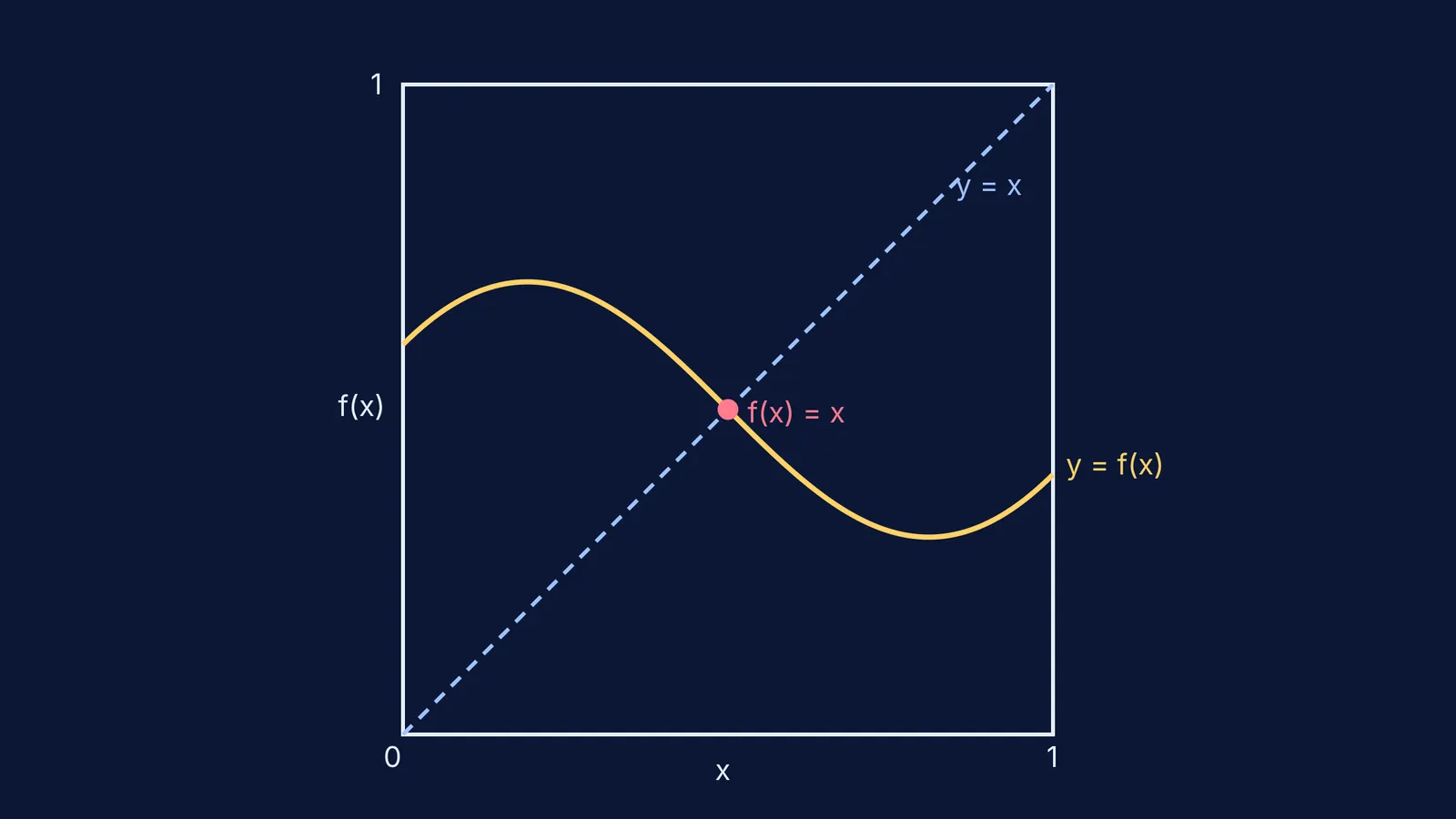
In its simplest, one-dimensional form, the theorem is closely related to the intermediate value theorem. If you have a continuous line on a graph that starts on the left edge of a square and ends on the right edge, it must cross the diagonal line y = x at least once. At that intersection, the output of the function equals its input. You can read more about the origins of these continuous curve rules in our post on Bernard Bolzano and the intermediate value theorem of 1817.
Where is the fixed-point theorem used?
Brouwer's theorem is far more than a coffee-table trick; it is a structural pillar of modern mathematics and economics. It ensures that certain complex differential equations have solutions, even when those solutions are too difficult to calculate directly.
The theorem also laid the groundwork for game theory. Years later, mathematicians generalised Brouwer's work, which in turn allowed economists to prove that stable strategies exist in competitive scenarios. You can explore how this shaped modern economics in our post on John Nash and the equilibrium that predicts how rivals choose. Every Nash equilibrium relies on the mathematical certainty that a "fixed point" of strategies exists.
How can you find fixed points in your studies?
When preparing for challenging exams, the syllabus can often feel like a turbulent, swirling cup of coffee. The sheer volume of information might seem chaotic, but the secret to mastering subjects like physics or mathematics is to look for the "fixed points"—the core, invariant concepts that do not change no matter how a question is framed.
Instead of trying to memorise every possible variation of a problem, focus on the fundamental conservation laws or equations that anchor the topic. Once you find that mathematical anchor, the rest of the problem simply swirls around it. When an abstract concept is hard to grasp, Fermi's AI tutor teaches rather than answers. It holds a line of reasoning across a session, notices where you are stuck, and decides whether to explain, ask or show to help you find your footing.
By treating your studies less like a test of memory and more like a search for structural invariants, you build a much stronger, more resilient understanding of the physical world.