On this page
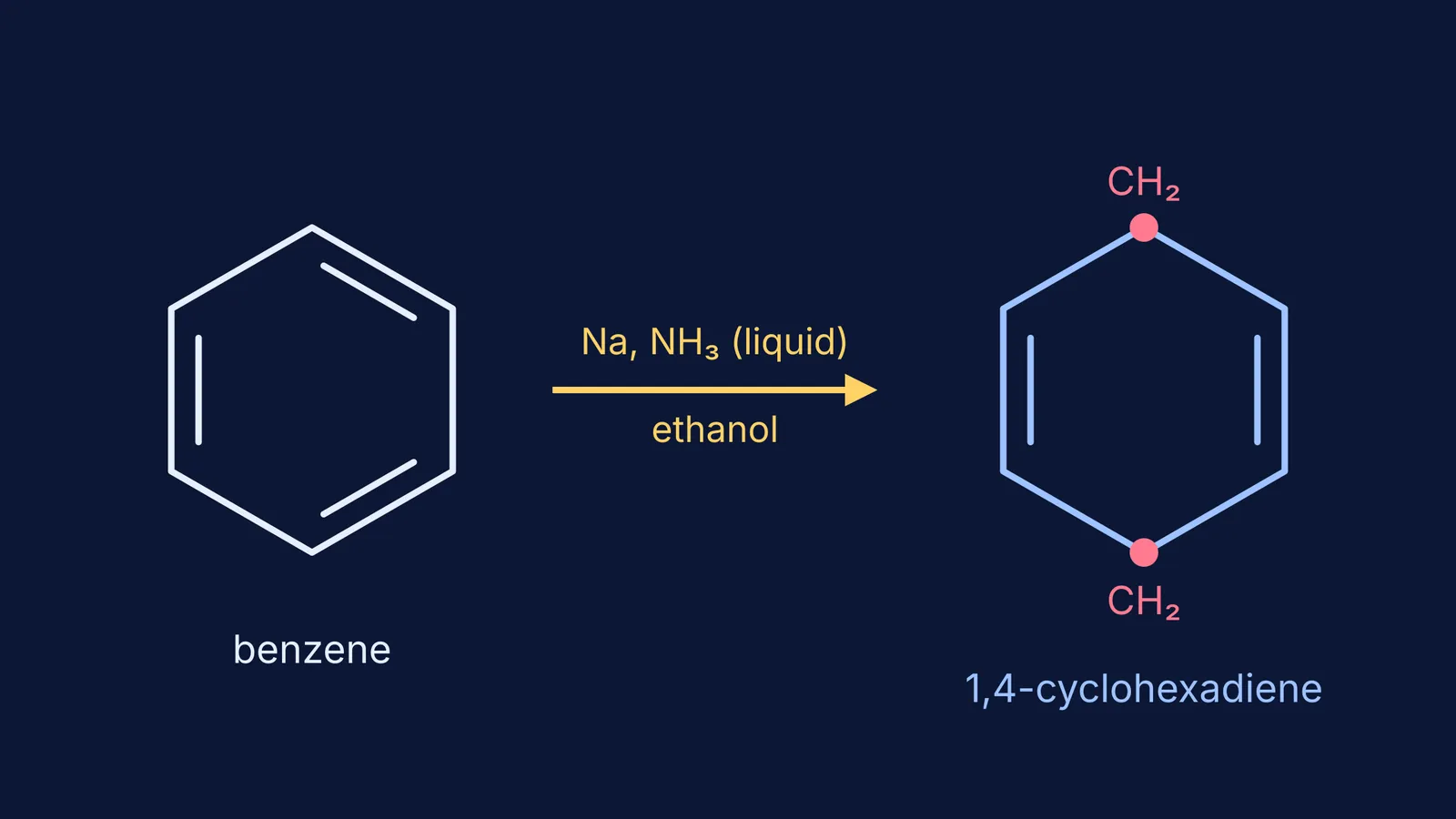
If you have met the Birch reduction in an organic chemistry chapter, you have probably seen it as one line: benzene plus sodium in liquid ammonia gives a ring with two double bonds left. Here is who Arthur Birch was, what his reaction does, and how to reason about it instead of memorising it.
Who was Arthur Birch?
Arthur John Birch was born in Sydney on 3 August 1915 and died in Canberra on 8 December 1995, according to his biographical memoir from the Australian Academy of Science. He studied at the University of Sydney, then went to Oxford to work with Sir Robert Robinson, finishing his DPhil in 1940.
The same memoir records that he was trying to make steroid hormone analogues at Oxford's Dyson Perrins Laboratory during the war. He built on a 1937 discovery by C. B. Wooster that benzene and methoxybenzene could be reduced by sodium and ethanol in liquid ammonia, and early in 1943 he tried the method on methoxybenzene. He published the work in 1944 as "Reduction by dissolving metals. Part I" in the Journal of the Chemical Society.
His later career took him to chairs at Sydney and Manchester and then to the Australian National University, where he was Foundation Dean of the Research School of Chemistry. He was elected a Fellow of the Royal Society in 1958, served as President of the Australian Academy of Science from 1982 to 1986, and his research is described in more than 400 publications (Australian Academy of Science memoir).
What does the Birch reduction actually do?
The Birch reduction converts an aromatic ring into a 1,4-cyclohexadiene using an alkali metal (traditionally sodium) dissolved in liquid ammonia, with an alcohol as the proton source (Birch reduction, Wikipedia). The key word is *partly*: the ring keeps two double bonds, on opposite sides, and two carbons become CH2 groups. The same source notes this is what sets it apart from catalytic hydrogenation, which takes the ring all the way to cyclohexane.
Ammonia boils at −33 °C, so a classic Birch reduction is run cold (Wikipedia).
How does the Birch reduction work, step by step?
When sodium dissolves in liquid ammonia it releases electrons that are surrounded by ammonia molecules, and the solution turns deep blue (Master Organic Chemistry). The mechanism is four moves, two electrons and two protons, in alternation:
An electron adds to the ring, giving a radical anion.
The alcohol hands over a proton, making a new C–H bond and leaving a radical.
A second electron turns that radical into a carbanion.
A second proton from the alcohol gives the 1,4-cyclohexadiene.
Where do the substituents end up?
This is where exam questions live. Master Organic Chemistry gives the rule in two halves:
An electron-donating group, such as methoxy (–OCH3), ends up on one of the remaining double bonds.
An electron-withdrawing group, such as –COOH, ends up on a saturated (sp3) carbon, because it stabilises a negative charge right next to it.
Worked example. Take methoxybenzene (anisole). Draw the ring, put the two new CH2 groups on opposite corners, and make sure neither is the carbon holding –OCH3. You get 1-methoxycyclohexa-1,4-diene. Now take benzoic acid: this time the carbon carrying –COOH is one of the two that gain a hydrogen, so the acid group sits on an sp3 carbon between the two double bonds.
The methoxy case is the one that mattered for medicine. Birch's memoir explains that "phenolic ethers became packaged cyclohexenones, stable to many manipulations of functional groups elsewhere in the molecule" (Australian Academy of Science). That let him convert a derivative of the hormone oestradiol into 19-nortestosterone. The memoir adds that the reaction has wide application, most notably in the commercial synthesis of oral contraceptives, and that Birch was called "the father of the pill", though he preferred "grandfather".
How can you practise the Birch reduction for exams?
Use this five-step check on any Birch question:
Draw the ring with all its substituents.
Label each substituent as donating (–OCH3, –CH3, –NH2) or withdrawing (–COOH, –CO–).
Pick two opposite carbons to become CH2 groups.
Donors must sit on a double bond; withdrawing groups must sit on an sp3 carbon. Rotate your choice until both rules hold.
Count: the product has exactly two C=C bonds, never conjugated with each other.
If the idea of a radical anion or a solvated electron still feels shaky, the Fermi Concept Library has a lesson on every concept in chemistry, each with its place in the map, so you can fill the gap before returning to the reaction. And when you are working through reduction problems, the Fermi Problem Library has a step-by-step solver that explains the reasoning rather than printing an answer.
Next time you see sodium and liquid ammonia in a question, picture Birch at his Oxford bench in 1943, and write the four arrows.