On this page
If you have met the Williamson ether synthesis in your chemistry textbook, you have met a reaction first reported in 1850 and still taught by name. It is short to write: an alkoxide plus an alkyl halide gives an ether. The story behind it is about a young chemist who used it to settle an argument about what alcohol actually is.
Who was Alexander Williamson?
Alexander William Williamson was born in London on 1 May 1824 and died on 6 May 1904, according to his biography on Wikipedia. He trained in Germany under Leopold Gmelin at Heidelberg and then Justus von Liebig at Giessen, where he earned his PhD in 1845.
In 1849 he became professor of analytical and practical chemistry at University College London, where he stayed until he retired in 1887. He did this despite losing the sight of one eye and having a largely useless left arm.
He is also remembered in Japan. In 1863 he and his wife Catherine took in five young Japanese students, now called the Choshu Five, and taught them English; all five later served in Japan's government (source).
What did Williamson actually do in 1850?
Williamson set out his result in "Theory of Aetherification", published in the Philosophical Magazine, volume 37, pages 350-356 in November 1850. The text is reproduced on the Classic Chemistry site at Le Moyne College.
At the time, chemists disagreed about the formula of alcohol, and one version, the "higher formula", gave alcohol twice as much oxygen as ether. Williamson saturated purified alcohol with potassium, then added an equivalent amount of "iodide of aethyle" (ethyl iodide). He got ordinary ether.
In his words, this was "inconsistent with the higher formula for alcohol; for if that body contained twice as many atoms of oxygen as are in aether, I ought clearly to have obtained a product containing twice as much oxygen as aether does" (Williamson, 1850).
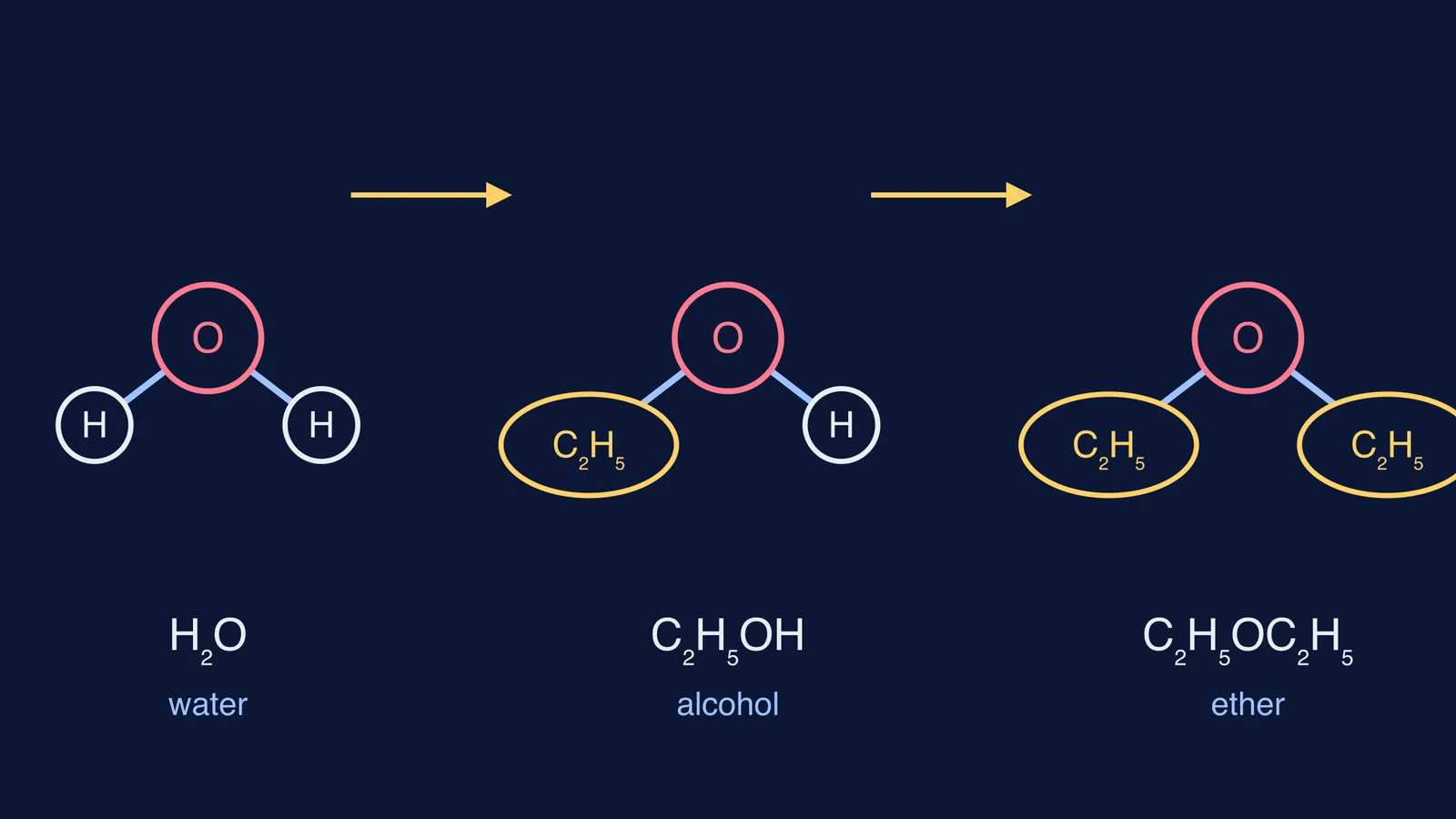
His conclusion followed:"Alcohol is therefore water in which half the hydrogen is replaced by carburetted hydrogen, and aether is water in which both atoms of hydrogen are replaced by carburetted hydrogen." That is the picture in the diagram above: one oxygen holding two groups, and only the groups change. The Royal Society gave him a Royal Medal for this work in 1862 (source).
How does the Williamson ether synthesis work?
Today we describe it as an SN2 substitution: the alkoxide ion attacks the carbon carrying the halogen from the back and pushes the halide out (LibreTexts/Ethers/Synthesis_of_Ethers/Williamson_Ether_Synthesis)).
That mechanism explains the rule exam questions test most. Alkoxides are strong bases, so with secondary and tertiary alkyl halides they tend to pull off a proton instead, giving an alkene by E2 elimination. The advice is to use a primary alkyl halide as the electrophile (LibreTexts).
The same source gives an example. For benzyl isopropyl ether, isopropoxide plus benzyl bromide (a primary halide) gives a cleaner yield, while the reverse pairing gives a lot of elimination product.
How do you choose the alkoxide and the alkyl halide?
Use this four-step check whenever a question asks you to prepare an ether.
Draw the ether and cut it at the oxygen. You now have two possible pairings.
For each pairing, look at the half that would carry the halogen. Is it methyl or primary?
Choose the pairing where the halide half is methyl or primary. The bulkier half becomes the alkoxide.
If both halves are secondary or tertiary, say that the Williamson route will mostly give alkene, and choose another method.
Worked example: ethyl tert-butyl ether. Option A is tert-butoxide plus ethyl bromide: the halide is primary, so SN2 works. Option B is ethoxide plus tert-butyl bromide: the halide is tertiary, so the strong base mainly gives an alkene (2-methylpropene). Option A is the answer.
If you keep mixing up which half goes where, the gap is usually the mechanism, not your memory. The Fermi Concept Library has a lesson for every concept in chemistry, so you can revisit SN2 and E2 side by side before coming back to ethers.
When you practise, write the reason, not just the product. The Fermi Problem Library has worked problems with a step-by-step solver that explains the reasoning rather than printing an answer, so you can check you chose the halide for the right reason.
Next time you write R-O-R', picture water with both hydrogens swapped out. That is what Williamson's 1850 experiment proved.