On this page
Alexander Bain, a Scottish clockmaker, built the foundations of two modern technologies decades before their widespread use: the electric clock and the fax machine. Born in Caithness, Scotland, in 1810, Bain combined his mechanical training in clockmaking with the new science of electromagnetism.
How did Alexander Bain invent the electric clock?
Before 1840, all clocks were mechanical, powered by falling weights or unwinding springs. On 10 October 1840, Bain patented a clock powered by electric current, making it the first electric clock.
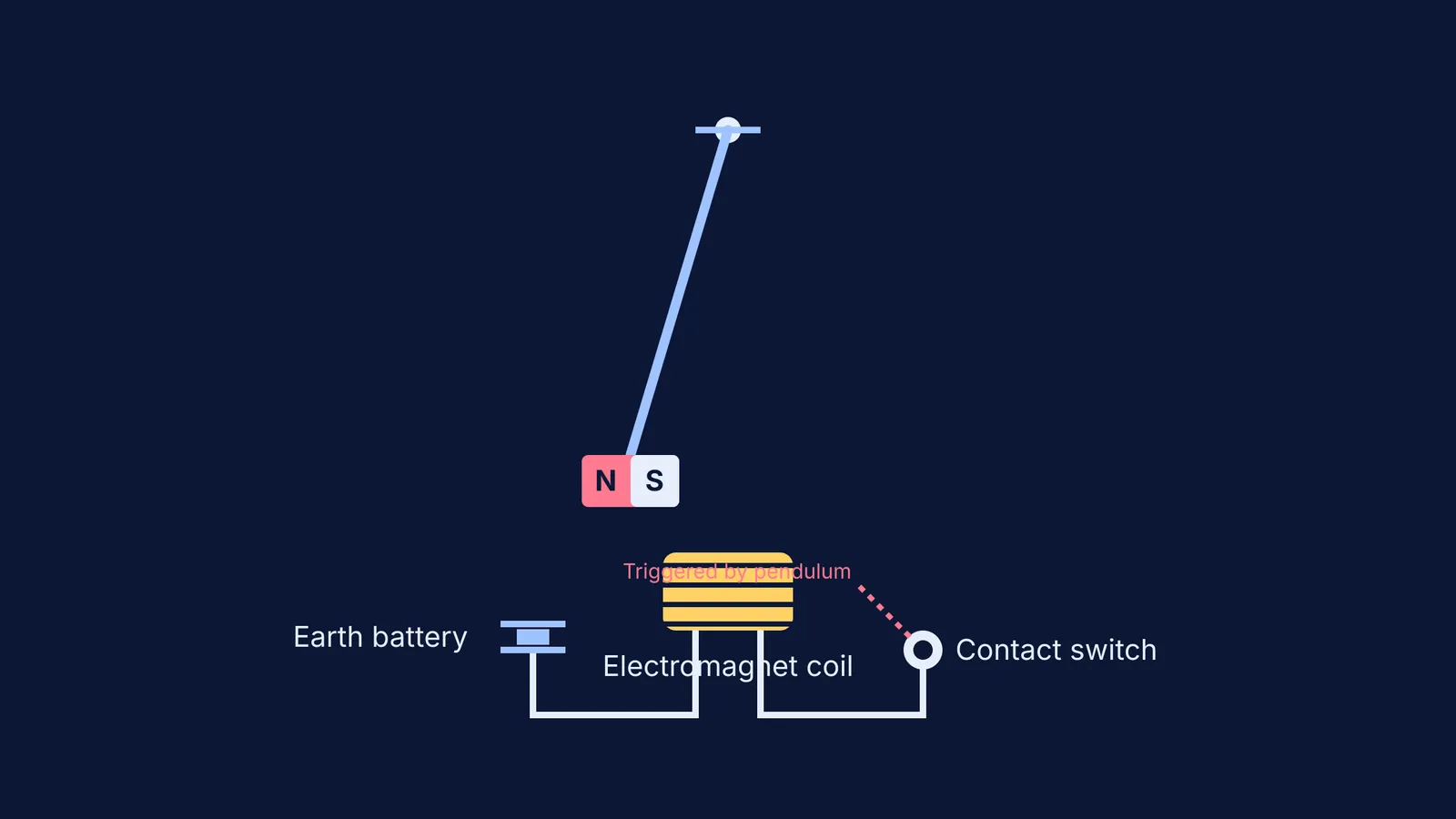
Instead of a mechanical mainspring, Bain's clock used an electromagnetic pendulum. As the pendulum swung, it triggered a contact switch. This briefly turned on an electromagnet (a coil of wire), which attracted or repelled a magnet attached to the pendulum, giving it a small push to keep it moving. This system was far more efficient than winding springs. It paved the way for modern electromechanical systems, similar to the principles behind how a microphone turns sound waves into electric current.
He even proposed an "earth battery" to power these clocks, consisting of zinc and copper plates buried in the ground to draw a continuous small current.
What was the 1843 Alexander Bain fax machine?
On 27 May 1843, Bain received British Patent 9745 for an "Electric Printing Telegraph." He had realised that electrical signals could be used to do more than just send Morse code clicks; they could reproduce images.
His experimental fax machine worked by synchronising two pendulums—one at the sending station and one at the receiving station—using an electric clock mechanism. At the transmitter, the message was formed of metal pins set in an insulating cylinder. A metal probe swung back and forth on the pendulum, scanning the pins line by line.
Whenever the probe touched a metal pin, an electrical pulse travelled down the wire. At the receiver, a matching synchronized pendulum dragged a similar probe across a sheet of chemically treated paper. The paper was soaked in ammonium nitrate and potassium ferrocyanide. When the electrical pulse hit the wet paper, a chemical reaction left a blue mark.
Line by line, the receiving pendulum painted a copy of the original pattern. This line-by-line scanning method remains the basis of all television, computer monitors, and digital scanners today.
Why did his inventions not catch on immediately?
Bain's ideas were conceptually brilliant but practically difficult. Keeping two pendulums perfectly synchronised over long distances was incredibly hard with 1840s technology. If the receiving pendulum swung slightly faster than the transmitter, the image would arrive distorted and unreadable.
In the case of his telegraphs, he also faced intense legal battles. When he demonstrated his ideas to Charles Wheatstone, a prominent English scientist, Wheatstone claimed the electric clock as his own invention. Though Bain successfully defended his patent and won £10,000) from the Electric Telegraph Company, he later faced an injunction in America from Samuel Morse, who argued Bain's paper tape system fell under his patents. Poor investments eventually drained his wealth, and he lived his final years on a government pension.
Understanding the mechanics of Bain's inventions involves linking electricity, magnetism and kinematics. If you are preparing for exams and need to see how a magnetic field interacts with a moving charge, Fermi's AI tutor can build a plan for the session, drawing the field lines and running the simulation as it teaches.
The legacy of the 1843 chemical telegraph
Bain's 1843 patent established the core idea of facsimile transmission: scanning a 2D surface, converting it into a time-varying electrical signal, and rebuilding the surface at the other end. While Giovanni Caselli built the first commercially successful fax network (the Pantelegraph) in 1865, and modern digital faxes emerged in the 1980s, the foundational concept traces straight back to a Scottish clockmaker experimenting with pendulums.
For students exploring the physics of electromagnetic induction, or checking how a coil generates a field, the Fermi Problem Library has worked problems with a step-by-step solver that explains the reasoning behind each formula. The same principles that let Alexander Bain swing a pendulum without a spring are the ones that let modern technology function, from generators to how the compass in a phone works without a needle.