

On this page
This guide follows Chapter 7, 'Women, Caste and Reform', of the NCERT Class 8 history textbook Our Pasts III (NCERT chapter PDF). Schools use different editions, so check with your teacher that this is the chapter on your syllabus before you revise.
What were women's lives like before the reforms?
Two hundred years ago, the NCERT chapter explains, most children were married off at an early age and widows in some regions were praised if they burned themselves on their husband's funeral pyre. Women who died this way were called sati, meaning virtuous women. Women's property rights were restricted, and most women had almost no access to education.
Caste divided society as well. Groups the upper castes treated as 'untouchable' were not allowed to enter temples, draw water from upper-caste wells or bathe in the ponds where upper castes bathed. Cheap printed books, newspapers and pamphlets let ordinary people read and argue about these customs in their own languages.
Who were the main reformers in Women, Caste and Reform?
Learn each reformer as problem, method, result. Every fact below is from the NCERT chapter.
Raja Rammohun Roy (1772 to 1833): founded the Brahmo Sabha, later the Brahmo Samaj, in Calcutta. Problem: sati. Method: he knew Sanskrit, Persian and several other languages and wrote to show that widow burning had no sanction in ancient texts. Result: sati was banned in 1829.
Ishwarchandra Vidyasagar: problem: widows could not remarry. Method: he used the ancient texts to argue that they could. Result: British officials adopted his suggestion and a law permitting widow remarriage was passed in 1856, though opponents boycotted him. He also set up schools for girls in Calcutta.
Jyotirao Phule (born 1827): problem: caste. Method: he attacked the Brahmans' claim to be superior as Aryans, urged Shudras and Ati Shudras to unite, founded the Satyashodhak Samaj and set up schools for girls in Maharashtra. Key date: in 1873 he wrote Gulamgiri, meaning slavery.
Pandita Ramabai: a Sanskrit scholar who felt Hinduism was oppressive towards women and wrote about the miserable lives of upper-caste Hindu women. She founded a widows' home at Poona where women were trained to support themselves.
Which laws came out of the reform movement?
The NCERT chapter names three laws you should be able to date:
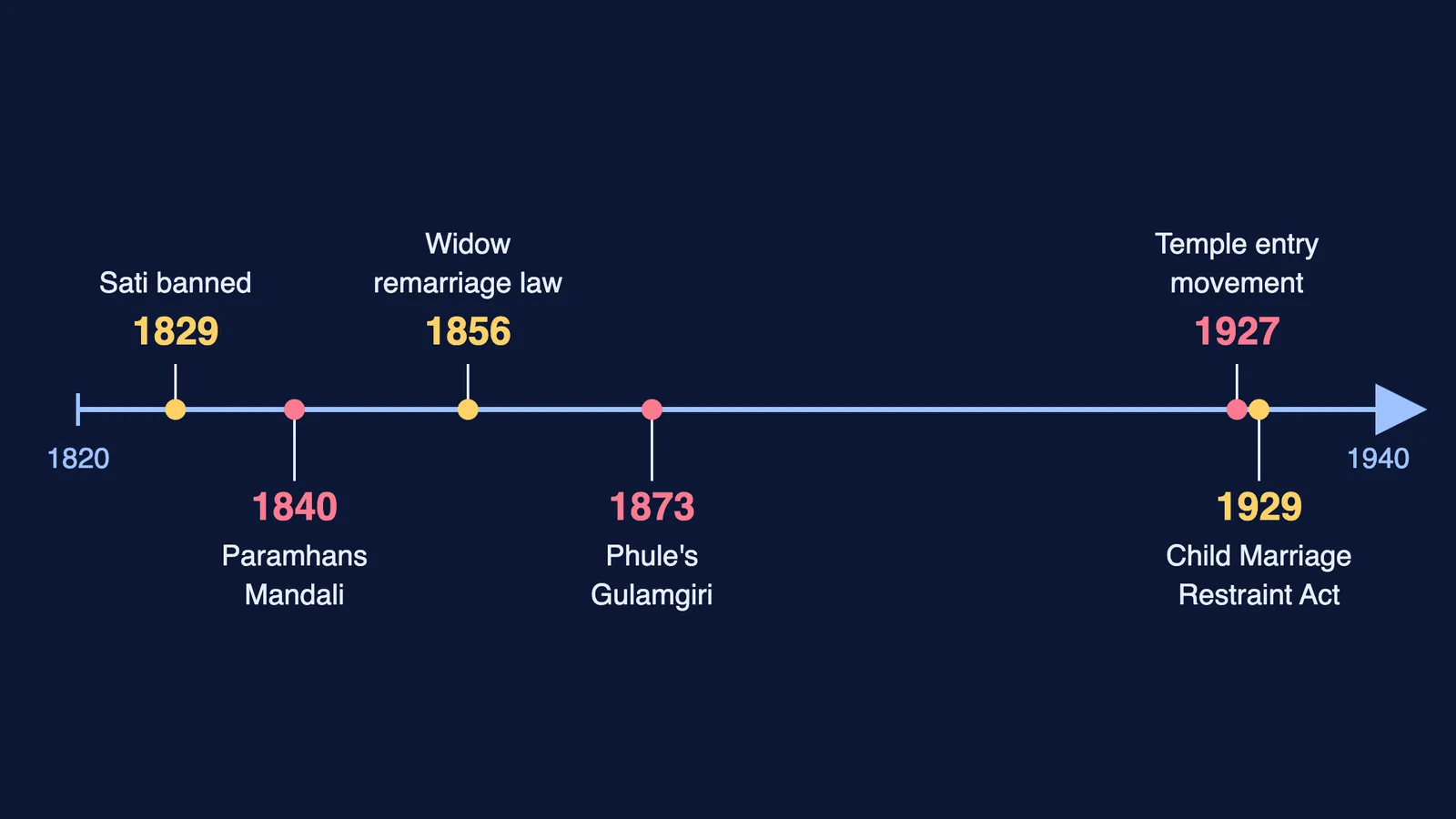
1829: sati was banned.
1856: a law permitted widows to remarry. Few widows actually remarried, and those who did were not easily accepted.
1929: the Child Marriage Restraint Act said no man below 18 and no woman below 16 could marry. These limits were later raised to 21 for men and 18 for women.
The chapter tells the story of caste reform through movements rather than laws. In Bombay, the Paramhans Mandali was founded in 1840 to work for the abolition of caste. B.R. Ambedkar led three temple entry movements between 1927 and 1935, and E.V. Ramaswamy Naicker, called Periyar, founded the Self Respect Movement in the south.
How do you write a 3-mark answer on this chapter?
Take a typical question: 'How did Rammohun Roy try to change the lives of widows?' Give one point per mark, each with a fact:
He campaigned against sati, the burning of widows on their husband's funeral pyre.
Using his knowledge of Sanskrit and other languages, he wrote to show that widow burning had no sanction in ancient texts.
British officials listened to him, and sati was banned in 1829.
An easy slip is swapping reformers: giving Vidyasagar the 1829 ban or Rammohun Roy the 1856 law. The problem, method, result pattern keeps them apart.
A 20-minute revision plan
Five minutes: write the four names and, from memory, one problem, method and result for each.
Five minutes: draw a line from 1820 to 1940 and mark 1829, 1856, 1873, 1927 and 1929.
Five minutes: read Source 1, Rammohun Roy's dialogue on sati, and write in two lines what the opponent of sati argues.
Five minutes: check against the textbook and mark gaps in red.
To turn the chapter into links between events, try our guide on making a cause-and-effect chart for a history chapter. The freedom struggle timeline for Class 8 uses the same dated-line method for the later chapters.
If science and maths chapters are also on this week's list, Fermi's AI tutor can work out what you already know and build a plan for the session.
Next, read how schools and colleges changed in the same century in our Class 8 guide to education under British rule.


