

On this page
If your Class 8 history book is NCERT's Our Pasts III, this is Chapter 6, "Civilising the 'Native', Educating the Nation" (NCERT chapter PDF). It asks who decided what Indians should learn under British rule, and how Indians answered back.
Who were the Orientalists and the Anglicists?
Orientalists were "those with a scholarly knowledge of the language and culture of Asia", in the words of the NCERT chapter. William Jones arrived in Calcutta in 1783 as a junior judge, learnt Sanskrit from pandits, and with Henry Thomas Colebrooke and Nathaniel Halhed set up the Asiatic Society of Bengal and the journal Asiatick Researches. They believed Indian civilisation had its glory in the ancient past, so Indians should be taught what they already valued.
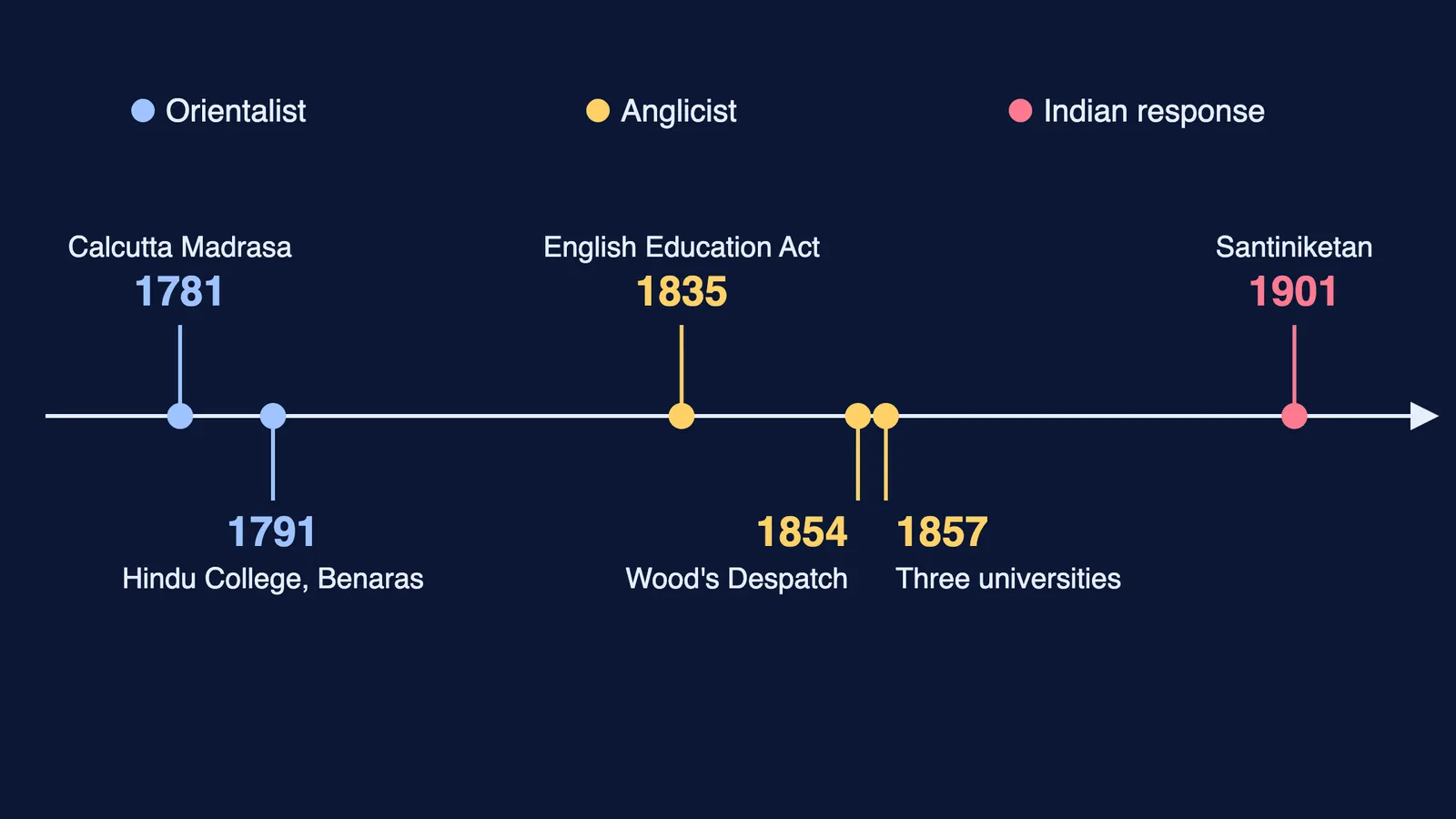
That belief built two institutions: a madrasa in Calcutta in 1781 for Arabic, Persian and Islamic law, and the Hindu College in Benaras in 1791 for ancient Sanskrit texts.
The other side, the Anglicists, argued for English and Western knowledge instead (Scroll, 2017). In the NCERT account, James Mill said education should teach what was "useful and practical": the scientific and technical advances of the West, not the poetry and sacred literature of the East.
What did Macaulay's Minute and Wood's Despatch change?
Thomas Babington Macaulay wrote his Minute on Indian Education on 2 February 1835, declaring that "a single shelf of a good European library was worth the whole native literature of India and Arabia" (NCERT chapter). He wanted English taught so that Indians could read Western literature, science and philosophy. In his own words, education should "form a class who may be interpreters between us and the millions whom we govern" (Scroll).
The English Education Act of 1835 followed. According to NCERT, it made English the medium of instruction for higher education and stopped the promotion of Oriental institutions such as the Calcutta Madrasa and Benaras Sanskrit College.
In 1854 the Company's Court of Directors sent the educational despatch named after Charles Wood, President of the Board of Control. Wood's Despatch argued that European learning would teach Indians the value of trade and create demand for British goods, and would make them "truthful and honest" civil servants.
After 1854, education departments were set up, and in 1857 universities were being established in Calcutta, Madras and Bombay (NCERT chapter).
What happened to the local pathshalas?
In the 1830s the Scottish missionary William Adam toured Bengal and Bihar for the Company and found over 1 lakh pathshalas teaching more than 20 lakh children (NCERT chapter). They had no fixed fee, no printed books, no annual examinations and no regular timetable, and they paused at harvest time so peasant children could still study.
After 1854 the Company appointed government pandits, each looking after four to five schools. Pathshalas that accepted timetables, textbooks, exams and regular fees received government grants; those that refused got no support. The demand for regular attendance, even at harvest, made school harder for children from poor peasant families.
How did Gandhi and Tagore respond to English education?
Mahatma Gandhi argued that colonial education created a sense of inferiority and made Indians "strangers in their own lands" (NCERT chapter). He wanted teaching in Indian languages and learning through a useful handicraft, writing that "literacy in itself is not education".
Rabindranath Tagore started Santiniketan in 1901, about 100 kilometres from Calcutta, as a school where children could learn freely in a natural setting. He wanted to combine elements of modern Western civilisation with the best of Indian tradition, so he taught science and technology along with art, music and dance.
To place these debates among the other events of the period, use our freedom struggle timeline for Class 8. For another way colonial rule reshaped Indian life, read forest society and colonialism.
How do you revise this chapter in one evening?
Make a four-row sheet with three columns: who, what they wanted, and what happened.
Orientalists: Jones, Colebrooke; Sanskrit, Arabic, Persian; Calcutta Madrasa 1781, Benaras 1791.
Anglicists: Mill, Macaulay; English and Western science; English Education Act 1835.
The Company: Wood's Despatch 1854; trade and trusted officials; universities 1857, regulated pathshalas.
Indian responses: Gandhi, Tagore; Indian languages, crafts, nature; Santiniketan 1901.
Then practise one textbook question as claim, reason, example. NCERT asks, "Why did Mahatma Gandhi want to teach children handicrafts?"
Claim: Gandhi believed literacy alone was not education.
Reason: he wanted to develop body, mind and spirit, and working with the hands built understanding.
Example: he wrote that the child should know "the why and the wherefore of every process".
Last, close the book and say the four rows aloud; whatever you cannot recall is what you reread tomorrow.
For your science and maths chapters, Fermi's AI tutor works out what you already know and builds a plan for the session, so you sit down to a clear next step. In Class 10, the history continues with print culture and the modern world.


