

On this page
This chapter of the NCERT Class 10 history book, India and the Contemporary World II, follows print from East Asia to Europe to India. Below are the dates worth memorising, two answer frameworks and a three-day revision plan.
Is print culture in the Class 10 board exam?
Yes. The CBSE Class X Social Science curriculum for 2026-27 lists Print Culture and the Modern World as Chapter V of the history book, and its question paper design puts the chapter in the history section of the board paper, worth 20 marks including map pointing (18+2). Its learning outcomes ask you to trace print from East Asia to Europe and India, compare handwritten manuscripts with print, and summarise the print revolution and its impact. Those three tasks are a useful guide to what questions can test.
How did print travel from woodblocks to Gutenberg?
Every date in this section comes from the NCERT chapter.
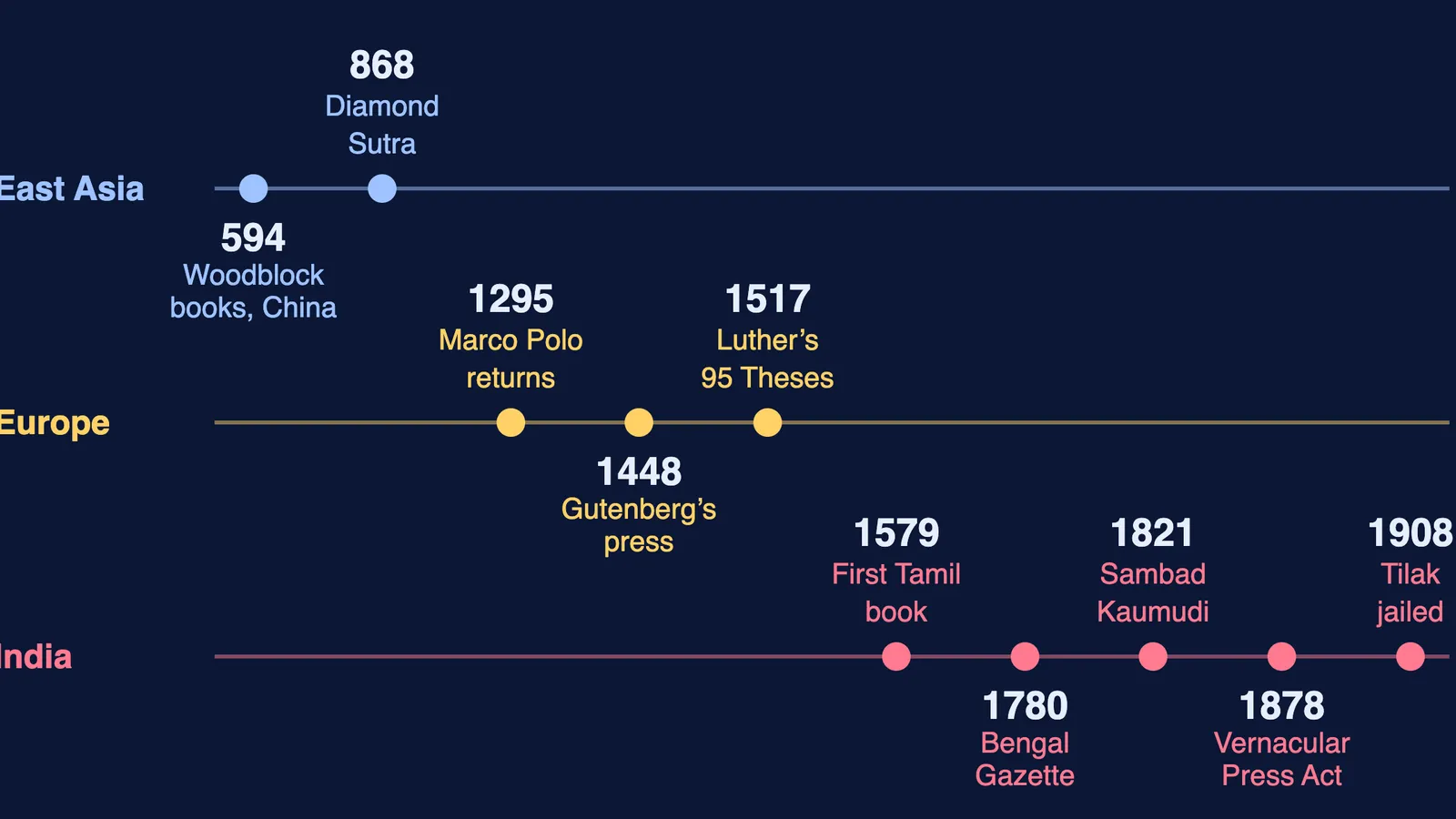
From AD 594, books in China were printed by rubbing paper against the inked surface of woodblocks.
In AD 868 the Buddhist Diamond Sutra was printed; NCERT calls it the oldest Chinese book.
In 1295 Marco Polo returned to Italy from China, bringing knowledge of woodblock printing.
In the 1430s Johann Gutenberg developed the first-known printing press at Strasbourg, and by 1448 he had perfected the system.
Gutenberg modelled his press on the olive press and used moulds to cast metal type. His first printed book was the Bible: about 180 copies, which took three years to produce, according to NCERT. As presses spread across Europe, the second half of the fifteenth century saw 20 million copies of printed books in European markets, rising to about 200 million in the sixteenth century.
NCERT calls this shift from hand printing to mechanical printing the print revolution. It cut the cost and labour of making books and created a new reading public. It also let critics reach readers fast: after Martin Luther's Ninety Five Theses of 1517, his translation of the New Testament sold 5,000 copies within a few weeks. For a related story from China, read about Wang Zhen's wooden movable type.
How did print help religious reform in India?
The NCERT chapter dates the first press in India to Goa, brought by Portuguese missionaries in the mid-sixteenth century. By 1674 about 50 books had been printed in Konkani and Kanara. The first Tamil book was printed at Cochin in 1579.
In the nineteenth century print became the arena for reform debates:
Rammohun Roy published the Sambad Kaumudi from 1821; the Hindu orthodoxy commissioned the Samachar Chandrika to oppose his opinions.
The Deoband Seminary, founded in 1867, published thousands of fatwas on everyday conduct.
Jyotiba Phule wrote about caste injustice in Gulamgiri (1871).
Rashsundari Debi's Amar Jiban (1876) was the first full-length autobiography in Bengali.
The pattern to write in an answer: ideas printed in everyday spoken language, a wider public joining the debate, and new ideas emerging from the clash of opinions.
How did print culture help nationalism in India?
This is one of NCERT's own end-of-chapter questions. Here is a four-point answer, every point from the chapter:
Connection: newspapers carried news from one place to another, creating pan-Indian identities.
Criticism: nationalist newspapers grew in number in all parts of India, reported colonial misrule and encouraged nationalist activities.
Repression that backfired: the Vernacular Press Act of 1878 gave the government extensive rights to censor reports and editorials in the vernacular press. When Bal Gangadhar Tilak wrote with sympathy about deported Punjab revolutionaries in his Kesari, he was imprisoned in 1908, provoking protests all over India.
Wartime control: under the Defence of India Rules in the First World War, 22 newspapers had to furnish securities, and 18 of them shut down rather than comply. Under the Defence of India Act of the Second World War, about 90 newspapers were suppressed in August 1942.
End with Gandhi's words from 1922, which NCERT quotes: "The fight for Swaraj, for Khilafat ... means a fight for this threatened freedom before all else".
How should you revise this chapter in three days?
Day 1, the date ladder: write every date in this post from memory, check against the chapter, and redo the misses next morning.
Day 2, the three groups: answer NCERT's question on what print meant to women, the poor and reformers, one short paragraph each. Then build a cause-and-effect chart for a history chapter.
Day 3, timed answers: write the nationalism answer without notes, then practise the chapter's source boxes the way you would answer case-based questions in CBSE board exams.
If science and maths revision is competing for the same evenings, Fermi's AI tutor can work out what you already know in those subjects and build a plan for the session, so you sit down to a clear next step.
Start with the date ladder tonight: ten minutes, then one honest check against the book.


