On this page
Every July the same thing happens in many Indian homes: the bedroom door that closed with a click in April now needs a shoulder push, and the cupboard drawer sticks halfway. Nothing is broken. The wood has taken in water from the air and grown a little. Once you see why, you can predict it, measure it and fix it properly.
Why do wooden doors get stuck in the rainy season?
Wood is hygroscopic: it takes on moisture from its surroundings, as the Wood Handbook chapter on moisture relations from the US Forest Products Laboratory explains. How much water it holds depends on the relative humidity and temperature of that air.
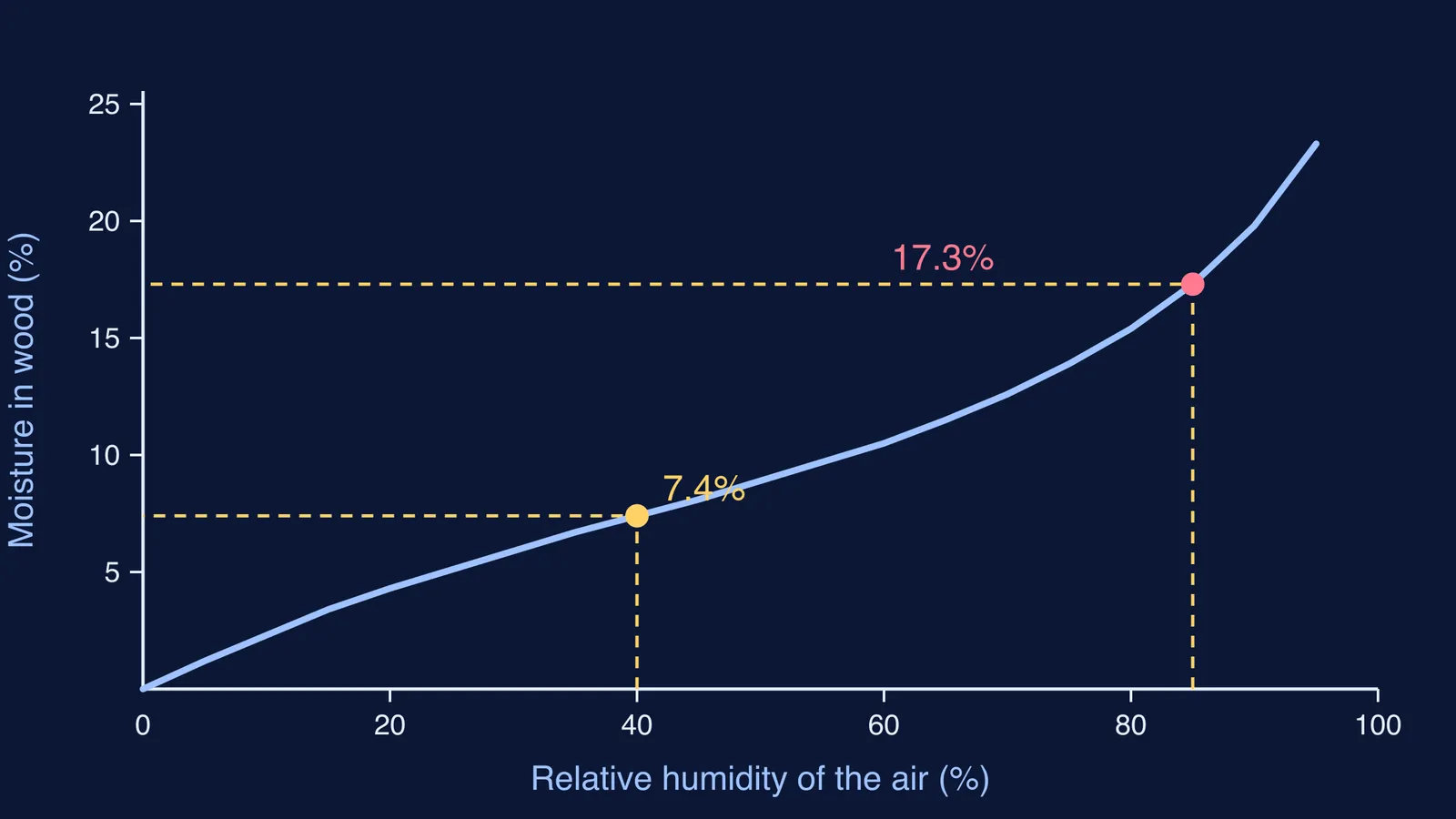
Equilibrium moisture content is the moisture content at which wood is neither gaining nor losing moisture (Wood Handbook, Chapter 4). In a dry month that equilibrium is low; in weeks of monsoon humidity it climbs, the door slowly absorbs water vapour, swells, and starts rubbing on its frame. When the air dries out again, the wood gives the water back and the door shrinks.
How much water does wood absorb from humid air?
The handbook's Table 4-2 gives values it calls suitable for most practical purposes, though real wood varies, especially at high humidity. At 32.2 °C, wood settles at about 7.4% moisture (by mass of dry wood) when the air is at 40% relative humidity, 10.5% at 60%, 17.3% at 85% and 23.3% at 95% (Wood Handbook, Table 4-2). The curve at the top of this page is drawn from that row. Notice it bends upward: the last few percent of humidity add the most water.
One word from chemistry class matters here. The handbook prefers "absorption" for wood, because water molecules are taken up within the cell walls, while "adsorption" strictly means something happening at a surface. If the difference between the two still feels fuzzy, the Fermi Concept Library covers every concept in physics, chemistry, biology, mathematics and computing.
Why does wood swell across the grain but not along it?
Water sits in wood in two places: as bound water inside the cell walls and as free water in the hollow cell cavities. Only bound water changes the size of the wood. Below the fibre saturation point, which averages about 30% moisture content, wood swells as it gains moisture and shrinks as it loses it (Wood Handbook, Chapter 4).
Wood is also anisotropic. The same chapter says it moves most along the growth rings (tangentially), about half as much across them (radially), and only slightly along the grain. Average longitudinal shrinkage from green to oven-dry is only 0.1% to 0.2% for most species (Wood Handbook, Chapter 4). So a door gets wider and thicker in the monsoon, not taller, which is why it is the edges that rub.
Worked example: how much does a teak plank grow?
The handbook lists teak's tangential shrinkage from green to oven-dry as 5.8% of the green width, a figure drawn from world literature rather than a guaranteed species average. It also gives a simple linear estimate: shrinkage starts at the fibre saturation point, about 30%, and grows in proportion as moisture falls (Wood Handbook, Table 4-4 and Equation 4-9).
Change per point of moisture: 5.8% / 30 = about 0.19% of the width.
Moisture change from a dry month (40% humidity, 7.4%) to the monsoon (85%, 17.3%): 9.9 points.
Total swelling: 0.19% x 9.9 = about 1.9%.
For a 10 cm wide plain-sawn teak board: about 1.9 mm wider, if it fully reaches equilibrium.
This is a rough estimate. A real door may not reach full equilibrium in one season, and paint slows the change. But a door is wider than one board, so even part of this swelling can be enough to close the small gap at the latch side.
Some science ideas are easier to see than to read. The Fermi Simulation Lab has interactive simulations for ideas like these.
What should you do about a door that jams every monsoon?
Wait before planing. A door planed in August to fit will show a gap in the dry months once it shrinks back.
Check the hinges first. A sagging door can rub for reasons that have nothing to do with humidity.
Seal every face, including the top and bottom edges, so moisture enters as slowly and evenly as possible.
Keep the room ventilated on dry days so the wood can give water back.
For a student, this makes a good one-season experiment. Once a week, slide a stack of paper sheets into the gap at the latch side and count how many fit, and note the humidity from a weather app. Plot gap against humidity from June to October and you will have drawn your own version of the curve above.