

On this page
Ask most people why the ocean appears blue, and they will tell you it acts as a giant mirror reflecting the sky. While the surface does reflect light, reflection is only a minor contributor to what your eyes perceive. In September 1921, Indian physicist C. V. Raman sailed across the Mediterranean Sea aboard the steamship SS Narkunda. Looking out over the deep waters, he doubted Lord Rayleigh's popular explanation that the sea was blue merely because of the sky.
Does the sea look blue only because it reflects the sky?
Raman tested Rayleigh's hypothesis on deck using a handheld Nicol prism. By orienting the polarizing prism at the Brewster angle of water, he extinguished the polarized reflection of the sky from the sea surface. The water did not turn grey; instead, it appeared an even deeper blue. As Raman reported in *Nature*, the colour was not an atmospheric illusion, but an intrinsic optical property of the water itself. Our profile of C. V. Raman and the Raman effect outlines how this maritime observation sparked a Nobel Prize-winning career in optics.
Surface reflection does contribute to what you see from a distance. Fresnel reflection at normal incidence is only about 2%, but it increases significantly at grazing angles near the horizon. This surface glare explains why the sea looks dull grey beneath heavy overcast clouds when viewed from afar. Yet even under clouds, looking straight down into deep water reveals an unmistakable blue-green body colour.
Why does water absorb red light faster than blue light?
In everyday life, a glass of water looks transparent because the path length through it is too short to produce noticeable tint. In large volumes such as swimming pools, lakes, and oceans, water acts as a selective optical filter. Most coloured compounds gain their hues from electronic transitions, where absorbed photons promote electrons between orbital energy levels. Liquid water is a rare exception in nature: its visible colour arises from vibrational transitions.
As researchers Charles L. Braun and Sergei N. Smirnov explained in the *Journal of Chemical Education*, liquid water owes its absorption profile to high-order vibrational overtones of the O-H stretching modes. While fundamental symmetric and asymmetric stretches sit in the infrared around 3,400 cm⁻¹, the fourth and fifth overtones extend directly into the red and orange regions of visible light. Hydrogen bonding between liquid water molecules shifts these vibrational bands slightly, enhancing their absorption of red light.
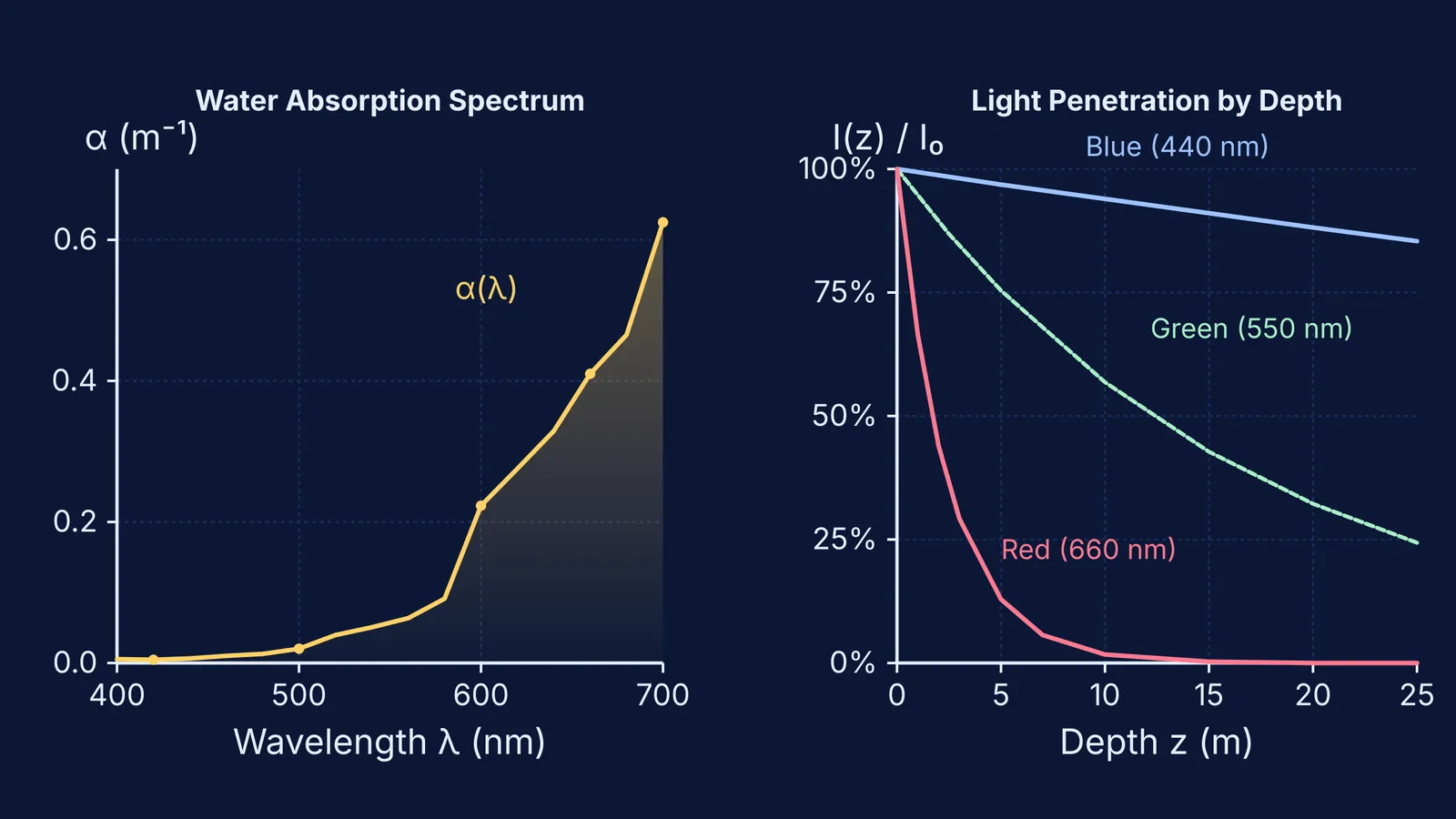
High-precision laboratory measurements by Robin M. Pope and Edward S. Fry, published in *Applied Optics*, quantify this contrast. At a blue-violet wavelength of 418 nm, the absorption coefficient of pure water reaches a minimum of just 0.0044 m⁻¹. In contrast, at a red wavelength of 660 nm, the absorption coefficient climbs to 0.410 m⁻¹, and reaches 0.624 m⁻¹ at 700 nm. Pure water absorbs red light at 700 nm roughly 140 times more strongly than violet-blue light at 418 nm.
What role does molecular scattering play in ocean colour?
If water only absorbed red light, sunlight entering the ocean would travel downward until all photons were extinguished, leaving deep waters pitch black to an outside observer. To look blue from above, sunlight must change direction and emerge back through the surface.
This upward redirection occurs through elastic scattering. As described by the NOAA National Ocean Service, water molecules and minuscule suspended particles scatter penetrating photons in all directions. Pure water molecules exhibit Rayleigh scattering, where scattered intensity scales with 1/λ⁴. In pure ocean water, blue light scatters nearly five times more strongly than red light, as catalogued by Raymond C. Smith and Karen S. Baker in *Applied Optics*. Our guide on the scattering of light and rainbow formation explains how this inverse-fourth-power law also gives our daytime sky its blue colour.
How does water depth affect light penetration?
To understand what happens to colours underwater, students can model light transmission using the Beer-Lambert law:
I(z) = I₀ e^(−α z)
Here, I₀ represents sunlight intensity entering the surface, z is depth in metres, and α is the wavelength-dependent absorption coefficient from Pope and Fry's dataset.
Consider what happens to red light (660 nm, α = 0.410 m⁻¹) compared to blue light (440 nm, α = 0.0063 m⁻¹) as depth increases:
At 5 metres depth, red light intensity falls to I/I₀ = e^(−0.410 × 5) ≈ 0.129 (12.9% remains), while blue light retains I/I₀ = e^(−0.0063 × 5) ≈ 0.969 (96.9%).
At 10 metres depth, red light intensity drops to I/I₀ = e^(−0.410 × 10) ≈ 0.017 (less than 2% survives), whereas blue light retains 93.9%.
At 20 metres depth, red light drops to I/I₀ = e^(−0.410 × 20) ≈ 0.0003 (0.03%), while blue light maintains 88.2% of its surface strength.
This exponential drop explains why scuba divers notice red gear turning dark brownish-black below 10 metres, and why underwater cameras require strobes to reveal true colours. By the time sunlight scatters back to an observer, red wavelengths have vanished, leaving an intense blue hue. Problems involving refraction underwater are explored in our tutorial on apparent depth and refraction problems.
How can interactive simulations clarify wave optics?
Visualising how light waves attenuate exponentially through different media is an idea easier to see than read; interactive simulations in the Fermi Simulation Lab allow students to explore wave propagation, absorption, and refraction visually.
When tackling complex optics and multi-step ray mechanics problems, the Fermi Problem Library provides worked problems with a step-by-step solver that explains the reasoning rather than printing an answer.


