On this page
Water is much denser than air. When a swimmer moves through a pool, they have to push a tremendous amount of water out of the way. This resistance is called hydrodynamic drag, and it is the primary physical barrier to swimming faster.
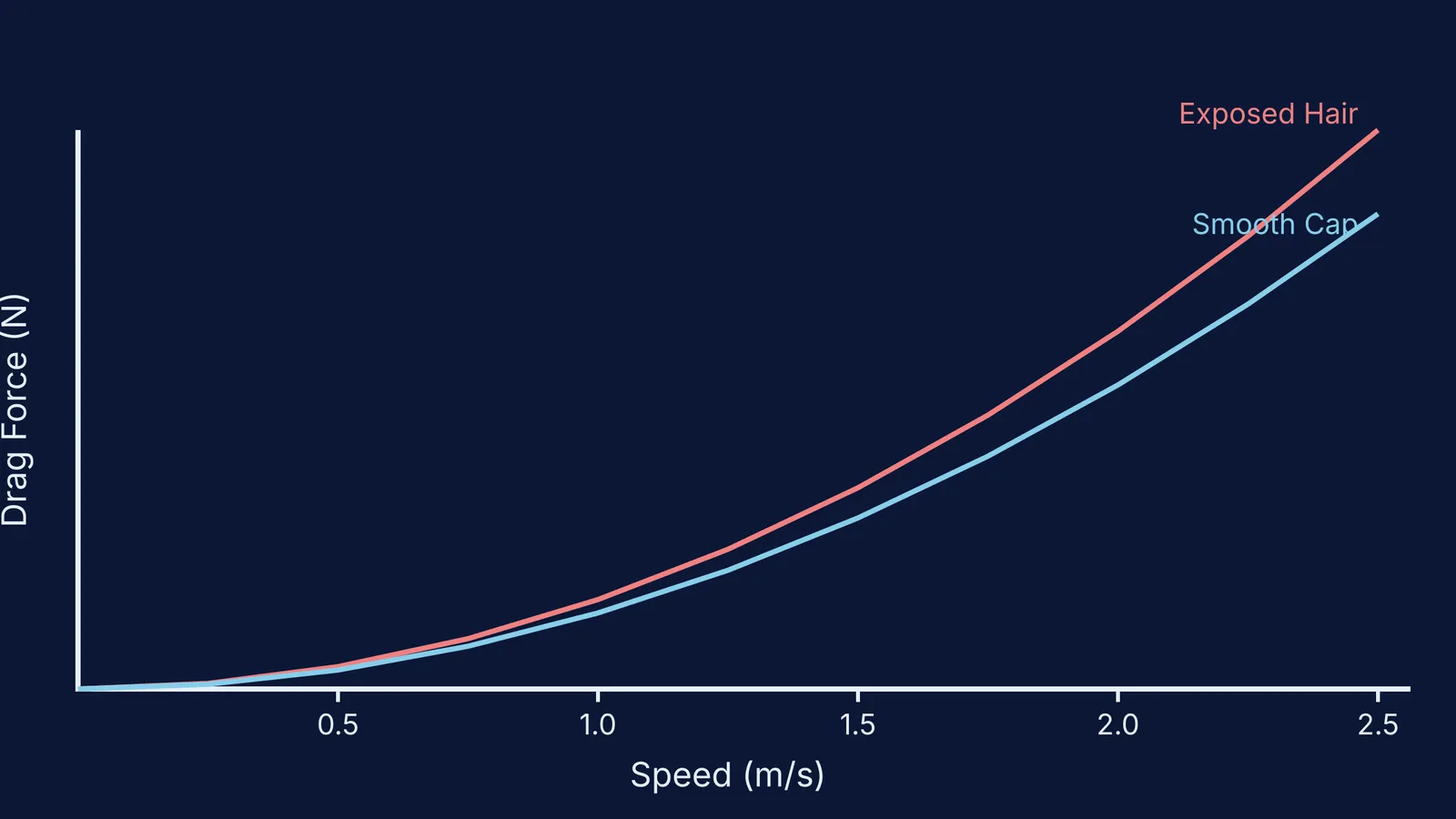
If you have ever tried running in waist-deep water, you know that moving slowly takes a moderate amount of effort, but sprinting is nearly impossible. This is because fluid drag increases with the square of the speed. If you double your swimming speed, the drag force pulling you backwards increases by four times.
To overcome this quadratic increase in resistance, competitive swimmers rely on equipment designed to make their bodies as smooth and streamlined as possible.
Why do swimmers wear caps and tight swimsuits?
When fluid flows over a rough or uneven surface, it breaks into swirling, chaotic patterns called turbulence. Turbulence creates a low-pressure wake behind the swimmer, which acts like a vacuum pulling them backwards. In physics, this is known as pressure drag.
Human hair is extremely rough on a macroscopic level. An exposed head of hair catches water, creating massive turbulence right at the leading edge of the swimmer's body where the water first makes contact. A silicone swim cap flattens the hair and creates a smooth, continuous surface, allowing water to glide cleanly over the head without breaking into chaotic swirls.
Tight swimsuits operate on the exact same principle. Loose fabric bunches up, wrinkles, and catches water, adding unnecessary surface area and turbulence. A skin-tight suit eliminates those wrinkles.
You can explore how moving objects experience fluid resistance and pressure in different environments using the Fermi Simulation Lab.
How much does a swim cap reduce drag?
The difference between wearing a cap and swimming with exposed hair is substantial and measurable. A 2011 computational fluid dynamics study published in the Portuguese Journal of Sport Sciences compared a highly detailed 3D model of a female swimmer gliding with and without a cap.
The researchers found that wearing a cap reduced frontal passive drag by approximately 15% at a speed of 2.0 metres per second. Because the top of the head breaks the water first, smoothing this leading surface is the single most efficient way to lower pressure drag. Even the type of cap matters; smooth silicone caps perform significantly better than wrinkled latex caps because they maintain a rigid, highly hydrodynamic dome shape.
How do tech suits streamline the body?
While a cap mostly reduces pressure drag at the front of the body, high-performance racing suits (often called tech suits) primarily target skin friction drag. This is the drag caused by water molecules physically sticking to the swimmer's body and pulling against their forward momentum.
When Speedo developed their famous LZR Racer suit, they tested dozens of fabrics in a wind tunnel at NASA's Langley Research Center. NASA researchers found that the woven fabric reduced skin friction drag by 24% compared to previous generations of standard racing suits.
The tight fit of these suits also provides extreme muscular compression. By tightly squeezing the swimmer's muscles, the suit slightly narrows their physical cross-section and stops the muscles from oscillating. This compaction improves their overall hydrodynamic efficiency by up to 5%.
If you are studying the mathematics of drag, you can see similar quadratic resistance effects when calculating trajectories in the air; for a deep dive, see our guide on projectile motion with air resistance.
How to apply this to physics problem solving
The physics of swimming is a perfect real-world example of fluid dynamics. When studying for mechanics exams, use the drag of a swimmer as a mental checklist to remember how the variables work:
Drag is proportional to the square of velocity. The standard formula for drag is F = ½ ρ v² C_d A. This means a 10% increase in speed requires a 21% increase in force to overcome drag (1.1² = 1.21).
Surface area (A) matters. A swimmer gliding perfectly flat has a much smaller cross-sectional area than one swimming with their legs dragging low in the water.
The drag coefficient (C_d) describes shape and smoothness. Putting on a smooth silicone cap and a tech suit lowers the C_d, allowing the swimmer to go faster with the exact same power output.
When solving fluid dynamics problems, you can often test your understanding by asking yourself what if questions to understand physics deeply, such as "what if the density (ρ) of the fluid doubled?" By linking abstract formulas to real-world actions—like a swimmer snapping on a silicone cap—the equations become much easier to remember, visualise, and apply.