

On this page
In short
Snakes keep flicking their tongues to sample the air for scent chemicals. A foundational 1994 study found that the forked tips act as an edge detector for scent trails, collecting molecules and delivering them to the Jacobson's organ to give the snake a directional sense of smell.
When you see a snake moving through the grass, its tongue constantly darts in and out in a rapid, flickering motion. This behaviour is so iconic that it is often mistaken for a threat display or an attempt to sting. In reality, the flickering tongue is entirely harmless; it is simply how the snake explores its environment. Snakes rely heavily on chemical cues to find prey, locate potential mates, and avoid predators in their habitat.
Just as we might ask why we get goosebumps when cold or scared or how the body knows when to feel thirsty, understanding this reptilian behaviour comes down to a brilliant example of sensory adaptation.
Why do snakes keep flicking their tongues?
Every time a snake flicks its tongue, it is collecting chemical molecules from the air and the ground. A foundational study by evolutionary biologist Kurt Schwenk explained that the forked shape of the tongue is crucial, acting as an edge detector for scent trails (Schwenk 1994).
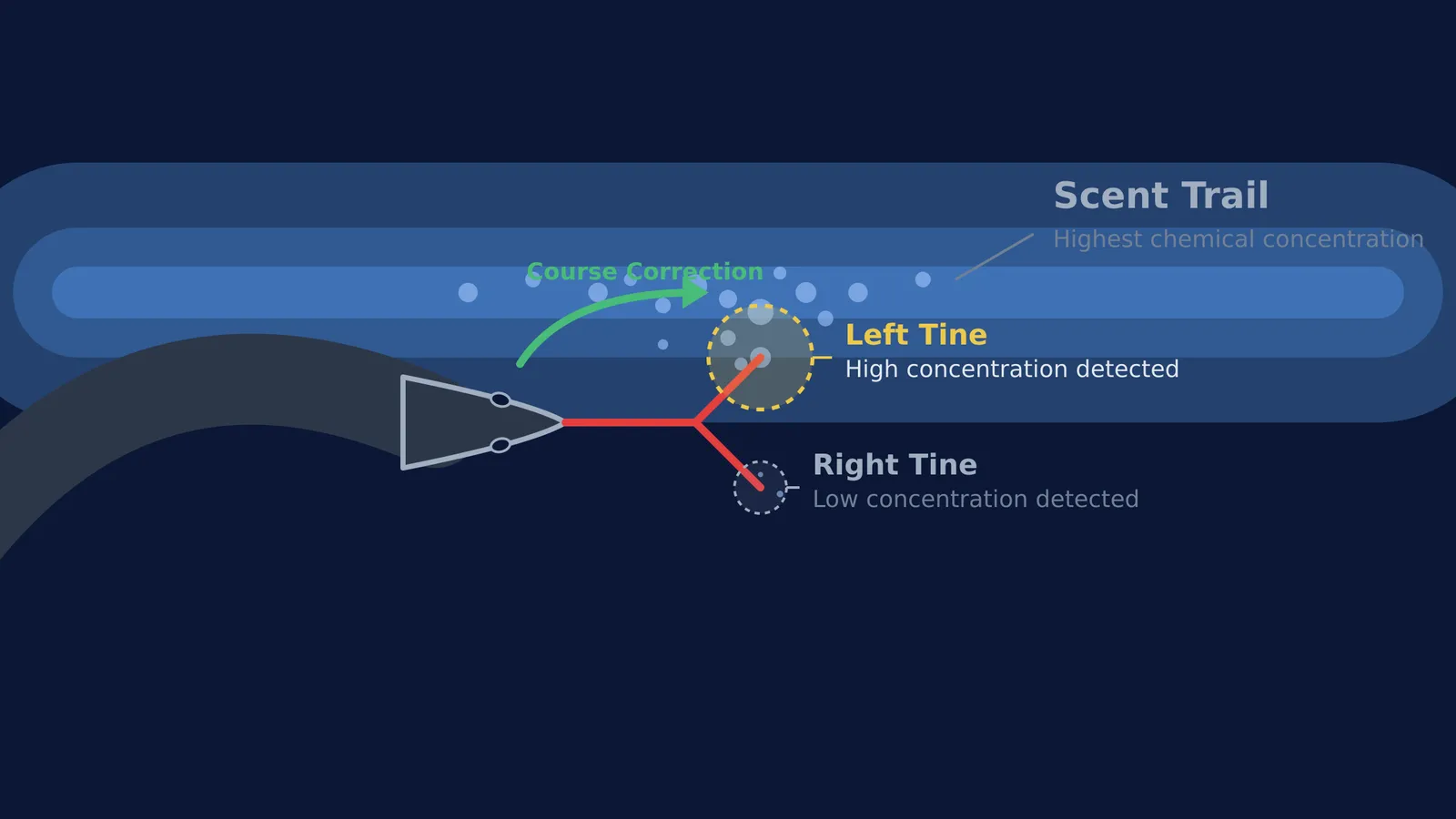
Because the tips are separated, they sample two different points in space simultaneously. This gives the snake a "stereo" sense of smell. If the right tip picks up a higher concentration of a mouse's scent than the left tip, the snake knows to turn right to follow the trail. This continuous adjustment is why snakes often slither in a sweeping, S-shaped motion when tracking prey.
What is the Jacobson's organ?
Collecting the scent is only the first step; the tongue itself does not process the smell. Once the tongue is pulled back into the mouth, the chemical stimuli must be transferred to the brain. Snakes have a specialised sensory structure called the vomeronasal organ, commonly known as Jacobson's organ, located in the roof of the mouth. This organ is lined with sensory receptors that are tuned to detect heavy, moisture-borne scent particles.
Research on the chemical delivery mechanism has shown that the tongue does not actually insert directly into the organ's openings (Filoramo and Schwenk 2009). Instead, when the snake closes its mouth, the tongue is compressed within a small chamber. This acts like a piston, pressurising fluid in the mouth and forcing the collected chemical molecules up toward the organ's openings. The organ's receptor cells then fire signals through the vomeronasal nerve straight to the brain's olfactory centres.
How does a forked tongue help track prey?
When a snake follows a scent trail left by a mouse, the trail is often narrow and irregular. If the snake's head drifts slightly to the left edge of the trail, the right tine of the tongue will detect more scent than the left tine. The snake's brain immediately processes this imbalance and corrects its path, steering back toward the centre of the highest concentration.
This continuous feedback loop of tasting the air, comparing the left and right signals, and adjusting direction is what gives snakes their remarkable tracking abilities.
If you are preparing for exams and find these physiological mechanisms hard to picture, you do not have to rely entirely on static textbook images. The Fermi Simulation Lab provides interactive simulations for the ideas that are easier to see than to read, helping you build a clear mental model of how different systems work. Understanding how biological forms meet their functions becomes much clearer when you can watch the process in motion.
How should you study biological adaptations?
When you study an organ system for your board exams, do not just memorise the names of the parts in isolation. To make the concepts stick, use this three-step structure-to-function checklist to build a stronger, more connected memory:
The stimulus: What physical or chemical signal is the organ detecting? For the snake, it is airborne scent molecules left by prey.
The structure: How does the physical shape of the organ help capture this signal? The forked tongue allows for simultaneous stereo sampling, acting as a highly sensitive left-right sensor for scent trails.
The processor: How does the signal reach the brain? The molecules are transferred to the Jacobson's organ, which translates the chemical presence into electrical impulses sent via the vomeronasal nerve.
Applying this practical framework to any biological system—whether it is the mechanics of the human ear, the opening of a plant's stomata, or the biology of how we see colours—makes the subject highly logical rather than just a dry list of facts.


