

On this page
When you step outdoors shortly after sunrise or before sunset, your shadow stretches dozens of paces across the ground. Midday, that same shadow shrinks into a compact pool beneath your feet.
The primary driver of this daily change is the solar elevation angle, which measures the angular height of the Sun above the horizon. According to the NOAA Global Monitoring Laboratory, the solar elevation angle and solar zenith angle are complementary quantities that always sum to 90°. At sunrise, the solar elevation angle starts near 0°, so sunlight travels almost parallel to the terrain. As Earth rotates eastward on its axis at approximately 15° per hour, the Sun appears to climb across the sky, reaching its peak altitude at solar noon before descending toward the western horizon.
Why do straight light rays create long shadows at low angles?
Shadows form because light travels in straight lines through a uniform medium, an optical property known as rectilinear propagation.
Unlike sound waves, which have wavelengths of centimetres or metres and bend easily around barriers, visible light has microscopic wavelengths. According to NASA Science, visible light spans wavelengths between 380 and 700 nanometres. As explored in our guide on why sound bends around obstacles but light does not, this short wavelength ensures that light casts sharp geometrical shadows rather than wrapping around everyday objects.
When an opaque object blocks parallel sunlight, it creates an unlit volume behind itself called the shadow cone or umbra. The shadow on the ground is the geometric intersection between this three-dimensional shadow cone and the horizontal surface.
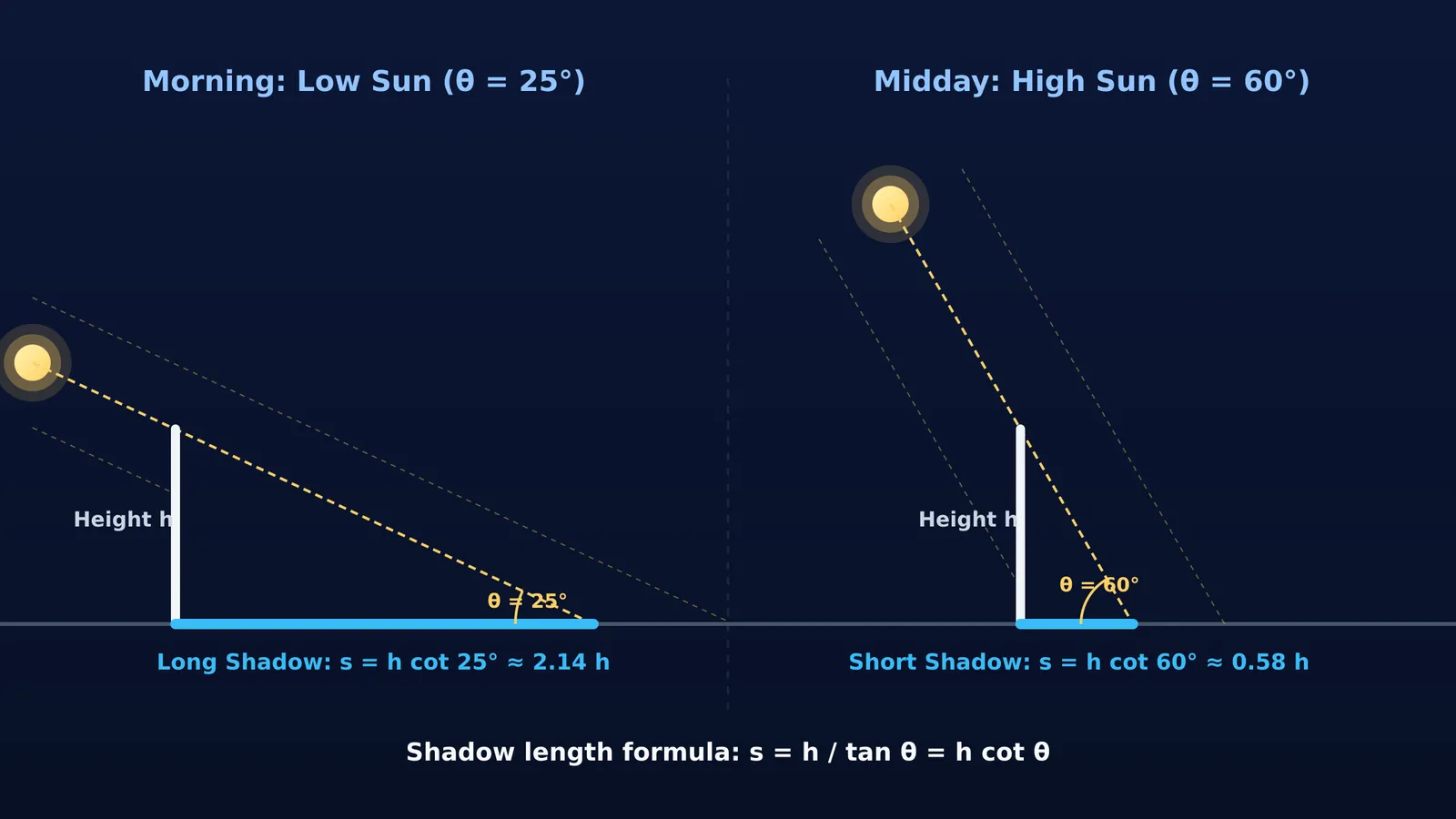
When the Sun is high, light rays strike at a steep angle, slicing the shadow cone close to the object's base. When the Sun is low, those same straight rays strike at a shallow grazing angle, stretching the horizontal projection across an extended path.
The Fermi Simulation Lab offers interactive simulations for ideas that are easier to see than to read, allowing students to adjust the source angle and watch the shadow stretch in real time.
How do you calculate shadow length using trigonometry?
Solar elevation angle θ, as detailed by the NOAA Global Monitoring Laboratory, allows you to calculate the exact length of any shadow on flat ground using right-angled triangle trigonometry.
Let h represent the vertical height of an object, θ represent the solar elevation angle above the horizon, and s represent the horizontal shadow length. In the right triangle formed by the object, the ground, and the straight ray of sunlight connecting the top of the object to the shadow tip:
tan θ = h / s
Rearranging this formula gives the shadow equation:
s = h / tan θ = h × cot θ
To see how shadow length changes throughout the day, consider a student of height 1.6 metres on level ground:
Early morning (θ = 15°): With tan 15° ≈ 0.268, the shadow length is s = 1.6 / 0.268 ≈ 5.97 metres, roughly 3.73 times the student's height.
Mid-morning (θ = 45°): With tan 45° = 1.000, the shadow length is s = 1.6 / 1.000 = 1.60 metres, matching the student's height.
Solar noon in summer (θ = 75°): With tan 75° ≈ 3.732, the shadow length is s = 1.6 / 3.732 ≈ 0.43 metres, shrinking to barely 27% of the student's height.
As explained in our tutorial on visualising heights and distances with trigonometry, trigonometry translates real-world geometric problems into simple algebraic ratios. The Fermi Problem Library provides worked problems with a step-by-step solver that explains the reasoning rather than just printing an answer.
What is the 45-degree shadow rule?
The geometric point where an object's shadow length matches its height occurs when the solar elevation angle is exactly 45°.
In a study published in the *Southern Medical Journal*, researcher Thomas F. Downham II demonstrated that this 45-degree boundary provides a practical guideline for ultraviolet radiation exposure known as the shadow rule.
Downham showed that when an observer's shadow is shorter than their height, the Sun is higher than 45° above the horizon, corresponding to peak ultraviolet-B radiation reaching the ground. When the shadow is longer than the object's height, the Sun sits below 45°, meaning sunlight traverses an extended atmospheric path that scatters and absorbs shorter ultraviolet wavelengths. If a shadow is shorter than the person, solar elevation is high; if longer, solar elevation is low.
What happens to shadows at solar noon and Zero Shadow Day?
Local solar noon is the moment each day when the Sun crosses the local celestial meridian, reaching its highest elevation.
Because solar elevation peaks at solar noon, shadows on level ground reach their daily minimum length at this instant. Outside the tropics, the Sun never reaches a 90° overhead position, so vertical objects always cast a small shadow pointing toward true north in the Northern Hemisphere.
However, between the Tropic of Cancer (+23.5° latitude) and the Tropic of Capricorn (-23.5° latitude), a unique alignment occurs twice each year. As documented by the Astronomical Society of India Public Outreach and Education Committee, Zero Shadow Day occurs when the Sun's declination matches the observer's latitude.
At local solar noon on these two dates, the Sun sits at an elevation angle of 90°. Because cot 90° = 0, the horizontal shadow length s becomes 0 metres, meaning a vertical pole casts no shadow around its base, as detailed in our guide to Zero Shadow Day in Bengaluru and Chennai.
Tracking how shadows shift from dawn to dusk connects everyday observations to planetary geometry, trigonometry, and the straight paths of light.


