

On this page
Pick up a stone from a riverbed and another from a hillside rockfall. The hillside stone has sharp edges; the river stone feels like a bar of soap. National Geographic's explainer on erosion puts it simply: river rocks are often much smoother than rocks found elsewhere because they have been eroded by constant contact with other river rocks.
That sentence hides some neat physics, plus a puzzle that geologists have argued about.
Why are stones in rivers smooth and round?
Fast-moving water lifts, rolls and drops stones along the riverbed. Every time one stone knocks into another, or scrapes across sand and gravel, tiny chips break off its surface. Douglas Jerolmack, a geophysicist at the University of Pennsylvania, summed up his team's 2018 findings in Penn Today: "We show that wind-blown sand, river pebbles, and wave-worked pebbles all round in the same way by colliding."
The key is which parts get chipped. Corners and edges stick out, so they take the hits first. A 2014 study in PLOS ONE by Gábor Domokos, Jerolmack and colleagues described pebble abrasion as a curvature-driven process: the most sharply curved parts of a stone are removed first. Keep that going long enough and every bump gets knocked down, leaving a smooth, rounded shape.
Is it weathering or erosion that makes river stones round?
Both play a part, at different stages.
Weathering is the breaking down or dissolving of rocks and minerals at Earth's surface, according to National Geographic's weathering explainer. It does not involve movement: the rock stays where it is.
Erosion is the process in which earthen materials are worn away and transported by natural forces such as wind or water, as the same erosion explainer defines it.
So weathering cracks an angular chunk off a cliff, and it ends up in the river. Then erosion takes over: the water carries it downstream and grinds it smooth on the way.
How long does it take a river stone to become round?
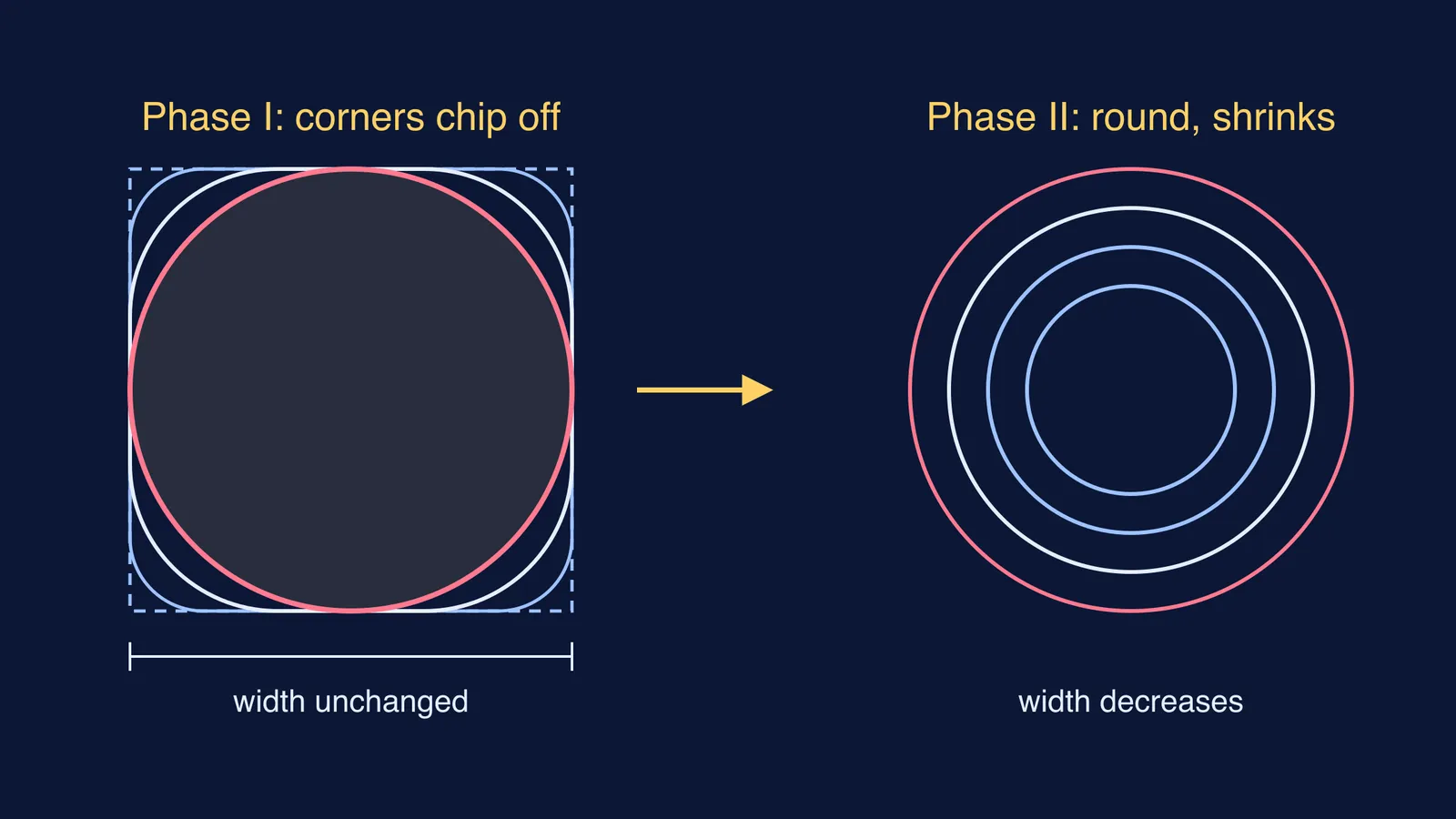
Sooner than you might think. In the 2014 PLOS ONE experiments, the team tumbled single limestone blocks about 7 cm long in a rotating drum 1 metre across. A paddle lifted each block and dropped it once per turn, so the wear came from impacts rather than sliding. The blocks wore down in two clear phases. First the edges rounded off while the stone's length, width and thickness stayed the same. Only once the edges had fully rounded off did those measurements slowly start to shrink. Pointing to earlier field studies, the authors note that pebble edges round rapidly within the "first few kilometers" of a stream.
This helps resolve an old puzzle. Rounded shapes downstream point to plenty of abrasion, yet many researchers argued that abrasion adds little to the way pebbles get smaller downstream. The paper shows that in the first phase a stone can lose up to about half its mass while its length, width and thickness stay put.
Worked example. The paper points out that rounding a cube into the sphere that just fits inside it leaves π/6 of the original mass (PLOS ONE, 2014). Take a cube with 6 cm sides:
Cube volume = 6 × 6 × 6 = 216 cm³.
Sphere that fits inside has diameter 6 cm, so radius 3 cm: volume = (4/3)π × 3³ ≈ 113 cm³.
Ratio = 113 ÷ 216 ≈ 0.52, which is π/6.
The stone has lost nearly half its rock, yet a ruler across it still reads 6 cm.
The same rules hold far from Earth. A 2015 study in Nature Communications used the shapes of rounded pebbles found by NASA's Curiosity rover in Gale Crater on Mars and concluded they had been carried tens of kilometres from their source by an ancient river system.
Try it at home: the sugar-cube jar test
You can watch the first phase happen at the kitchen table.
Put a handful of sugar cubes in a dry jar with a lid. Set one aside as your "fresh rock".
Predict: will the cubes get smaller, or will the corners go first?
Shake hard, tip them out and compare with the fresh cube. Measure across a flat face with a ruler.
Repeat a few times. Notice the sugar dust building up.
Explain: you should see the corners round first while the width barely changes, as in the drum experiment. The dust is your "sand and silt".
Parents, on a riverside walk, ask your child to find the most angular and most rounded stones, and guess which travelled further. Our guide to starting a rock and shell collection with kids has more outing ideas. For the bigger picture, read about Charles Lyell and the foundations of geology.
Some ideas about collisions and motion are easier to see than to read. The Fermi Simulation Lab has interactive simulations for exactly those ideas.
Next time you are at a river, pick up two stones and work out their stories.


