On this page
You grab a plastic bucket on a freezing winter morning, accidentally knock it against a tap, and it shatters. In the height of summer, the same impact would merely cause the plastic to flex and bounce back.
This dramatic shift from tough to brittle is a classic demonstration of polymer physics. To understand why your bucket shattered, you have to look at how temperature changes the mobility of its molecular chains.
What makes plastics flexible?
Plastics are polymers, which are massive molecules made of repeating structural units bonded together into long, tangled chains. You can picture the structure of a flexible plastic like a dense bowl of cooked spaghetti.
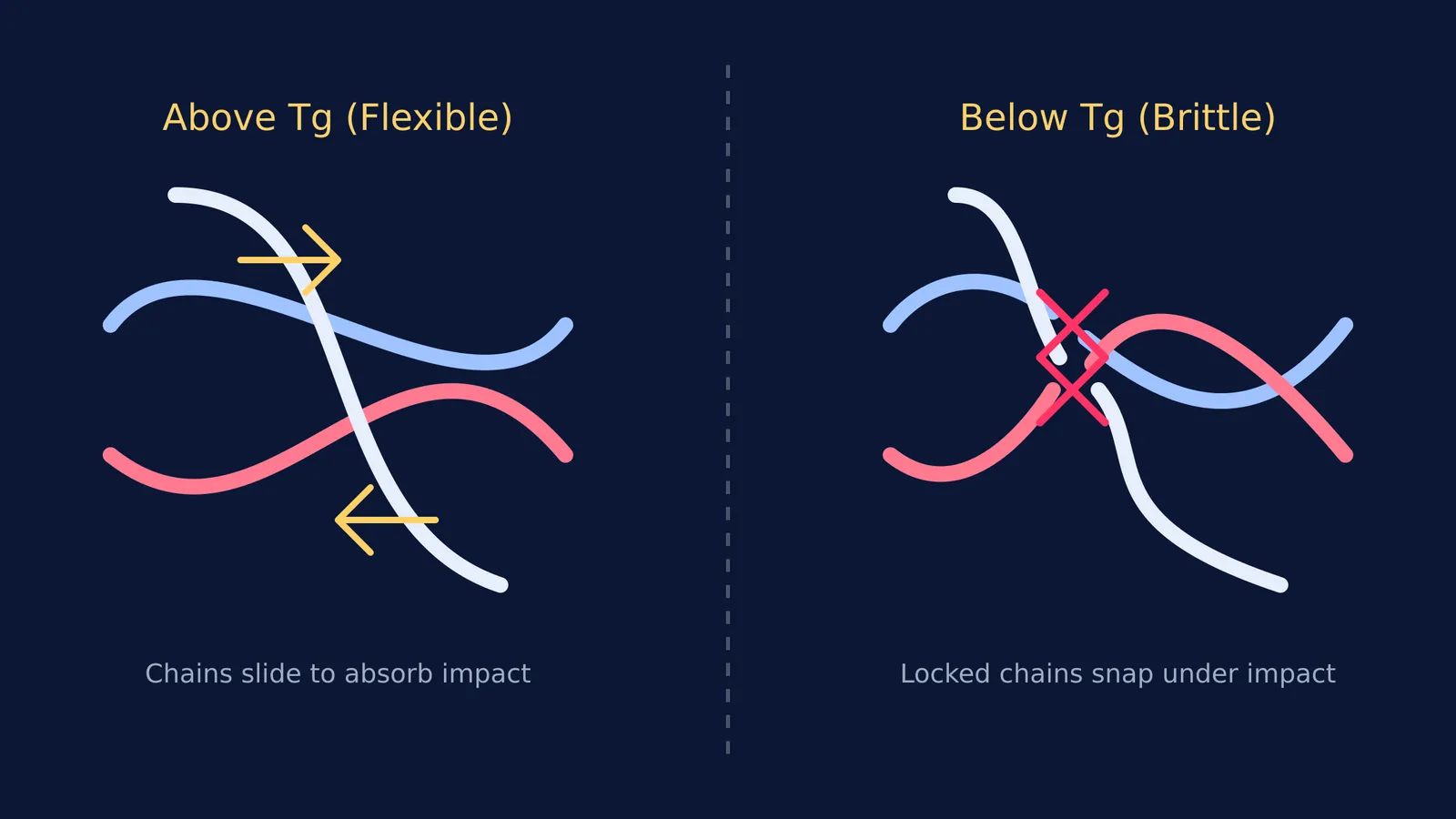
At room temperature, these long chains possess enough thermal energy to wriggle and slide past one another. According to the International Union of Pure and Applied Chemistry (IUPAC), a flexible polymer allows for rapid conformational changes—movements involving segments of 10 to 20 main-chain atoms at a time (Glass transition - Wikipedia).
When you hit a flexible bucket, the impact energy is absorbed by the chains temporarily sliding and stretching out of the way before snapping back. This ability to deform without breaking is what makes plastic so durable in warm weather.
Why do plastic buckets crack more easily in winter?
As the temperature drops, the thermal energy vibrating within the polymer chains decreases. If the temperature falls far enough, the material reaches a critical threshold known as the glass transition temperature (Tg).
Below the glass transition temperature, those conformational changes become infinitely slow. The chains lose their ability to wriggle and slide. Instead of a bowl of soft spaghetti, the molecular structure behaves more like uncooked, dry pasta locked rigidly in place.
Most household buckets are manufactured from polypropylene because it is cheap, mechanically rugged, and highly resistant to chemicals. However, polypropylene has a relatively high glass transition temperature. According to Wolfgang Kaiser's textbook *Kunststoffchemie für Ingenieure* (Plastics Chemistry for Engineers), polypropylene becomes brittle below 0 °C (Polypropylene - Wikipedia).
When a cold polypropylene bucket is struck, the locked chains cannot slide to absorb the energy. The stress is forced directly onto the chemical bonds, snapping them and causing a crack to propagate through the material. (This temperature dependence of state is similar to why temperature stays constant during melting and boiling, as energy dictates how bonds behave.)
Are all plastics brittle in the cold?
Not all polymers crack in the winter. The glass transition temperature depends heavily on the specific atomic structure of the plastic, such as the size of the side groups attached to the main polymer backbone.
High-density polyethylene (HDPE), another common plastic, has a glass transition temperature of approximately -110 °C (Polyethylene - Wikipedia). Because its Tg is far below any natural winter temperature on Earth, HDPE chains retain their mobility and flexibility even in the freezing cold. This makes HDPE a superior choice for outdoor winter equipment that must withstand impacts.
How do engineers choose materials for winter?
When selecting a material for a cold environment, engineers do not just look at its absolute strength; they carefully evaluate its thermal operating window to ensure long-term durability:
Find the average low temperature: Determine the absolute coldest temperature the physical item will face in its intended environment.
Check the glass transition temperature (Tg): Ensure the Tg of the chosen polymer is safely below the environmental low to prevent sudden failure.
Account for impact: If the item will experience sudden physical shocks or drops, engineers will proactively prioritize a low Tg over having a higher absolute tensile strength.
To see how molecular motion scales with temperature, try the Fermi Simulation Lab, which features interactive simulations for the ideas that are easier to see than to read. Seeing how thermal energy drives particle mobility helps explain related phenomena like why metal feels colder than wood at the same temperature and why solubility of most solids increases with temperature.