On this page
Picture a 40°C April afternoon in eastern India. The sky turns dark, and suddenly ice is bouncing off the road. The heat is why the ice exists, through the convection and cooling-with-height you meet in school physics.
How does hail form inside a thunderstorm?
NOAA defines hail as precipitation formed when thunderstorm updrafts carry raindrops upward into extremely cold areas of the atmosphere (NOAA JetStream).
The raindrop freezes into a small ice pellet. Up there it meets supercooled drops: liquid water surrounded by air that is below freezing, which NOAA says is common in thunderstorms. Each drop that hits the pellet freezes onto it, so the stone grows. When the water freezes slowly, air bubbles escape and the new ice is clear; when drops freeze the instant they hit, trapped bubbles make it cloudy.
A sliced hailstone can show layers of clear and cloudy ice. NOAA's National Severe Storms Laboratory says the layers form as the stone meets different temperatures and amounts of liquid water while moving across or near the updraft, not simply from going up and down (NSSL).
The stone stays up only as long as the updraft can support its weight. Once it grows too heavy, or the updraft weakens, it falls.
Why does hail fall during hot summer storms?
Hot ground helps make strong updrafts. Sun-baked land heats the air above it. Warm air is less dense than the air around it, so it rises as a buoyant plume. This is convection, and strong surface heating helps drive it. NOAA's table shows how strong the lift must be: a golf-ball hailstone (1.75 inches) needs an updraft of 64 mph, about 103 km/h, and a grapefruit-sized one (4 inches) needs 98 mph, about 158 km/h (NOAA JetStream).
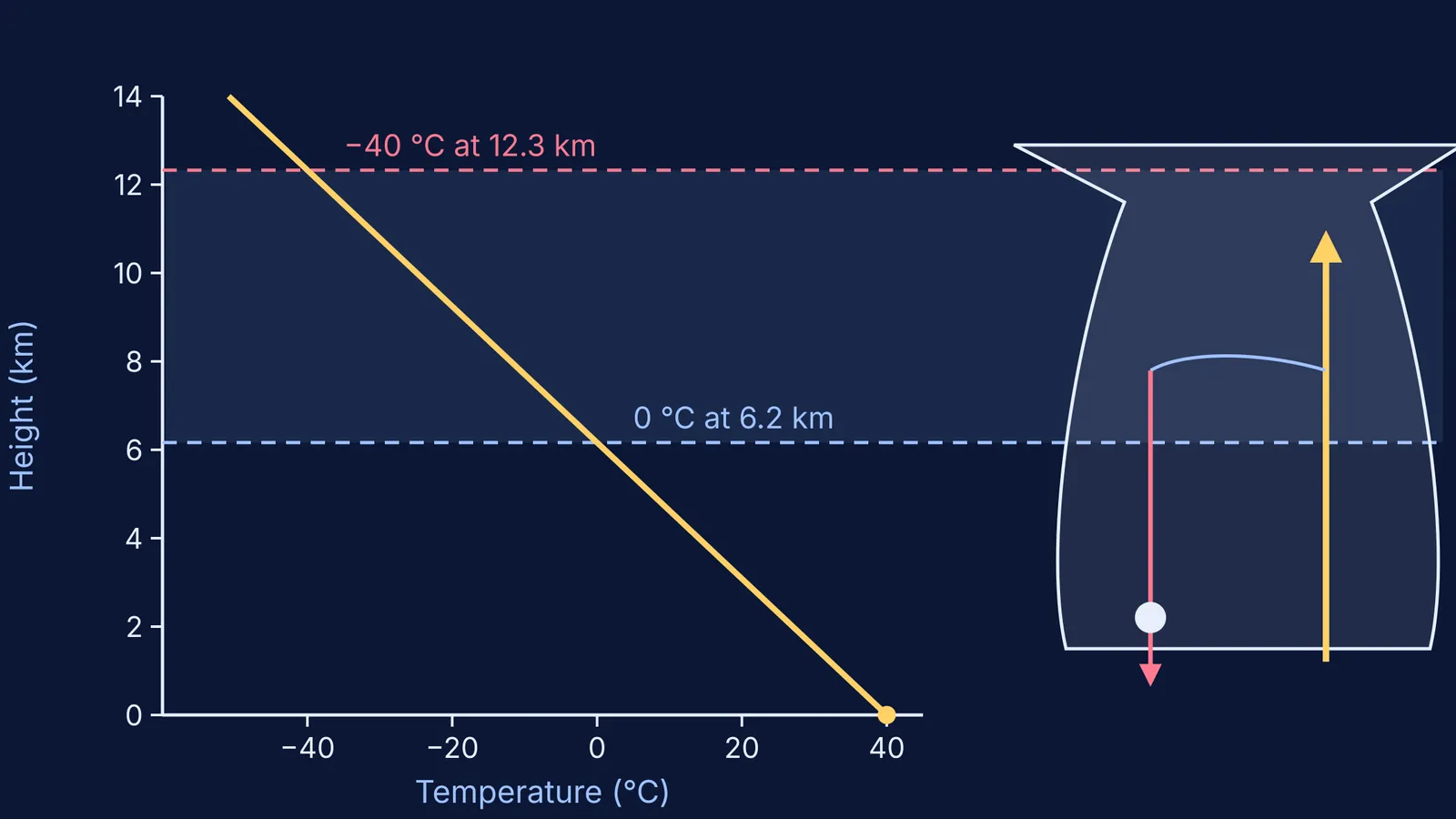
Freezing air is always overhead. In NASA's standard-atmosphere model, temperature in the troposphere falls by 0.00649°C for every metre of height, about 6.5°C per kilometre, from the ground up to 11,000 m (NASA Glenn Research Center). Near the equator the troposphere is 18 to 20 km high (NOAA JetStream), so a tall storm cloud has room to reach sub-zero air, however hot the street is.
Worked example: where does water freeze on a 40°C day?
Use the NASA rate as an idealised model; real lapse rates vary from day to day, so these are estimates.
Surface temperature: 40°C. Cooling rate: 6.49°C per km.
Freezing level: 40 ÷ 6.49 ≈ 6.2 km up. Above this, raindrops can freeze.
The −40°C level: (40 + 40) ÷ 6.49 ≈ 12.3 km up. NASA's line only runs to 11 km, so this is a rough extension. NSSL says that colder than −40°F (which is also −40°C), all liquid water has frozen into ice, and hailstones need liquid water to grow (NSSL).
So in this model the layer where a stone can find supercooled water is about 6 km thick, from 6.2 to 12.3 km. Lofting a stone to the very top of the storm does not help it grow.
Try it yourself with a 30°C day: 30 ÷ 6.49 ≈ 4.6 km. A hotter day pushes the freezing level higher, and that matters for what reaches the ground.
Why doesn't every hot storm drop hail?
The height of the freezing level decides whether the ice survives the fall. NOAA notes that Florida has the most thunderstorms in the US, yet New Mexico, Colorado and Wyoming usually get the most hailstorms, because the freezing level in Florida's storms is so high that hail often melts before reaching the ground (NOAA JetStream).
Size matters too. NSSL gives fall speeds of 9 to 25 mph for hail under 1 inch, against 44 to 72 mph for the 2 to 4 inch hail of the strongest supercells (NSSL). Small stones fall more slowly, so they spend longer in the warm air near the ground, which gives them more time to melt.
India sees this in the pre-monsoon months. A paper in Mausam, the India Meteorological Department's journal, notes that violent thunderstorms producing high winds, large hail and even tornadoes are common from March to May in East India and Bangladesh (Lefort, Mausam, 2013).
How do you explain hail in an exam answer?
Write it as a five-link chain.
Heat: the sun warms the ground, which warms the air above it.
Convection: warm, less dense air rises in a strong updraft.
Cooling with height: rising air reaches levels below 0°C, roughly 6.5°C colder per kilometre (NASA).
Growth: frozen drops collect supercooled water and grow as they move through the cold part of the cloud.
Fall: when its weight beats the updraft, the stone falls, and it reaches you as ice only if it does not melt on the way.
Convection is one of those ideas that is easier to see than to read. The Fermi Simulation Lab has interactive simulations for ideas like this, and if density or buoyancy is your shaky link, the Fermi Concept Library gives each concept its own lesson and its place in the map.