On this page
Frozen peas look freshly shelled months after harvest, and the cold is only part of the reason. Before freezing, peas get a short bath in boiling water called blanching. It is about enzymes, the proteins you study in school biology, and the maths is the first-order kinetics from chemistry.
Why do frozen peas stay green for months?
Because the enzymes inside them are switched off before they are frozen. University of Illinois Extension puts it plainly: "Freezing does not stop enzyme activity; only blanching inactivates enzymes in vegetables." The same page defines blanching as quickly exposing vegetables to boiling water or steam for a set time, then cooling them rapidly.
For garden peas, Penn State Extension gives the recipe: shell, blanch for 1½ minutes in boiling water, then drain and chill in ice water. Penn State says the frozen peas keep for up to a year at −18 °C (0 °F).
What does blanching buy you? Clemson University's Home and Garden Information Center says it "stops enzyme actions which otherwise cause loss of flavor, color and texture," and that it brightens colour and helps slow vitamin losses.
What do enzymes do to peas in the freezer?
A pea is a living seed, full of enzymes. Illinois Extension describes enzymes as large protein molecules that promote chemical reactions such as ripening. Cold slows those reactions; it does not end them. So an unblanched pea keeps changing, slowly, all the time it sits in your freezer.
Heat works where cold does not because an enzyme's job depends on its folded shape. Boiling water unfolds (denatures) the protein, and a denatured enzyme stays switched off when it is frozen.
A 2005 study of peas by Gökmen, Bahçeci, Serpen and Acar in LWT - Food Science and Technology tracked two enzymes, lipoxygenase and peroxidase, as markers of whether a blanch was long enough. It suggested blanching for 2.0 minutes at 80 °C, enough to inactivate 90% of the original peroxidase activity, and concluded that blanching until peroxidase is switched off appears necessary to retain vitamin C and chlorophyll pigments during frozen storage. Neither enzyme regenerated in peas stored at −18 °C.
Why is blanching so short?
Because heat is also an enemy of green. Chlorophyll has a magnesium atom at its centre. With heat and acid, that magnesium is replaced by two hydrogen atoms, turning chlorophyll into pheophytin and shifting the colour from bright green towards olive brown, as a 2023 review in Molecules explains.
So timing matters both ways. Clemson warns that over-blanching partly cooks vegetables and costs flavour, colour, vitamins and minerals, while under-blanching "stimulates enzyme activity and thus is worse than no blanching." Its advice is to cool vegetables for as long as you blanched them.
In the pea study, blanching lengthened the half-life of vitamin C but shortened the half-lives of chlorophylls a and b. The bright green in a frozen packet is a balance: long enough in hot water to stop the enzymes, then straight into ice water to spare the pigment.
How fast do unblanched peas lose vitamin C and colour?
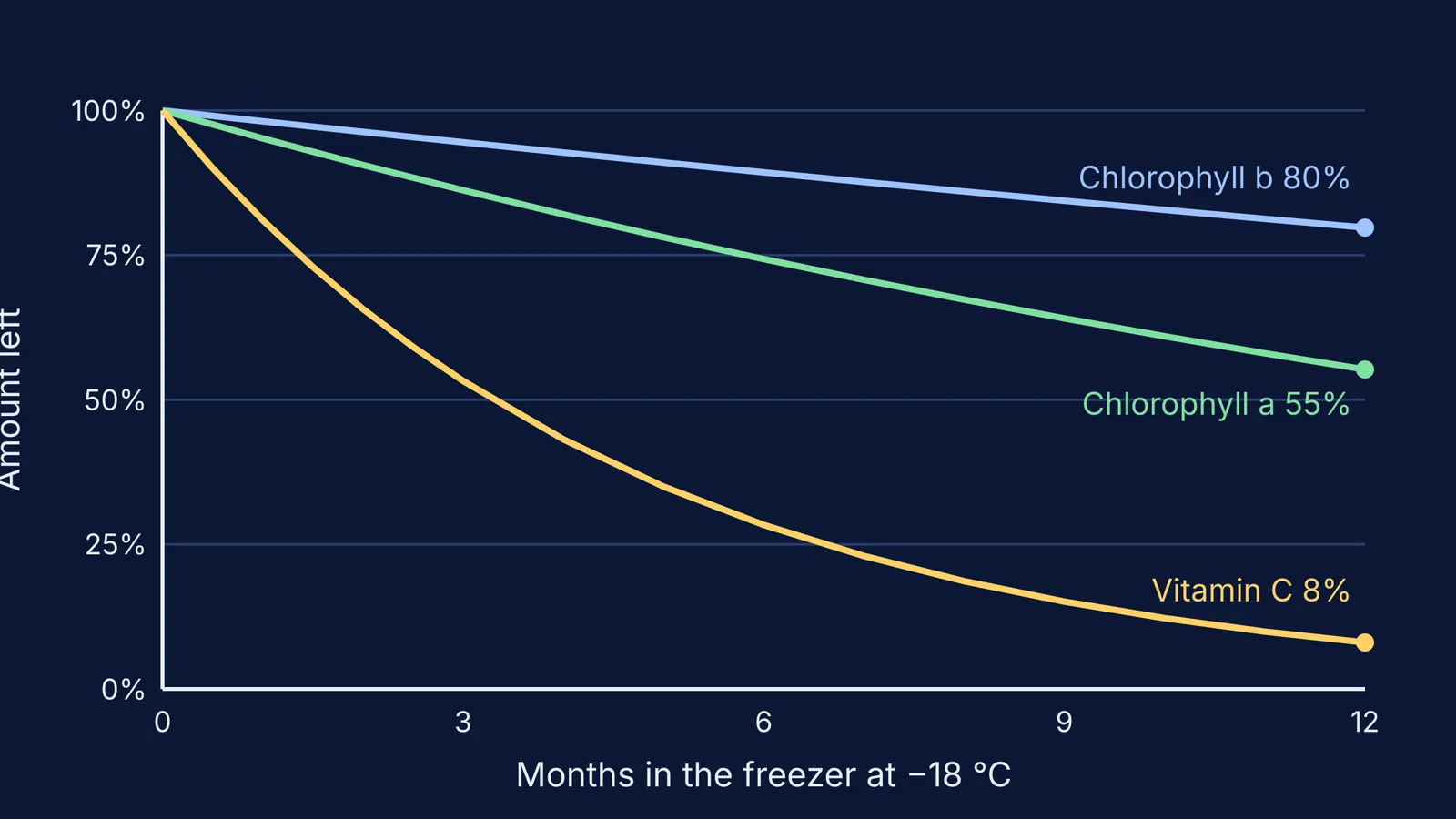
The pea study found that vitamin C and chlorophyll broke down by first-order kinetics. In unblanched peas at −18 °C, the half-lives were 3.30 months for vitamin C, 14.01 months for chlorophyll a and 36.76 months for chlorophyll b.
That is enough to work out what is left, using the same formula as radioactive decay: fraction left = (1/2)^(t ÷ half-life).
Vitamin C after 6 months: (1/2)^(6 ÷ 3.30) = (1/2)^1.82, about 0.28, so roughly 28% remains.
Chlorophyll a after 6 months: (1/2)^(6 ÷ 14.01) = (1/2)^0.43, about 0.74, so roughly 74% remains.
After 12 months: vitamin C about 8%, chlorophyll a about 55%, chlorophyll b about 80%.
So, on these numbers, unblanched peas would keep more than half their chlorophyll after a year while most of their vitamin C has gone. Colour is the loss you can see; the bigger one is invisible.
If half-lives and decay curves feel abstract, the Fermi Simulation Lab has interactive simulations for ideas that are easier to see than to read. For the biology side, the Fermi Concept Library gives each concept in chemistry and biology its own lesson.
Can you test this at home?
Yes, with one cup of fresh matar and two freezer bags. Ask an adult to handle the boiling water.
Shell the peas and split them into two equal piles.
Batch A: boil for 1½ minutes, as Penn State advises, then cool in ice water for 1½ minutes, following Clemson's rule, and drain.
Batch B: bag the raw peas as they are.
Label both bags with the date and freeze them side by side.
Before you open them, write down your prediction for colour, smell, taste and texture.
After 4 weeks and again after 8 weeks, cook a spoonful from each bag the same way and compare.
Clemson notes that blanching is about quality, not safety. Next time you open a packet of frozen peas, you will know the 90 seconds of chemistry that kept them green.