On this page
Watch any match, on TV or in your colony: a fielder takes a hard catch and lets the hands travel back with the ball. It is not style. It is Newton's second law, and a common "give reason" question in Class 9 science.
Why do fielders pull their hands back while catching?
To catch the ball, the fielder must take away all of its momentum (mass times velocity, p = mv). The ball decides how much that is. The fielder decides only how long the stopping takes.
Impulse is the average net force multiplied by the time it acts, and it is equal to the change in momentum: change in p = F x t (OpenStax College Physics 2e, section 8.2). Rearrange it and F = (change in p) / t. Pulling the hands back stretches the time, so the force on the palms falls in the same proportion.
In the NCERT Exploration textbook for Class 9 (2026-27), this sits in Chapter 6, "How Forces Affect Motion" (Vedantu chapter page). Notes for that chapter use exactly this example: "By pulling their hands back, a fielder increases the time it takes for the ball's velocity to drop to zero" (LearnCBSE chapter notes).
How does Newton's second law explain it?
The second law says the rate of change of momentum of an object is proportional to the net force acting on it (LearnCBSE chapter notes). For a ball of mass m that slows from speed u to speed v in time t, that becomes F = m(v - u) / t.
In a catch the final speed v is zero, so the size of the force is F = mu / t. The mass and the incoming speed belong to the ball. The time t is the only thing in that formula the fielder can change. Double t and the force halves.
How much force does a cricket ball put on your hands?
Let us put numbers in. Under the ICC's men's ODI playing conditions, a new ball must weigh between 155.9 g and 163 g (ICC clause 4.1), so take m = 0.16 kg. Suppose it reaches the fielder at 20 m/s (72 km/h), and that it slows steadily, so its average speed while stopping is 10 m/s.
Change in momentum: 0.16 kg x 20 m/s = 3.2 kg m/s. This is the same for both catches below.
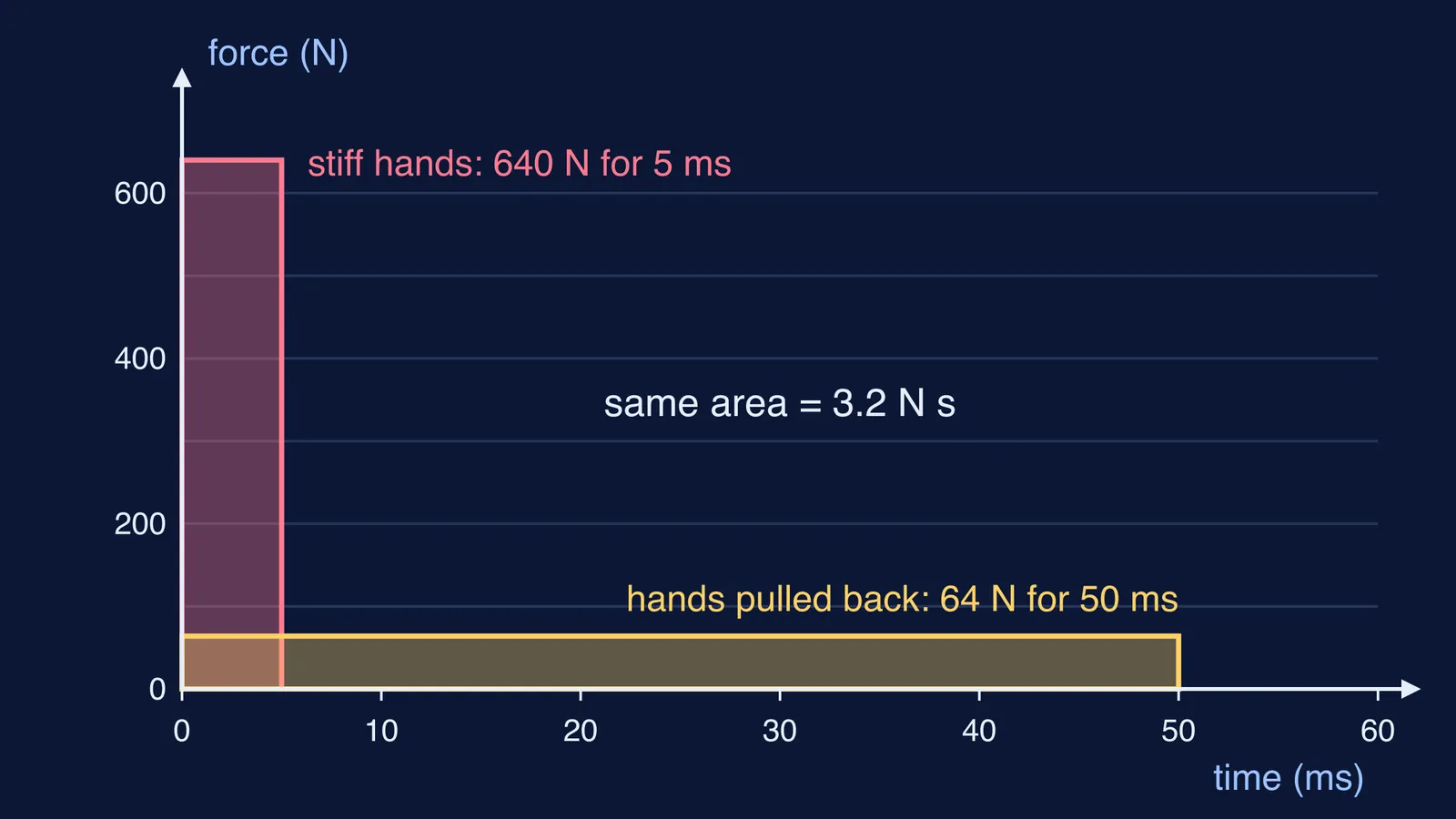
Stiff hands, ball stopped in about 5 cm: t = 0.05 m / 10 m/s = 0.005 s, so F = 3.2 / 0.005 = 640 N.
Hands pulled back about 50 cm: t = 0.5 m / 10 m/s = 0.05 s, so F = 3.2 / 0.05 = 64 N.
Ten times the stopping time, one tenth of the force. For a feel of the sizes, 640 N is about the weight of a 65 kg person (640 / 9.8), and 64 N about that of a 6.5 kg bag of rice.
The graph at the top draws this example: both rectangles have the same area, the 3.2 N s impulse, but one is tall and thin and the other low and wide. If a picture like this helps more than the formula, the Fermi Simulation Lab has interactive simulations for ideas that are easier to see than to read.
Where else does the same idea show up?
The same textbook section on impulse gives these cases (OpenStax College Physics 2e, section 8.2):
Airbags and dashboard padding let the stopping force on passengers act over a much longer time in a sudden stop.
A car's crumple zone makes a collision last longer, so the force on the car is smaller.
Rolling on a soft mat after jumping from a table extends the time the ground pushes on you.
How do you write this as a Class 9 exam answer?
A complete answer makes three moves:
State what must happen: the ball's momentum must become zero, so its change in momentum (mu) is fixed.
Name the law: by Newton's second law, F = m(v - u) / t, so for a fixed change in momentum the force is inversely proportional to the time taken.
Apply it: pulling the hands back increases the time, so the force on the hands decreases and the catch hurts less.
Two common slips are "it reduces the momentum" and "it reduces the impulse". Both stay the same either way. What falls is the force.
For more numericals like the one above, the Fermi Problem Library has worked problems with a step-by-step solver that explains the reasoning rather than printing an answer.
Next match, watch the hands on a hard catch: that is F = (change in p) / t at work.