On this page
Wrap your hand around an egg, put the pointed end against your palm and the round end against your fingers, and squeeze. You might expect a mess. Often you just get a sore hand.
The shell doing this is thin. A hen's eggshell is about 0.3 mm thick, according to the poultry breeder Lohmann Breeders, which also notes that each shell uses about 2 g of calcium carbonate. So the strength cannot come from thickness. It comes from shape, and from how your hand delivers the force.
Why is an egg hard to crush end to end?
The shape. An egg is a closed, curved shell. Push on its ends and the curve redirects the push along the surface, around towards the middle and on to the other end, instead of letting one spot bend inward. The whole shell shares the load.
Your hand. Your palm and fingers wrap around the curve, so the force is spread over a wide patch of shell instead of landing on one point.
The result is that the shell mostly carries the load along its own surface, squeezed lengthwise, rather than bending.
What does the dome shape actually do?
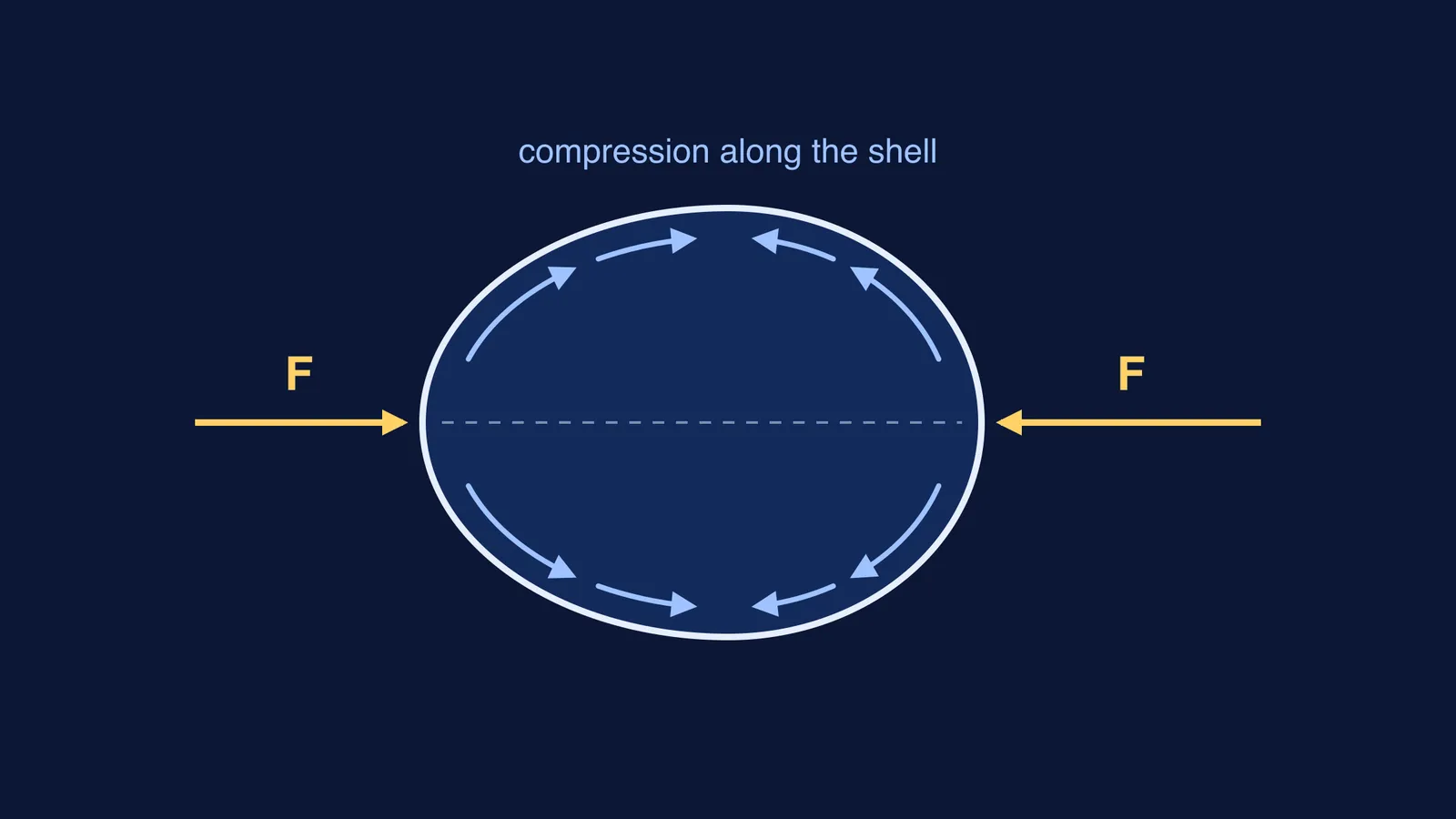
An egg end is a small dome, and a dome is an arch spun round in a circle. An arch "distributes the compressive forces to the load-bearing piers that support the arch," and that design "eliminates some tension stresses in the structure", as a Science Buddies eggshell experiment published by Science News Explores explains.
That is the idea in the diagram above. Each yellow arrow is your squeeze, F. The blue arrows show the shell carrying that push as compression along its surface, from each end towards the equator. Because every slice across the egg has to pass the full force F along, the compression per centimetre of shell is greatest near the narrow ends, where there is the least shell to share it.
Are eggs really strongest at the ends?
In 2025, an MIT-led team, with civil and environmental engineer Tal Cohen as senior author, published "Challenging common notions on how eggs break and the role of strength versus toughness" in Communications Physics. They slowly squeezed eggs either end to end or across the sides.
As reported by GIGAZINE, the maximum load was 46.0 ± 6.61 N on the ends and 45.2 ± 5.52 N on the sides, so the force needed to crack an egg was about the same either way. MIT News summarises it plainly: it "required the same amount of force to initiate a crack in both orientations."
What differed was stiffness. Squeezed end to end, eggs bent only 0.161 mm before cracking, against 0.213 mm across the sides, per the same GIGAZINE report. The softer, side-on direction absorbed more energy, so in an 8 mm drop only 5% of eggs landing on their sides cracked, compared with about 55% landing on their ends.
So the honest answer to the search question is this: an egg is hard to crush end to end because of its dome shape and an even grip, not because the ends are secretly stronger than the sides.
How can you test arch strength safely in the kitchen?
Try this with an adult around and an egg you plan to cook anyway.
Take off any rings. A ring presses on one small point, which is exactly what you are trying to avoid.
Put the egg in a sealed zip-lock bag and hold it over the sink.
Squeeze end to end with your whole hand, increasing the force slowly. Note what happens.
Now press one fingertip hard on the side. Note the difference.
Wash your hands afterwards, since raw egg can carry germs.
For a bigger test, Science Buddies suggests standing three clean eggshell halves dome-up in a triangle and stacking magazines on a book across them until they crack, then recording the total mass.
Why does the same egg crack on the edge of a bowl?
Pressure is force divided by area, p = F/A. A small contact area gives a large pressure, and a point load bends the shell locally instead of letting the dome share it.
Here is a worked example with round, illustrative numbers (assumptions, not measurements). Say your palm spreads 45 N (about the crack force in the MIT study) over 4 cm² of shell, which is 0.0004 m². The pressure is 45 ÷ 0.0004 = 112,500 Pa, about 110 kPa. Now say a bowl rim touches just 2 mm², which is 0.000002 m². To reach the same 110 kPa there, you need only 112,500 × 0.000002 = 0.225 N. The rim needs 200 times less force to press as hard on the shell, which helps explain why a gentle tap works.
If forces on curved surfaces are hard to picture from a textbook figure, the Fermi Simulation Lab has interactive simulations for ideas that are easier to see than to read. If pressure itself still feels shaky, the Fermi Concept Library gives each physics concept its own lesson.