On this page
Every Diwali, many dogs in India spend the night shaking under a bed or pacing the house. The reason is partly biology and partly physics, and understanding both makes it easier to help.
Why are dogs so scared of Diwali crackers?
Noise fear is common. In a University of Bristol study of dog owners, almost half reported that their dog showed at least one behavioural sign typical of fear when exposed to noises, such as vocalising, trembling, hiding or seeking people, yet only a quarter had reported their dog as fearful of noises. A larger survey in Scientific Reports found that noise sensitivity was the most common anxiety-related trait, with a prevalence of 32% in 13,700 Finnish pet dogs.
How much better do dogs hear than humans?
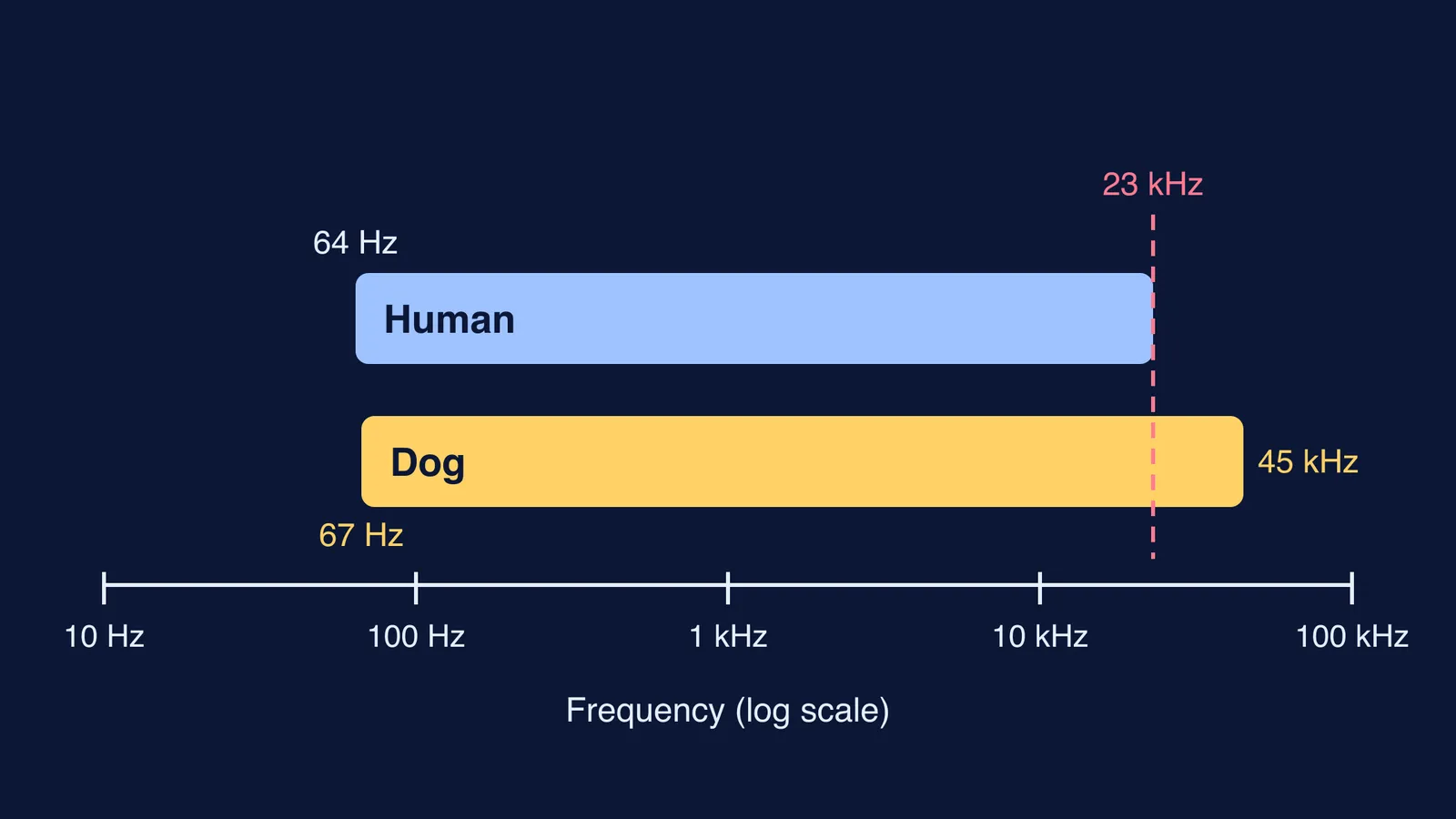
Hearing has two parts: which pitches you can hear, and how faint a sound can be. On pitch, Louisiana State University's comparison of animal hearing gives the human range as about 64 to 23,000 Hz and the dog range as about 67 to 45,000 Hz, using data compiled from earlier reference works. At the low end the two are close; at the high end a dog hears almost twice as far up.
On faintness, the same LSU page compiles dog hearing tests, including Henry Heffner's 1983 study of large and small dogs in Behavioral Neuroscience, and notes that dogs had slightly greater sound sensitivity than humans. In Heffner's tests one poodle heard a 4 kHz tone at -4 dB, below the 0 dB reference level.
Sound intensity is the sound power per unit area, and 0 dB is set at the threshold of human hearing, 10^-12 W/m². Every 10 dB step means ten times the intensity. The same page gives a nominal pain threshold of 130 dB.
How loud is a Diwali cracker, really?
India's noise standard for firecrackers, quoted in a district order in Kohima, prohibits crackers that generate more than 125 dB(AI) or 145 dB(C)pk measured 4 metres from where they burst. That is the legal ceiling, not a typical value, and it is not far below the nominal pain threshold for people.
Now a worked example. Sound from a point source obeys the inverse square law if there are no reflections or reverberation: double the distance and the intensity falls to a quarter. A quarter is a drop of 10 × log10(4), or about 6 dB. Starting from a cracker at the 125 dB limit:
At 4 m from the burst: 125 dB
At 8 m: about 119 dB
At 16 m: about 113 dB
At 32 m: about 107 dB
At 64 m: about 101 dB
The catch: buildings bounce sound back, so real streets lose less than this. Even 64 m away, a cracker at the legal limit would still be about 100 dB above the threshold of human hearing by this estimate, and a dog's threshold sits slightly lower still.
A sharp bang is also not a single note: a very short pulse is built from many frequencies at once, so it spreads across much of the range a dog hears. The Bristol researchers also found that fear responses to fireworks, gunshots and thunder commonly occur together.
If inverse squares feel abstract, it can help to see a physics idea move. The Fermi Simulation Lab has interactive simulations for ideas that are easier to see than to read.
What can you do to help your dog this Diwali?
The Dogs Trust guide to fireworks suggests steps that work for Diwali too. Here is a plan built on them.
In the week before:
Talk to your vet early if your dog has panicked before; the Bristol study found that less than a third of owners seek professional advice.
Choose a safe space: a cosy spot in a quiet inner room with their bed.
Ask neighbours, politely, to burst crackers away from your gate.
A script for neighbours or the children in your building: "Our dog gets really frightened by crackers. Could you burst them at the far end of the lane, away from our window? It makes a big difference. Thank you, and happy Diwali."
On the night:
Walk your dog in daylight, and be settled inside before the evening crackers start.
Close windows and curtains to muffle the sound and hide the flashes.
Play music or the TV to help disguise the bangs.
Stay home, or make sure someone your dog trusts is there.
If your dog comes to you for comfort, calmly give it. Never scold a frightened dog, even if it has an accident.
After Diwali, note what worked. If the fear is severe or growing, your vet or a qualified clinical behaviourist can create a tailored plan before next year.
The physics that explains the fear also points to the fix: sound fades with distance and is blocked by walls, so every metre and every closed window helps.