

On this page
When you light a traditional clay diya, the flame appears calm and steady, shaped like an upright teardrop. This stability is an active mechanical balance between fluid flow and chemistry. As Michael Faraday noted in The Chemical History of a Candle, heat conducts down into the cotton wick, vaporising the liquid fuel. In our explainer on why a diya wick draws up oil, capillary action inside the cotton fibres steadily lifts liquid oil from the bowl.
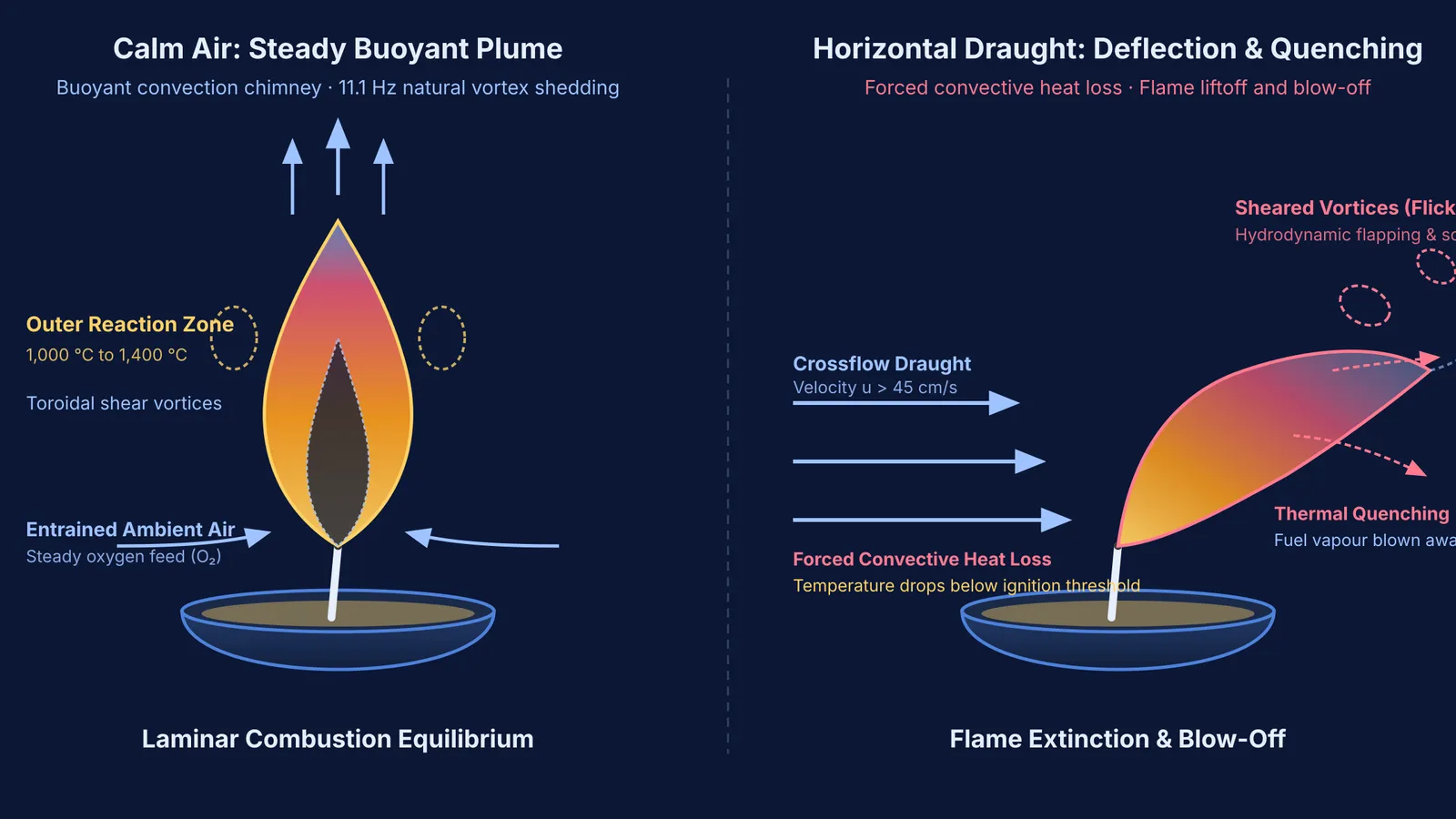
At the wick tip, oil vaporises into hydrocarbon gases that meet atmospheric oxygen in a thin reaction zone reaching 1,000 °C to 1,400 °C, as documented in Combustion Science and Technology. Because hot gas expands, its density falls to roughly 0.25 kg/m³, compared with 1.2 kg/m³ for surrounding room air. Gravity pulls cooler air downward, creating an upward buoyant force that accelerates hot exhaust upward. In calm air, this natural convection plume stays smooth and laminar, feeding in oxygen while radiating heat back to vaporise more fuel.
Why does moving air make the flame flicker?
When a fan turns on or a breeze blows past, this calm vertical chimney is disrupted. A horizontal draught introduces crossflow velocity that collides with the rising buoyant plume.
Even in calm air, buoyant plumes exhibit hydrodynamic instability. In AIP Advances, researchers Suraj Dange, Samadhan A. Pawar, Krishna Manoj, and R. I. Sujith at IIT Madras observed an isolated diffusion flame oscillating at roughly 11.1 Hz. Rising hot exhaust creates a buoyancy-driven Kelvin-Helmholtz shear against still ambient air, shedding toroidal, smoke-ring-shaped vortices that squeeze the flame neck. Earlier work by T. Maxworthy in the Journal of Fluid Mechanics showed that buoyant plumes naturally transition into such global oscillations.
An external draught shears these vortices into irregular eddies, tilting the reaction zone and forcing it to flap. Because yellow light comes from incandescent soot particles, rapid fluctuations in flame volume produce visible shifts in brightness—what we observe as flickering.
The Fermi Simulation Lab provides interactive simulations for ideas that are easier to see than to read, allowing students to visualise how fluid velocities and buoyancy forces interact.
How does wind cool a flame below its ignition temperature?
If the breeze strengthens, the diya suddenly goes out. Moving air carries oxygen, so why does it extinguish the flame?
Combustion requires three essentials: fuel vapour, oxygen, and heat to keep the fuel at or above its ignition temperature—the lowest temperature at which a substance catches fire, as defined in the NCERT Science curriculum. As discussed in our guide to Diwali diyas and the science of heat, vegetable oils need temperatures above 300 °C to sustain active vapour-phase combustion.
In still air, heat generated by combustion exceeds heat lost to surroundings. A draught replaces slow natural convection with rapid forced convection, carrying heat away from the reaction zone. If heat loss outpaces heat release, the reaction zone cools below the ignition temperature. Because chemical reaction rates drop exponentially with falling temperature, this thermal quenching extinguishes the flame.
What causes flame blow-off in a strong draught?
Wind also exerts mechanical displacement. In the Annual Review of Fluid Mechanics, combustion researchers Amable Liñán, Marcos Vera, and Antonio L. Sánchez show that diffusion flames remain attached only when flow velocity matches flame propagation speed—typically 30 to 45 cm/s for hydrocarbon diffusion flames.
When draught speed exceeds this laminar burning velocity, air sweeps fuel vapour away before it can mix with oxygen and ignite:
When flow residence time exceeds chemical reaction time (high Damköhler number), burning remains stable.
When wind reduces residence time below reaction time (low Damköhler number), the flame lifts off and blows out.
Without heat radiating back to the wick, oil stops vaporising, leaving a wisp of unburnt smoke. To explore how fluid density and drag operate across physical systems, test predictions in our buoyancy and density simulation guide, or consult the Fermi Concept Library for lessons across thermal physics and chemistry.
How can you keep an open diya flame steady?
Controlling wick exposure and managing surrounding airflow preserves the delicate balance between convective heat loss and buoyant fuel feed:
Keep the exposed wick between 5 mm and 6 mm: Flame safety standards from the National Candle Association recommend trimming exposed wicks to roughly one-quarter inch (about 6 mm). A longer wick enlarges the exposed vapour plume, increasing surface area for forced convective cooling and soot generation.
Fill oil near the rim: A low oil level creates recirculation eddies inside the shallow bowl that buffet the base of the wick from behind.
Use a vented glass chimney: As demonstrated in the NCERT Science combustion curriculum, a vented chimney shields the flame from horizontal crosswinds while allowing air to enter smoothly from underneath, sustaining the upward buoyant draught.
Place windward barriers 10 to 15 cm away: Barriers positioned directly adjacent shed turbulent wake vortices onto the flame; keeping a distance of 10 to 15 cm allows wake eddies to disperse before reaching the wick.


