

On this page
Diwali is the festival of lights. But what makes a diya glow? Before you light the next row of clay lamps, pause for a moment with your child. A simple diya is actually a live physics and chemistry lesson waiting to be discussed.
What is the science behind a diya flame?
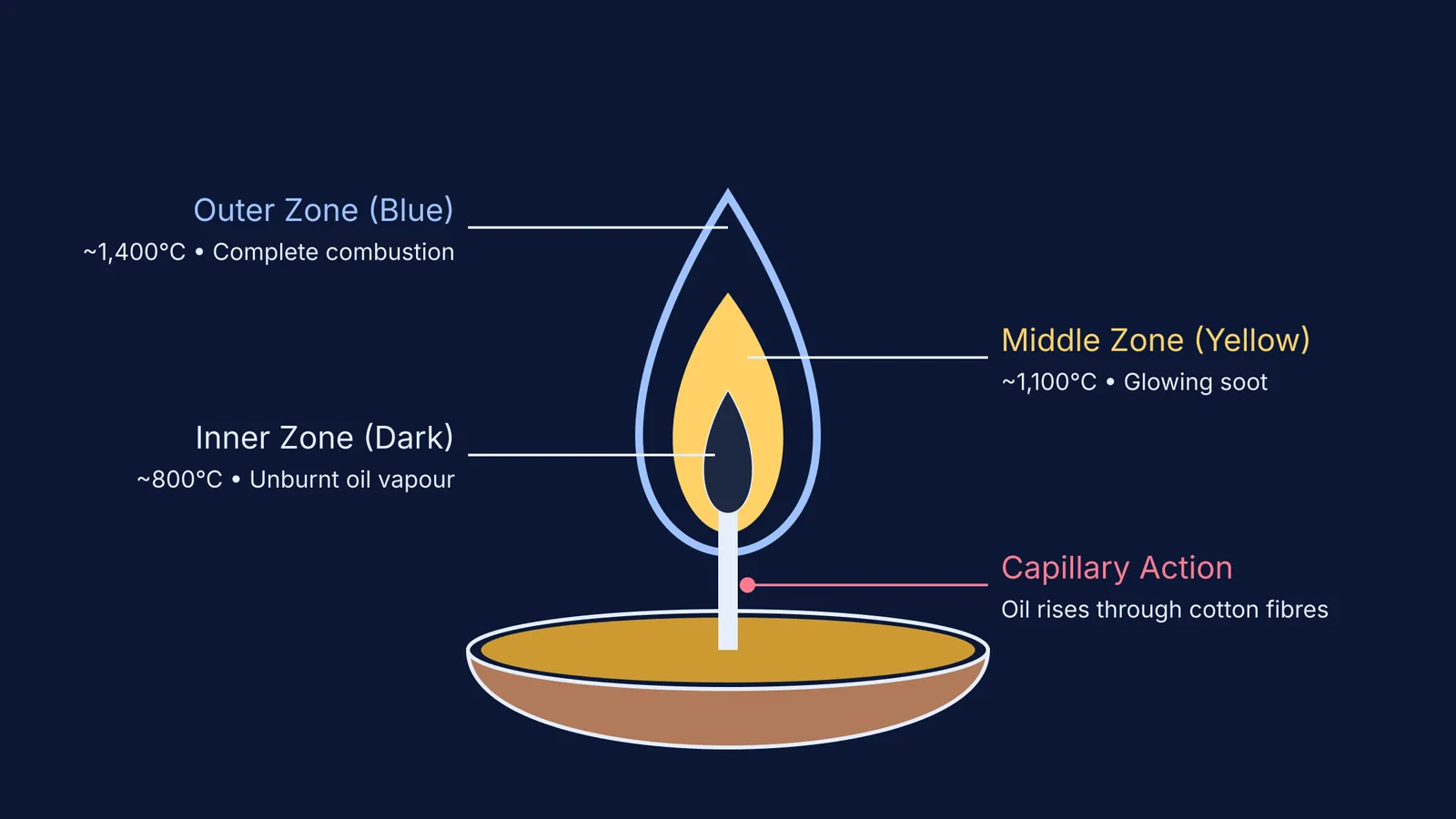
A diya consists of a clay lamp, oil as fuel, and a cotton wick. The first piece of physics happens before the flame even lights: how does the oil travel upwards against gravity?
The answer is capillary action. The cotton wick is made of thousands of tiny fibres with microscopic gaps between them. Because the oil adheres to the cotton, surface tension pulls it up these tiny channels. Once the oil reaches the top, the heat from the flame turns the liquid oil into a gas. It is this vapour, not the liquid oil, that actually burns.
Why does a diya flame glow yellow?
Look closely at a burning diya and you will see it is not just one colour. A flame has distinct temperature zones, each revealing a different stage of combustion.
The outer zone is a faint blue ring and is the hottest part of the flame at approximately 1,300–1,400 °C (Wikipedia). Here, the vaporised oil has plenty of oxygen from the surrounding air, resulting in complete combustion.
The middle zone is the brightest part, glowing a beautiful yellow. In this region, there is less oxygen, so the combustion is incomplete. Tiny unburnt carbon particles, or soot, are formed. These particles heat up to around 1,100 °C and glow, a process called incandescence. This is the exact same physics that makes the wire in an old-fashioned light bulb shine.
Finally, the inner dark zone right around the wick is the coolest part of the flame, at roughly 600–800 °C. This area lacks oxygen and contains unburnt oil vapour waiting to rise and burn.
How can we make Diwali safe?
While a diya is a wonderful way to learn about physics, it is also a live fire. Firecrackers often get the most attention for safety, but lamps are just as important to discuss.
A 2024 study by Safdarjung Hospital in New Delhi, published in the *Indian Journal of Plastic Surgery*, reviewed five years of Diwali-related burn injuries (DOI: 10.1055/s-0044-1788915). The researchers found that diyas accounted for 32.5% of all festival burns.
The study also highlighted a critical demographic trend: 70.4% of the victims of diya-related burns were female. The most common cause was loose-fitting traditional clothing catching fire from a burning diya left on the floor. While many injuries were minor, approximately one-third of the patients required hospital admission.
A simple plan for a safe Diwali
You do not need to stop lighting diyas to be safe. Instead, use this as an opportunity to set clear, practical rules with your family:
Elevate the lamps: Place diyas on raised platforms or tables rather than directly on the floor where long clothes can brush against them.
Choose cotton: Wear tight-fitting cotton clothes instead of loose synthetic fabrics. Synthetics can melt and stick to the skin if they catch fire, causing deeper burns.
Watch the flame: Use the moment to talk about the 1,400 °C outer blue zone. Understanding how hot a flame really is helps children respect it rather than just fear it.
If your child is fascinated by how everyday things work, they might enjoy exploring more concepts. The Fermi Concept Library maps out ideas in physics and chemistry, helping them see the science in the world around them.


