On this page
The best cricket bats come from one particular tree: cricket bat willow, *Salix alba* var. *caerulea*, whose timber forest scientist Gabriel Hemery describes as "stiff with excellent impact resistance, ideal for quality cricket bats". Willow sits at a sweet spot of three properties you meet in physics: density, stiffness and toughness. Here is what the numbers say, and how to reason through them yourself.
Why are cricket bats made of willow wood?
Start with the rulebook. Law 5.3.2 of the MCC Laws of Cricket says: "The blade shall consist solely of wood." Law 5.7 caps the bat at 38 in (96.52 cm) long and the blade at 10.8 cm wide and 6.7 cm deep, so makers cannot win by simply making a bigger bat.
Within those limits, the choice of wood decides a great deal. The Wood Database gives white willow an average dried density of 400 kg/m³ and an elastic modulus (stiffness) of 7.76 GPa. It describes the wood as "a lightweight hardwood with good shock resistance", though it adds that the wood "overall is weak for its weight". For a bat, being light, stiff enough and hard to shatter matters more than raw strength.
Cricket bat willow is a variety of that species. Woodlands.co.uk describes its wood as "tough but lightweight and does not shatter easily", which is what you want in something hit by a hard ball.
How does willow's structure absorb the shock?
Wood is not a uniform solid. Think of a tight pack of drinking straws: long hollow cells running along the trunk, glued together.
In 2015, researchers at the Australian National University began studying why English willow makes better bats than Kashmir willow. The project's lead researcher, Dr Mohammad Saadatfar, told cricket.com.au that "Willow has pockets of air trapped inside the cells, which deform elastically when the cricket ball hits it".
So when the ball meets the blade:
The air-filled cells squash a little and spring back, spreading the impact instead of concentrating it.
The long fibres help the wood resist splitting, which is why sources describe it as not shattering easily.
With so much of the volume air, the blade stays light enough to swing fast.
The catch is that willow is soft. The Wood Database lists its Janka hardness at 2,530 N. To help the wood withstand a ball arriving at high speed, bat makers press the blade, at pressures of up to 2,000 lb according to Woodlands.co.uk.
Why not use teak, ash or bamboo instead?
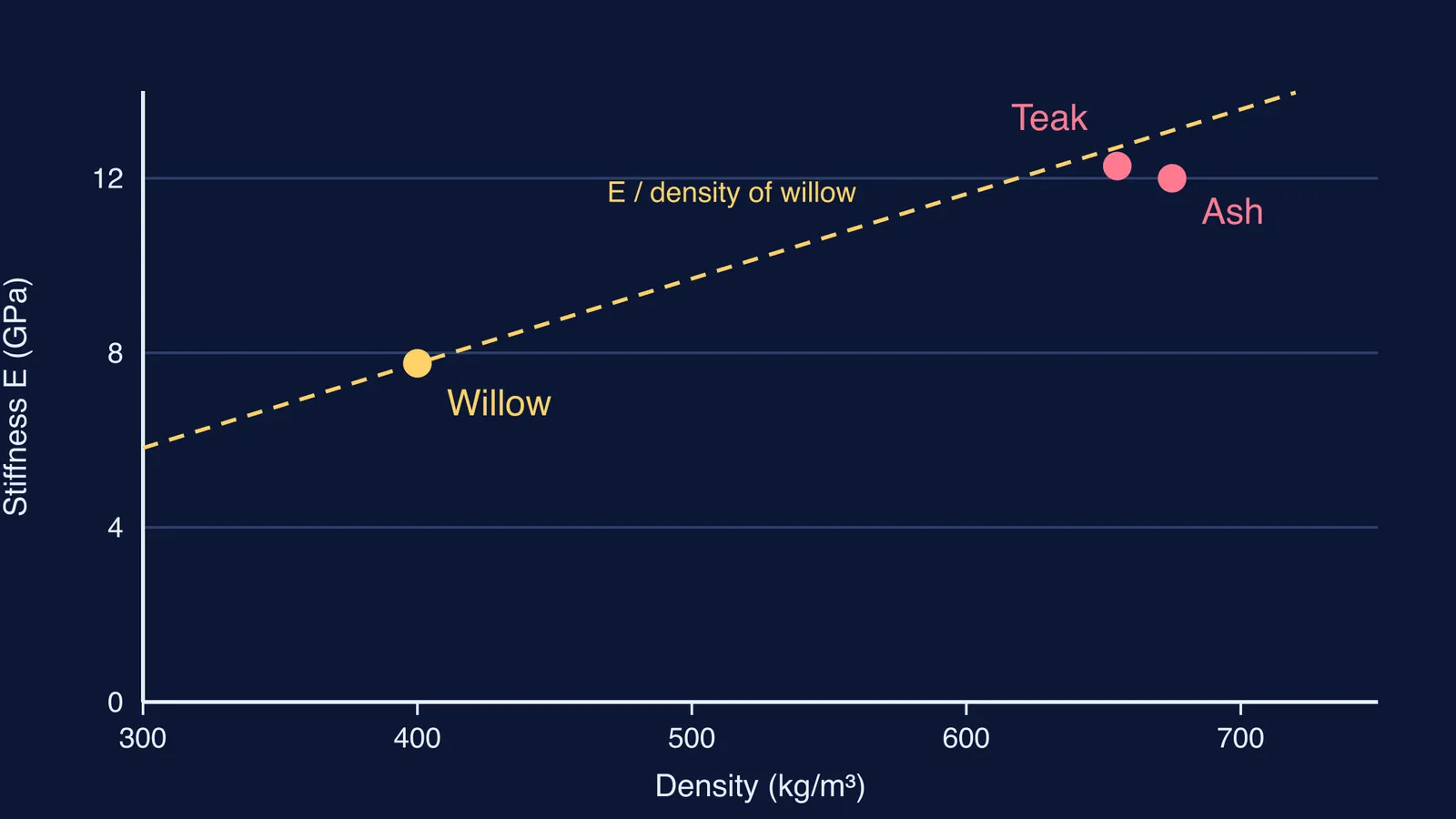
Here is a worked example you can check with a calculator, using figures from the Wood Database for white willow, teak and white ash, a baseball-bat wood.
Density: willow 400 kg/m³, teak 655 kg/m³, ash 675 kg/m³.
Stiffness: willow 7.76 GPa, teak 12.28 GPa, ash 12.00 GPa.
Stiffness per unit density (GPa per 1,000 kg/m³): willow 7.76 ÷ 0.400 = 19.4; teak 12.28 ÷ 0.655 = 18.7; ash 12.00 ÷ 0.675 = 17.8.
Same shape, different wood: suppose a willow bat weighs 1.2 kg. Mass scales with density, so a teak copy weighs 1.2 × 655 ÷ 400 ≈ 1.97 kg and an ash copy 1.2 × 675 ÷ 400 ≈ 2.03 kg.
Teak and ash are stiffer outright, but per kilogram willow comes out slightly ahead, and a two-kilogram bat would be slow to swing. Of these three woods, willow gives the most stiffness for the weight.
Bamboo is the serious challenger. A 2021 study by Ben Tinkler-Davies, Michael Ramage and Darshil Shah in the Proceedings of the Institution of Mechanical Engineers, Part P: Journal of Sports Engineering and Technology found laminated bamboo had a higher modulus of elasticity, a higher coefficient of restitution and a larger sweet spot than willow, though its higher density means the bat shape must be optimised to keep weight down. The University of Cambridge adds that willow takes up to 15 years to mature and bat makers often throw away up to 30% of the wood they source. But the MCC said on 10 May 2021 that bamboo is a grass, and that the Laws ban lamination of the blade except in junior bats, so a bamboo bat would need a change in the Laws to be legal.
How can you use this to study properties of materials?
The bat is a model for any "why is X made of Y" question. Use four steps:
Name the job: what force, impact or temperature must the object survive?
Pick the properties that matter for that job (density, stiffness, hardness, toughness).
Find real values from a data source and compare ratios, not just raw numbers.
Check the constraints: rules, cost, how long the material takes to grow or make.
Try it on a tennis racket frame or a bicycle helmet. If you would rather watch energy transfer than read about it, the Fermi Simulation Lab has interactive simulations for ideas that are easier to see than to read. To revise elasticity, density or Young's modulus from the ground up, each concept has its own lesson in the Fermi Concept Library.
Next time you watch an innings, listen for the sound of a clean hit. Behind it are air-filled cells and long fibres doing their job.