

On this page
Any family that hangs out white school shirts has seen it: after a few months the collar and the body take on a dull, creamy look, even when the shirt is clean. The old fix is a few drops of liquid blue (neel) in the last rinse. The modern fix is already in your detergent. Both rely on the same idea from your physics syllabus: complementary colours.
Why do white clothes turn yellow?
The main suspect is your own skin. It makes an oily secretion called sebum, and some of it stays in the fibres after every wash. A wear-and-wash study of white dress shirts in the Journal of the Korean Home Economics Association followed shirts washed at home in 20 households for six months. Leftover sebum tracked yellowing closely (correlation 0.98), much more than leftover protein soil (0.58).
So a yellowed shirt is not dirty in the usual sense. It reflects slightly less blue light than red and green light, and your eye reads that imbalance as yellow.
Why does adding blue make white clothes look whiter?
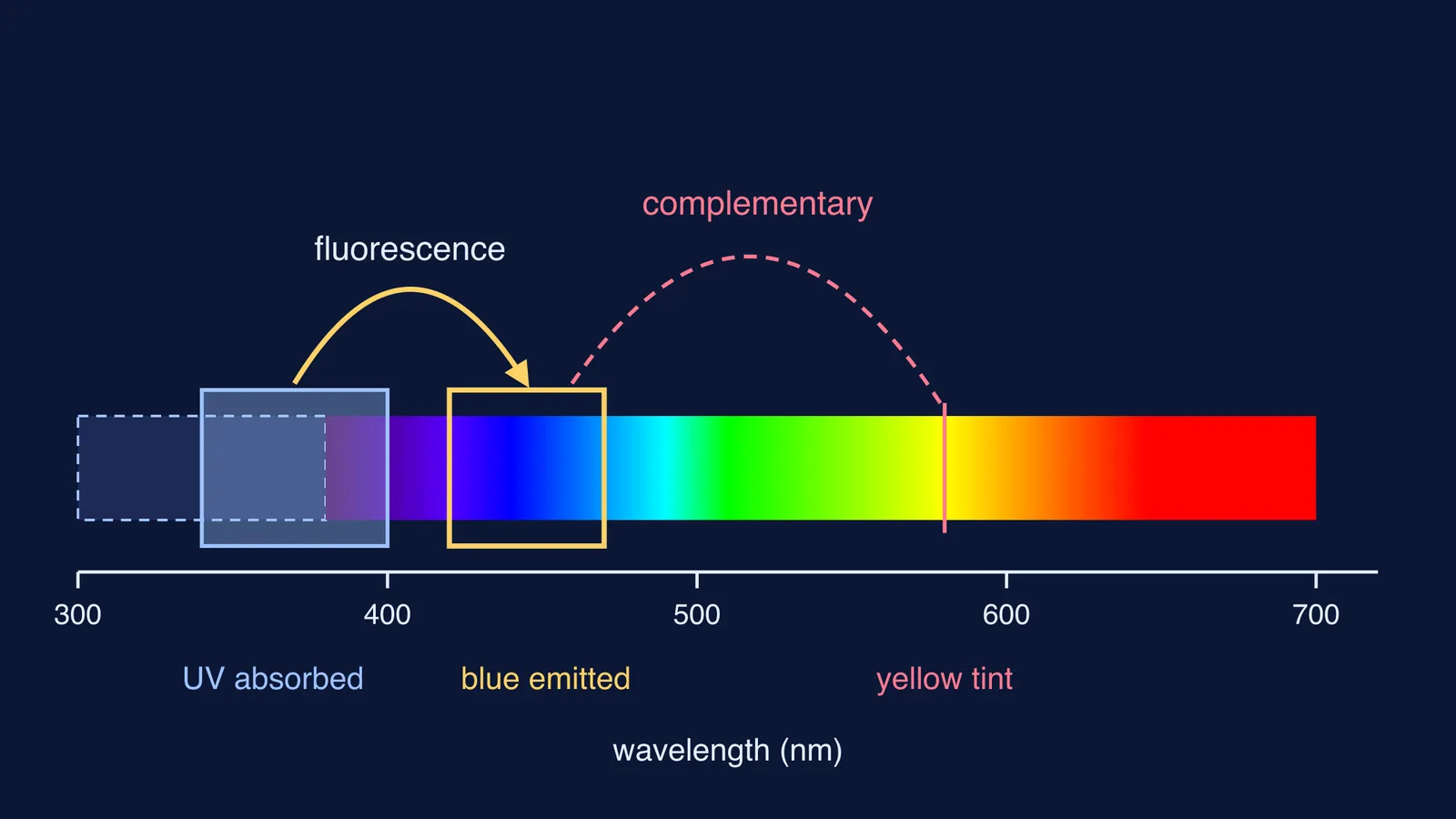
Two colours that produce white when added together are called complementary, and yellow is the complement of blue, according to HyperPhysics at Georgia State University. Yellow light is what you see when red and green arrive without enough blue. Put the blue back and you have red, green and blue in balance: white.
Laundry blue does this with a dye. The blue particles absorb a little of the red and yellow light, so the cloth now reflects all colours in roughly equal amounts. Strictly, the cloth reflects slightly less light overall, but because the tint is gone your brain files it as "whiter", not "darker".
Manufacturers have known people like this effect for decades. A 1973 Colgate-Palmolive patent on laundry bluing dyes states: "The average person appears to favor white articles, such as washed fabrics, which have a slight blue cast to them."
If you want to feel complementary colours in your own eyes, try the experiment in our post on why staring at red gives a green afterimage. The cone cells behind it are explained in how our eyes see so many different colours.
How do optical brighteners in detergent work?
Optical brighteners are fluorescent compounds: a 2024 paper in Toxics describes them as molecules that can be excited in the 340–400 nm range, absorbing ultraviolet light and emitting visible blue–violet light. The same paper notes that the most commonly used ones are stilbene derivatives, and that brighteners are widely used in detergents, textiles, paper and plastics.
The human eye typically detects wavelengths from 380 to 700 nanometres, according to NASA. So much of what a brightener absorbs is light you can barely see or cannot see at all, and it hands it back as blue light you can see. Unlike a dye, it adds light instead of removing it, which is why brightened whites can look almost luminous in sunlight.
The effect is large. In a 2012 Dyes and Pigments study, untreated cotton scored a CIE whiteness index of 81; cotton treated with 0.25% of two new stilbene brighteners scored 144 and 139.
It also fades. A 2014 study in Tenside Surfactants Detergents washed cotton with detergent containing stilbene and biphenyl brighteners, exposed it to artificial light, and found considerable sensitivity to light. That suggests one reason a brightened white does not stay brilliant forever.
If you want the chemistry of the detergent itself, see the difference between soap and detergent.
Blue dye or brightener: which one is doing the work?
Here is a quick way to tell them apart:
Laundry blue (dye): subtracts light. Needs no ultraviolet, so it works under any lamp. Too much turns the cloth visibly blue.
Optical brightener (fluorescent): adds blue light made from ultraviolet. It needs ultraviolet to work, so the glow is strongest in daylight.
Bleach: actually breaks down the coloured compounds, so it changes the stain itself rather than hiding it.
A ten-minute test at home
Take one new white T-shirt and one old, yellowed one.
Look at both in daylight near a window. The new one often looks brighter and slightly blue-white.
In a dark room, shine a UV torch (the kind used to check currency notes) on both. Never point it at anyone's eyes.
If the new shirt carries a brightener, it glows blue. That glow is fluorescence.
Wash the old shirt a few times with a detergent that lists an optical brightener, then look again.
Note what you saw and which idea explains it: complementary colours or fluorescence.
Additive colour mixing is one of those ideas that is easier to see than to read. The Fermi Simulation Lab has interactive simulations for ideas like this, and the Fermi Concept Library has a lesson on each concept, including light and colour, if you want to revise the theory behind your observations.


