On this page
You press the starter, the engine turns over slowly, coughs and dies. In the afternoon sun, the same bike starts first time. Often nothing is broken. Three pieces of school science are working against you at once: evaporation, viscosity and the effect of temperature on reaction rates.
Why is a bike hard to start on a cold morning?
An engine needs three things to start: a mix of fuel vapour and air that a spark can light, a crankshaft that turns freely, and enough electrical power to turn it and make the spark. Cold weakens all three.
Less petrol evaporates, so the mixture can be too lean to light.
Engine oil thickens, so the engine is harder to turn.
The battery's chemical reactions slow down, so it delivers less just when the starter needs more.
Why does cold petrol not light easily?
A spark lights fuel vapour, not liquid. Petrol is a blend of hydrocarbons, mostly with four to twelve carbon atoms per molecule (Wikipedia: Gasoline), and how readily they evaporate is measured by vapour pressure, which falls as the temperature drops.
That is why refiners change the recipe with the seasons. Winter-grade petrol has a higher vapour pressure to improve cold-weather starting (Wikipedia: Gasoline). As the US Energy Information Administration puts it, "in cold weather, higher volatility helps engines start more easily" (EIA).
Engines make up for it by adding extra fuel when cold, so enough evaporates; on a carburettor bike, that is the choke's job. Engineers call this mixture enrichment. A 1992 paper by Gardiner and colleagues assessed its environmental cost and tested an alternative (SAE Technical Paper 920011).
Why does cold engine oil make the starter struggle?
Viscosity is a fluid's resistance to flowing. Cold oil is thicker, and the starter has to drag the moving parts through it before the engine can fire.
The "W" in an oil grade such as 10W-30 stands for winter: it rates how the oil flows when an engine starts from cold (R. David Whitby, STLE TLT, 2017). Under the SAE J300 standard, every 0W oil must have a cold-cranking viscosity below 6,200 mPa·s at −35°C (same source).
Why does a cold battery give less power?
A battery makes electricity from chemical reactions, and most reactions slow down in the cold. The Arrhenius equation, k = A·e^(−Ea/RT), links a reaction's rate constant k to the absolute temperature T (LibreTexts Chemistry). A common rule of thumb, which LibreTexts warns is not generally true, is that a 10°C rise roughly doubles a reaction's rate.
Lead-acid battery capacity falls by about 1% per degree below about 20°C (PVEducation).
Starting power is rated in cold cranking amps: the current a 12 V battery can deliver at −18°C for 30 seconds without dropping below 7.2 V (Battery University). A battery low on charge is also more likely to freeze than a fully charged one (Battery University).
Worked example: a 30°C afternoon vs a 5°C morning
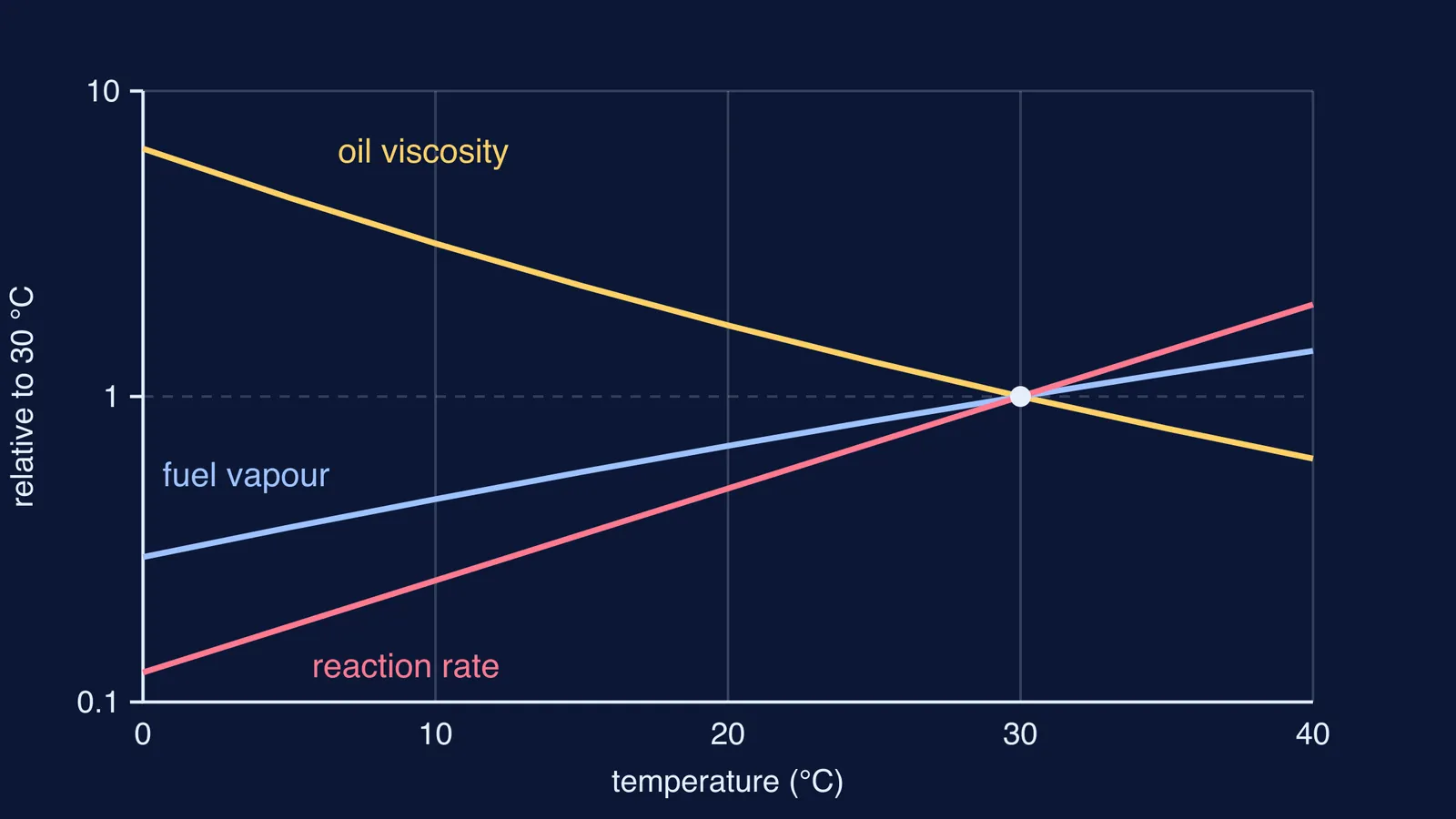
Here is what the sources above predict for a 25°C drop. Real engines differ; the size of each effect is the point.
Fuel vapour. Pentane is a five-carbon hydrocarbon of the kind found in petrol. NIST's Antoine equation for n-pentane (NIST Chemistry WebBook) gives a vapour pressure of about 0.82 bar at 30°C and about 0.31 bar at 5°C, roughly 37% of the afternoon value.
Oil thickness. A 10W-30 bike oil measures 70.7 mm²/s at 40°C and 10.8 mm²/s at 100°C (Mobil data sheet). Extending those two points with the ASTM D341 viscosity-temperature equation (summary of ASTM D341) gives an estimate of about 113 mm²/s at 30°C and about 505 mm²/s at 5°C, roughly 4.5 times thicker.
Battery reactions. A reaction that follows the doubling rule (LibreTexts) would run at about 2 to the power −2.5, or 18%, of its afternoon rate after a 25°C drop. A battery's usable capacity falls far less: by the 1% rule (PVEducation), it is about 15% below its rating at 5°C.
So on that morning a pentane-like fuel gives off about a third of the vapour, the oil is roughly four and a half times thicker, and the battery is weaker. Together they give you the slow, coughing start.
If ideas like these are hard to picture, the Fermi Simulation Lab has interactive simulations for ideas that are easier to see than to read. The Fermi Concept Library gives every concept in physics and chemistry its own lesson.
What can you do on a cold morning?
Follow your owner's manual first. Then, from the science above:
Use the choke if your bike has one, and switch it off once the engine runs smoothly, because running rich carries an environmental cost.
Use the oil grade the manual specifies; for cold starts, the number before the W is the one that matters.
Keep the battery charged, since a charged battery has more to give and is less likely to freeze.
Park under cover where you can, because anything that keeps the engine a little warmer helps all three problems.
Next time the bike coughs on a winter morning, you are watching evaporation, viscosity and reaction rates at work.