

On this page
If you have ever accidentally touched a dilute solution of sodium hydroxide or bleach in a chemistry lab, you might have noticed it feels surprisingly smooth or slimy. This isn't because the chemical itself is slippery. It feels that way because you are literally touching newly formed soap.
Why do bases feel slippery on the skin?
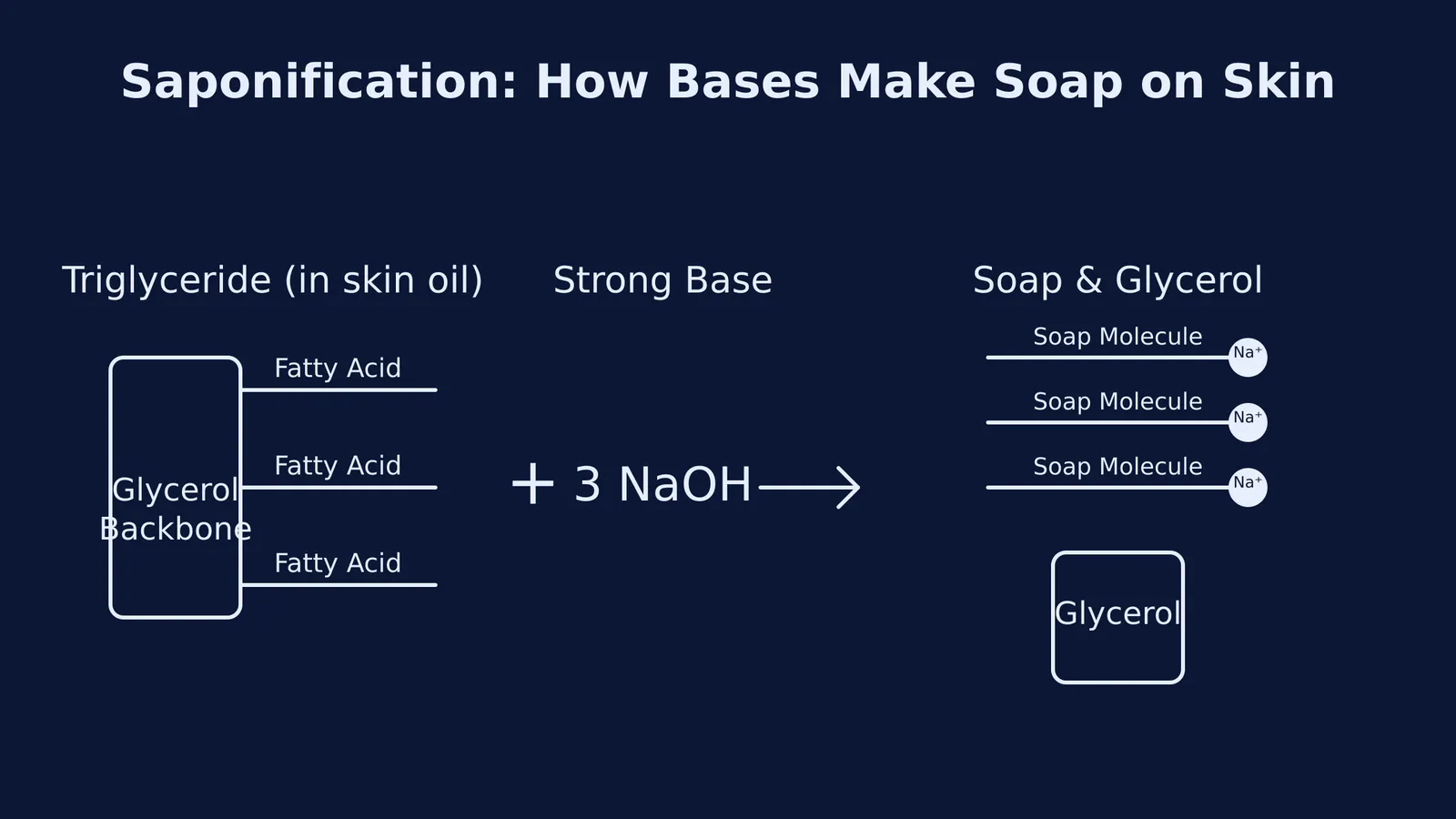
Your skin naturally produces sebum, an oily substance that contains lipids known as triglycerides. A triglyceride is formed from one glycerol molecule bound to three fatty acids. When a strong base like sodium hydroxide (NaOH) comes into contact with these oils, it triggers a chemical reaction called saponification. The base breaks the ester bonds in the triglycerides, converting them into glycerol and fatty acid salts. Those fatty acid salts are the exact same molecules found in a bar of soap. Because the soap molecules are surfactants, they reduce friction. The slippery sensation is literally the feeling of those newly formed soap molecules acting as a lubricant between your fingers.
Why are strong bases more dangerous than acids?
While making soap on your hands might sound like a harmless trick, this exact chemical process is what makes alkaline chemical burns uniquely destructive and difficult to treat.
When a strong acid touches the skin, it typically causes what pathologists call coagulative necrosis. The acid leads to cytotoxicity and the precipitation of proteins in the tissue. This causes the proteins to clump together and form a tough, dry barrier known as an eschar. According to clinical guidelines in the National Center for Biotechnology Information's StatPearls, this protein precipitation creates a coagulum that actually helps limit further absorption of the chemical. Because this scab physically blocks the acid, the damage is often restricted to the more superficial layers of the skin, preventing deeper toxicity.
Bases, however, cause liquefactive necrosis. The hydroxide ions (-OH) in the alkali cause irreversible changes to the protein matrix and vascular structures, as detailed in NCBI StatPearls. Because the alkali saponifies the skin's protective fats and dissolves structural proteins, it turns the solid tissue into a soft, gelatinous mass. Since it melts away the cell membranes rather than hardening them into a protective coagulum, the chemical is not stopped by a physical barrier. It continues to penetrate deeper into the underlying tissue, causing progressive damage if not thoroughly washed away.
What should you do if you touch a strong base?
Because bases penetrate so deeply through liquefactive necrosis, the standard first aid for an alkaline chemical burn is immediate and copious irrigation with water. The primary goal is to physically wash away the chemical and stop the ongoing saponification and tissue destruction.
Medical guidelines emphasize that the primary treatment for external chemical burns is thorough and copious irrigation of the affected areas. If the chemical contacts the eye, immediate and exhaustive rinsing is mandatory to prevent severe vision loss.
It might be tempting to use a weak acid, such as vinegar or lemon juice, to neutralize the strong base on your skin. However, medical professionals strongly advise against introducing neutralizing agents. According to StatPearls, attempting to neutralize the chemical can exacerbate the situation. Acid-base neutralizations are highly exothermic, meaning they release a sudden burst of heat. This heat can add a severe thermal burn on top of the existing chemical injury, causing increased tissue damage. The safest and most effective method is always dilution and mechanical removal with plain water.
Learning the chemistry behind the reaction
Organic chemistry often feels like an endless list of named reactions to memorise. But when you connect a term like saponification to a physical sensation—like understanding exactly why a base feels slimy on your fingers—it becomes a permanent piece of your chemical intuition.
If you are revising organic reactions, lipid structures, or the properties of acids and bases, you can explore these mechanisms in the Fermi Concept Library. Rather than just handing you the final products of a chemical reaction, Fermi teaches by holding a line of reasoning. The AI tutor works through problems alongside you, helping you trace the movement of electrons and ions step by step, so you understand exactly how ester bonds are broken during saponification.
When you practice application questions in the Fermi Problem Library, the tutor notices where you are stuck and decides whether to explain, ask, or show. It checks your understanding as it goes, asking you to predict intermediate steps—like the formation of the coagulum during acid burns—instead of just waiting for the final answer. This active approach builds the kind of deep conceptual clarity that memorisation alone cannot provide.


