

On this page
Before astronauts step outside the International Space Station, they rehearse the job at the bottom of a very large pool. According to ESA's spacewalk training page, full spacewalk training for the station is traditionally done at NASA's Neutral Buoyancy Laboratory in Houston and at Russia's Gagarin Cosmonaut Training Center.
The trick is a balance of two forces. Get it right and a person in a bulky suit hovers in the water, which ESA calls the closest you can get to microgravity on Earth.
What does neutral buoyancy mean?
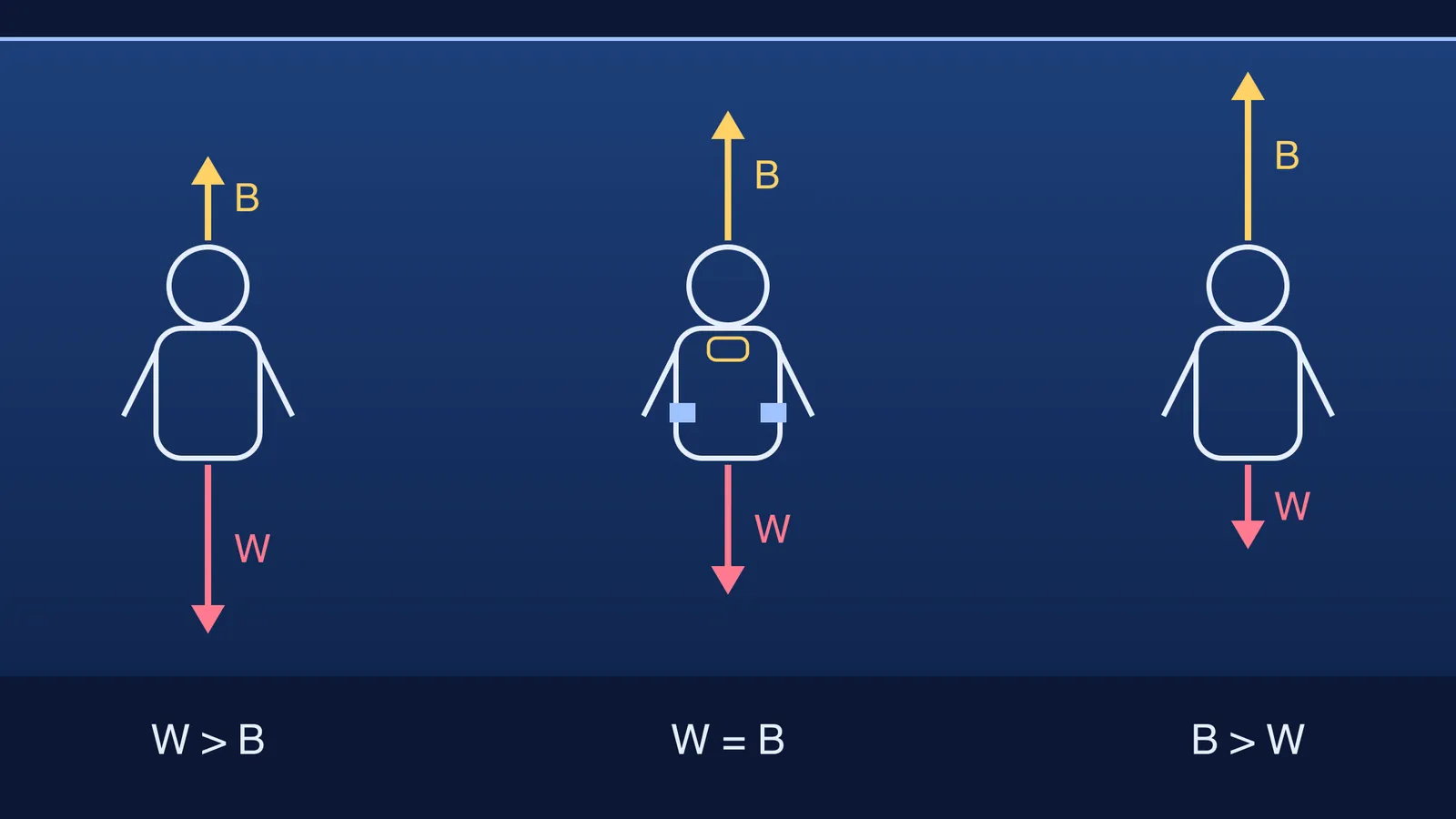
Two forces act on anything under water. Its weight pulls it down. The water pushes it up with the buoyant force, which by Archimedes' principle equals the weight of the water the object displaces.
If the weight is bigger, the object sinks.
If the buoyant force is bigger, it rises.
If the two are equal, the net force is zero and it stays where you put it.
That third case is neutral buoyancy. NASA's fact sheet on the facility defines it as "the equal tendency of an object to sink or float" and says an item balanced "through a combination of weights and flotation devices" will seem to hover under water.
The buoyant force depends on how much water is pushed aside, not on depth, so an object that does not squash stays balanced at any depth. We explain why in does buoyant force change with depth.
Why does floating in a pool feel like space?
In orbit, gravity has not switched off. Astronauts float because they and the station are falling around Earth together; our explainer on why astronauts feel weightless in orbit walks through it, and why astronauts float in the space station covers the view from inside.
In the pool, the water's upward push cancels gravity instead. The same NASA fact sheet says that in this state "even a heavy object can be easily manipulated, much as it is in the zero gravity of space."
How big is NASA's astronaut training pool?
NASA's Neutral Buoyancy Laboratory page lists the pool as 61.5 metres long, 31.1 metres wide and 12.2 metres deep. It holds 6.2 million gallons of chlorinated fresh water kept at 28.9 to 30 °C, roughly 23 million litres. The same page says the NBL has a professional diving staff and an on-site hyperbaric chamber.
The NASA fact sheet notes that the International Space Station, at 350 ft by 240 ft when complete, will not fit inside, so crews train on mock-ups of sections.
The training is long. ESA's training page quotes Swedish astronaut Christer Fuglesang: "One EVA run lasts around 5 hours, and the standard right now is that you spend five to seven times as long in the NBL at Houston for each EVA, depending on the difficulty." EVA (extravehicular activity) means a spacewalk.
What can a pool not copy about space?
NASA's fact sheet names two important differences, and ESA mentions the same two.
You still feel your weight inside the suit. The water pushes on the outside of the suit, so the suit as a whole hovers. Your body inside still rests on whichever part of the suit is below you.
Water drag slows every movement. Push a box in orbit and it keeps drifting, as Newton's first law says. Push it in a pool and the water soon stops it. NASA says this makes some tasks easier and others harder than in space, so trainers have to allow for it.
Even so, NASA's fact sheet calls neutral buoyancy the best method currently available for spacewalk training.
Worked example: how much weight does a suit need?
These are round numbers for easy arithmetic, not real suit data, worked with Archimedes' principle.
Say a suited trainee displaces 0.25 cubic metres of fresh water. At about 1,000 kg per cubic metre, the buoyant force equals the weight of 250 kg.
Say the trainee plus training suit has a mass of 230 kg. The buoyant force wins by the weight of 20 kg, so they rise.
Add about 20 kg of weights, plus a little extra, because the weights displace some water too. Now weight equals buoyant force and they hover.
If the suit had been heavier than 250 kg, you would add foam floats instead.
Place the weights and floats so the trainee does not tip. If weight and buoyancy act at different points, they twist the body until one point sits directly above the other.
To change mass and volume and watch the forces shift, the Fermi Simulation Lab has interactive simulations for ideas that are easier to see than to read.
Next time you see a photo of an astronaut in a pool, look for the weights and floats on the suit: that is Archimedes doing the work.


