

On this page
Most people assume that astronauts float on the International Space Station (ISS) because they have travelled far enough away from Earth to escape its pull. However, gravity is everywhere in the universe. At the station's cruising altitude of roughly 250 miles (400 kilometres) above Earth, the pull of gravity is still about 90% as strong as it is on the ground, according to NASA.
So why do astronauts look and feel completely weightless? The answer lies in the physics of free fall and the mechanics of orbital motion.
Is there gravity in space?
Yes. Gravity is the fundamental force that keeps the Moon in orbit around the Earth and the Earth in orbit around the Sun. If gravity simply vanished in space, the Moon, the planets, and the International Space Station would all fly off in straight lines.
To understand what is happening, it helps to separate mass from weight. Your mass is the total amount of matter in your body, and it remains the same no matter where you are in the universe. Your weight, however, is a measurement of how hard gravity is pulling your mass against a surface (like a floor or a weighing scale).
Instead of escaping gravity, the space station and everything inside it—including the astronauts—are falling toward Earth. Because they are all falling at the exact same rate, there is no contact force pushing up against their feet to create the feeling of weight. This lack of a supporting normal force creates the sensation of weightlessness, a condition NASA officially refers to as microgravity.
Why do astronauts float in the space station?
Imagine jumping off a diving board or being at the peak of a roller coaster drop. For the brief moment you are in the air, you are in free fall. If you dropped an apple at the same time, it would fall right beside you. From your perspective, the apple would appear to be floating, because both you and the apple are accelerating downwards at exactly the same rate.
This is exactly what is happening in the space station, just on a much larger scale. The station is falling, and the astronauts are falling inside it. Because the "floor" of the station is dropping away exactly as fast as the astronauts are falling, they never actually hit it.
How orbit works: the Newton's cannonball thought experiment
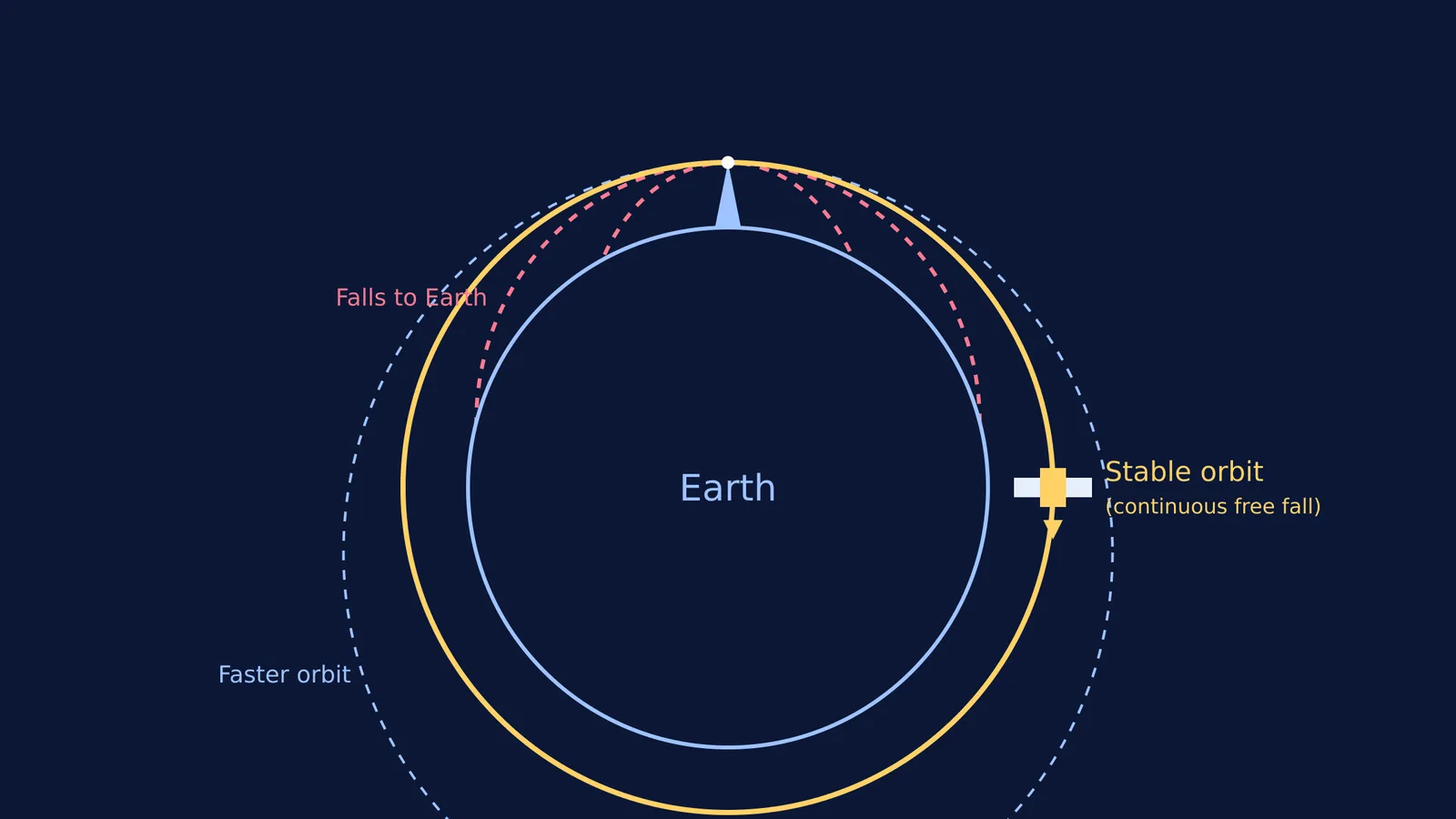
If the station is always falling, why does it never hit the ground? Sir Isaac Newton explained this with a thought experiment that remains the clearest way to picture an orbit.
Imagine a cannon placed on a remarkably tall mountain. If you fire a cannonball at a slow speed, it travels forward for a bit and then curves down to hit the ground. If you fire it faster, it travels further across the surface before eventually landing. This same principle applies when figuring out the equation of trajectory of a projectile, where gravity is the only force acting on the object after it is launched.
Now, imagine firing it fast enough—at about 17,500 mph (28,000 km/h) for the ISS, according to NASA. At this extreme speed, the cannonball is moving sideways so quickly that as it falls, the curved surface of the Earth drops away beneath it at the exact same rate. It is constantly falling, but it keeps missing the ground. This state of continuous free fall is what we call an orbit.
Visualising how falling forward turns into a stable orbit can be difficult because we are so used to seeing things hit the ground. For the ideas that are easier to see than to read, the Fermi Simulation Lab has interactive simulations.
What happens to the body in microgravity?
Living in continuous free fall has significant effects on the human body. Because astronauts do not have to use their muscles to stand up or walk against the pull of gravity, their bodies quickly adapt to the reduced workload.
Without regular resistance, muscles begin to shrink and bones lose density, becoming weaker over time. To counteract this, astronauts on the space station must use specialised equipment that simulates the resistance they would normally feel on Earth. NASA studies these changes closely to ensure astronauts can remain healthy during long-duration missions to places like Mars.
A practical framework for apparent weight problems
The concept of astronauts floating is a classic example of apparent weight, which is a standard topic in JEE and NEET physics. Your apparent weight is simply the normal force pushing back on you. When you are in free fall, the normal force is zero, so your apparent weight is zero.
Here is a straightforward framework you can use to solve apparent weight problems, whether the question asks about a person in an accelerating elevator or a car driving over a hump:
Draw the free-body diagram: Identify the true weight (mg) pulling downwards and the normal force (N) pushing upwards from the surface.
Determine the acceleration: Is the system accelerating up, down, or moving at a constant velocity? For circular motion (like an orbit or driving over a curved bridge), the acceleration is v²/r directed towards the centre of the circle.
Write Newton's second law: Set up the equation ∑F = ma.
If the object is accelerating downwards (like an elevator dropping): mg − N = ma, which rearranges to N = m(g − a).
If the object is in free fall (a = g): N = m(g − g) = 0. The apparent weight is zero.
If you are stuck on setting up these equations or deciding which direction the acceleration points, Fermi's AI tutor can draw the figure and explain the reasoning step by step. Understanding this core idea is key to mastering mechanics: floating does not mean the forces have disappeared, only that the ground is falling away just as fast as you are.


