

On this page
Wet a fingertip, run it slowly round the rim of a thin glass, and a clear, steady note fills the room. It looks like a party trick, but it is two ideas from school physics working together: friction and resonance.
What happens when you rub a wet finger on a glass?
Your finger does not slide smoothly. It sticks to the glass for an instant, drags the rim a tiny distance, slips free, then sticks again. Physicists call this stick-slip motion, and every slip gives the rim a small kick.
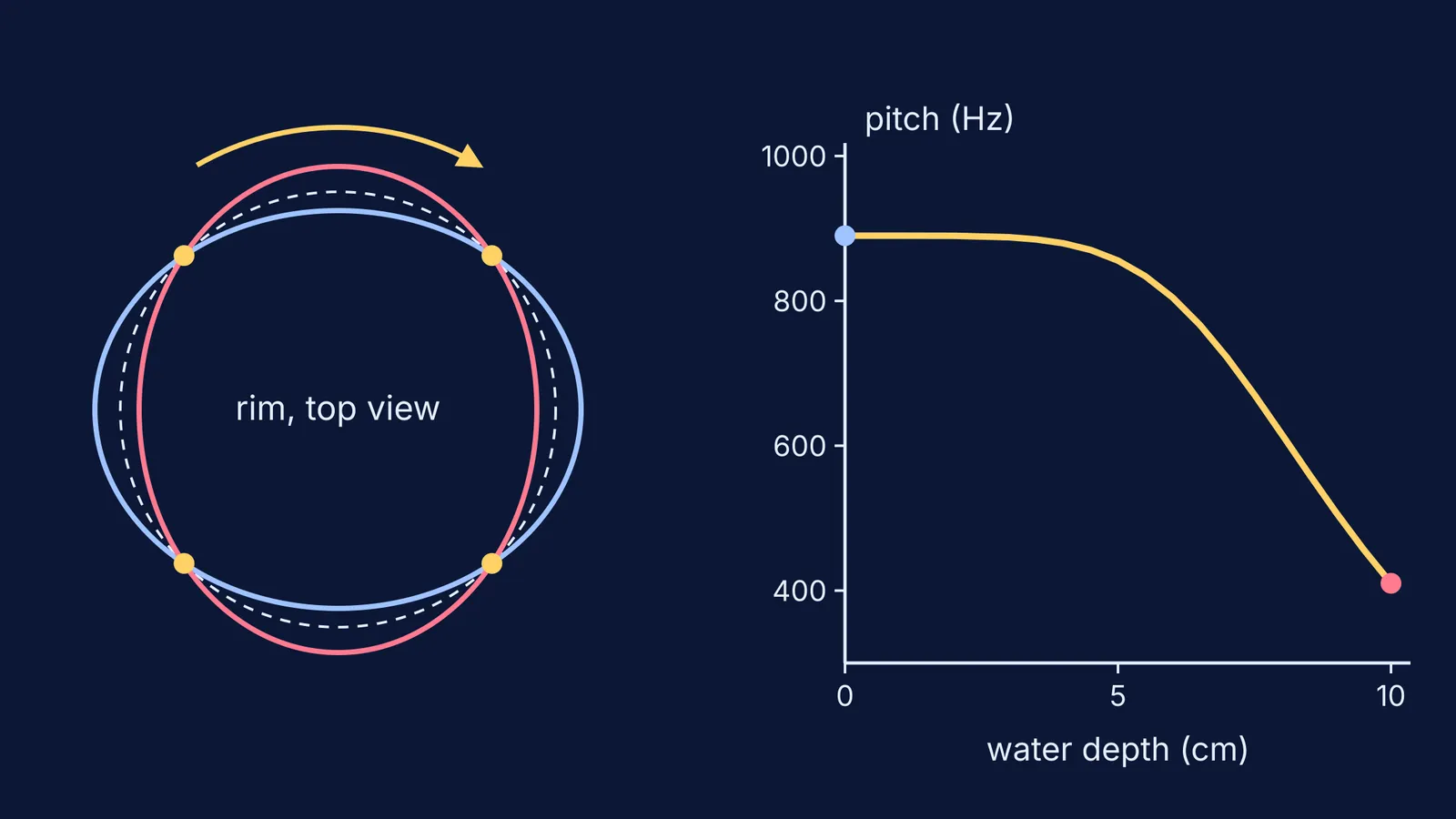
A glass, like a guitar string or a swing, has a natural frequency: the rate at which it vibrates on its own after you disturb it. For a wine glass, the main way of vibrating squeezes the rim into an oval, then into the opposite oval, while four points on the rim stay still. A 2006 paper in the Journal of the Acoustical Society of America by Gregor Jundt and colleagues calls this the (2,0) mode, a simple elliptical squeeze of the cup, and notes that the vibration pattern follows your finger round the rim.
The key is timing. The rim's motion changes how hard it pushes on your finger, so sticking and slipping fall into step with the natural frequency. Each kick arrives at the right moment and the glass rings. That is resonance, the same idea as pushing a swing in time.
A review of the acoustics of friction by Adnan Akay of Carnegie Mellon University describes this feedback between friction and the vibrations it causes, with violin music and car brake noise as everyday examples.
Why does the finger have to be wet?
A dry fingertip grips too much to let the rim slip cleanly. The Science Buddies activity published by Scientific American explains that the water on your finger forms a cushion that reduces friction, so the finger can slip as well as stick. The same activity suggests washing your hands with dish soap first and, if you hear nothing, changing your speed and pressing more or less firmly.
Why does more water make the note lower?
Think of the glass wall as a spring with a mass on it, where frequency is f = (1/2π)√(k/m). Adding water barely changes the stiffness k of the glass, but the water next to the wall has to move with it, which adds to m. Bigger mass, lower note.
Jundt and colleagues measured this. In their 2006 study, the main note of an empty glass was close to 900 Hz and the full glass sat at about 415 Hz, more than an octave lower. The first few centimetres of water barely changed the note; it fell steeply only as the water reached the upper cup, where the walls move most. With liquids from isopropanol (0.79 kg/L) to dichloromethane (1.32 kg/L), denser liquids pulled the note down further, as the spring-mass picture predicts.
Worked example: how much heavier does the glass act?
From f = (1/2π)√(k/m), frequency goes as 1/√m when k stays fixed, so m₂/m₁ = (f₁/f₂)².
Use the study's numbers: f₁ ≈ 900 Hz (empty), f₂ ≈ 415 Hz (full).
f₁/f₂ ≈ 2.17.
(2.17)² ≈ 4.7.
So the full glass vibrates as if it were nearly five times heavier. This is a simplified estimate; the paper's model weights each layer of water by how much the wall moves at that height.
Our post on blowing over a bottle as the water level changes covers the air-column side.
How can you test it at home?
You need one thin, stemmed glass, a jug of water, a ruler and a free tuner app on a phone.
Stand the glass on a steady table and hold the base flat.
Wash your hands, then wet one fingertip.
Circle the rim slowly with light, even pressure until it sings. Note the pitch.
Add water about 1 cm at a time, recording depth and pitch each time.
Before you start, predict where the pitch will fall fastest. Then plot pitch against depth and check.
Watch the water surface as the glass sings: small ripples should follow your finger.
Which physics ideas does a singing glass connect?
The singing glass ties together natural frequency, forced oscillations and resonance in one object you can hold. If free and driven oscillators still blur together, read our guide to damped and forced oscillations and resonance graphs, then try making a straw oboe to hear pitch change.
Resonance is easier to see than to read, which is what the Fermi Simulation Lab is for: interactive simulations of ideas like this one. If the spring-mass formula itself is the gap, the Fermi Concept Library gives each concept its own lesson.
Tonight, wet a finger, find a glass and listen. Then add water and check whether the pitch falls the way the formula says.


