

On this page
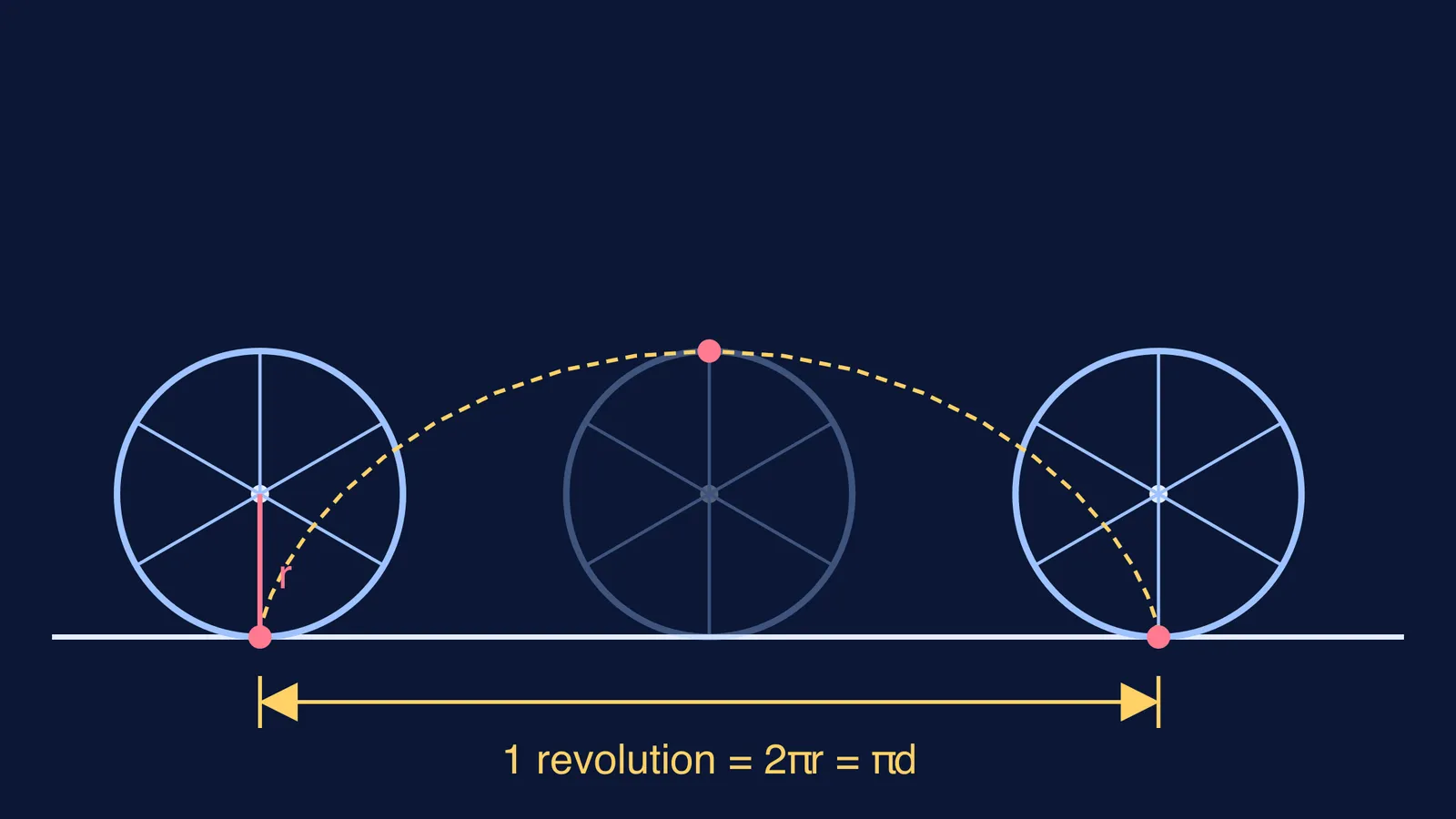
Wheel questions turn up in school maths chapters on circles and again in physics when you reach rotational motion. They all rest on one idea: in one full turn, a wheel rolls forward by exactly its own circumference. After that, every version is one division plus careful units.
How many revolutions does a wheel make over a distance?
The circumference of a circle is C = 2πr = πd, where r is the radius and d is the diameter, as Wolfram MathWorld's entry on circumference sets out. Pi is the ratio of a circle's circumference to its diameter, about 3.14159, according to MathWorld's entry on pi.
When a wheel rolls without slipping, its outer surface "maps onto the ground by exactly the distance travelled", as the OpenStax University Physics chapter on rolling motion puts it. So one revolution moves the wheel forward one circumference, and:
Number of revolutions = distance ÷ circumference = distance ÷ πd
Worked example: a bicycle wheel has a diameter of 70 cm. How many complete revolutions does it make in 1 km?
Circumference = π × 70 cm ≈ 219.9 cm, or 220 cm if you use π = 22/7.
Put the distance in the same unit: 1 km = 100,000 cm.
Revolutions = 100,000 ÷ 219.9 ≈ 454.7.
The question asks for complete revolutions, so the answer is 454.
The hero diagram shows why this works: a point on the rim traces a looping path called a cycloid and touches the ground again exactly 2πr further on. For practice in this direction, see our guide to distance covered by a wheel in a given number of revolutions.
How do you convert speed to revolutions per minute?
Speed questions add time. Revolutions per minute (rpm) is the distance covered in one minute divided by the circumference.
The conversion factors are fixed: 1 h = 60 min = 3600 s, as NIST's Guide to the SI, Chapter 5 states. That makes 1 km/h = 1000 m ÷ 3600 s ≈ 0.2778 m/s, the factor in NIST's conversion table, Appendix B.9.
Worked example: a car with wheels 60 cm in diameter travels at 54 km/h. Find the wheel's rpm.
Speed: 54 km/h × 1000 ÷ 3600 = 15 m/s.
Circumference: π × 0.60 m ≈ 1.885 m.
Revolutions per second: 15 ÷ 1.885 ≈ 7.96.
Revolutions per minute: 7.96 × 60 ≈ 477.5 rpm.
Physics questions often want angular speed in radians per second instead. One revolution is 2π rad, and 1 rpm ≈ 0.1047 rad/s, according to the same NIST Appendix B.9 table. So 477.5 rpm × 0.1047 ≈ 50 rad/s. You can check this with v = rω from the OpenStax rolling-motion chapter: ω = 15 m/s ÷ 0.30 m = 50 rad/s. Two routes, one answer.
How do you go from rpm back to km/h?
Run the same steps in reverse, using C = 2πr from MathWorld. A wheel of radius 35 cm turns at 300 rpm. How fast is the vehicle moving?
Circumference: 2π × 0.35 m ≈ 2.199 m.
Distance per minute: 300 × 2.199 ≈ 659.7 m.
Distance per hour: 659.7 × 60 ≈ 39,580 m.
Speed: about 39.6 km/h.
If the metre-to-kilometre step still trips you up, the ×10 ladder for km, m, cm and mm is a quick fix.
Why does a small wheel turn more times than a big one?
Over the same distance, revolutions are inversely proportional to diameter, because circumference is π times diameter for every circle (MathWorld). A tractor's front wheel 80 cm across and its rear wheel 2 m across cover the same ground, so the front wheel turns 200 ÷ 80 = 2.5 times for every turn of the rear wheel. If the rear wheel makes 1,000 revolutions, the front wheel makes 2,500.
Our explainer on why circumference is π times diameter walks through why that ratio holds.
Where do students lose marks on wheel questions?
Before you write the final answer, check these five things:
Did you use the diameter with π, or the radius with 2π, and not mix them up?
Are the distance and the circumference in the same unit?
Is time in the unit the question asks for: per second, per minute or per hour?
Does the question say "complete revolutions"? Then round down, never up.
Does the answer make sense? As the car example shows, a car wheel at city speeds turns hundreds of times a minute, not a handful.
If you get the right method but keep landing on the wrong number, work through a few of these in the Fermi Problem Library, where a step-by-step solver explains the reasoning rather than just printing an answer. If the link between rolling and circumference still feels abstract, the Fermi Concept Library has a lesson on each idea, from circles to rotational motion.


