

On this page
The Sun and the Moon look almost the same size in our sky, but the match is not perfect. When the Moon is a little farther away than usual, it cannot quite hide the Sun, and you get a bright ring instead of darkness. Here is why, worked out with real numbers.
What is a ring of fire solar eclipse?
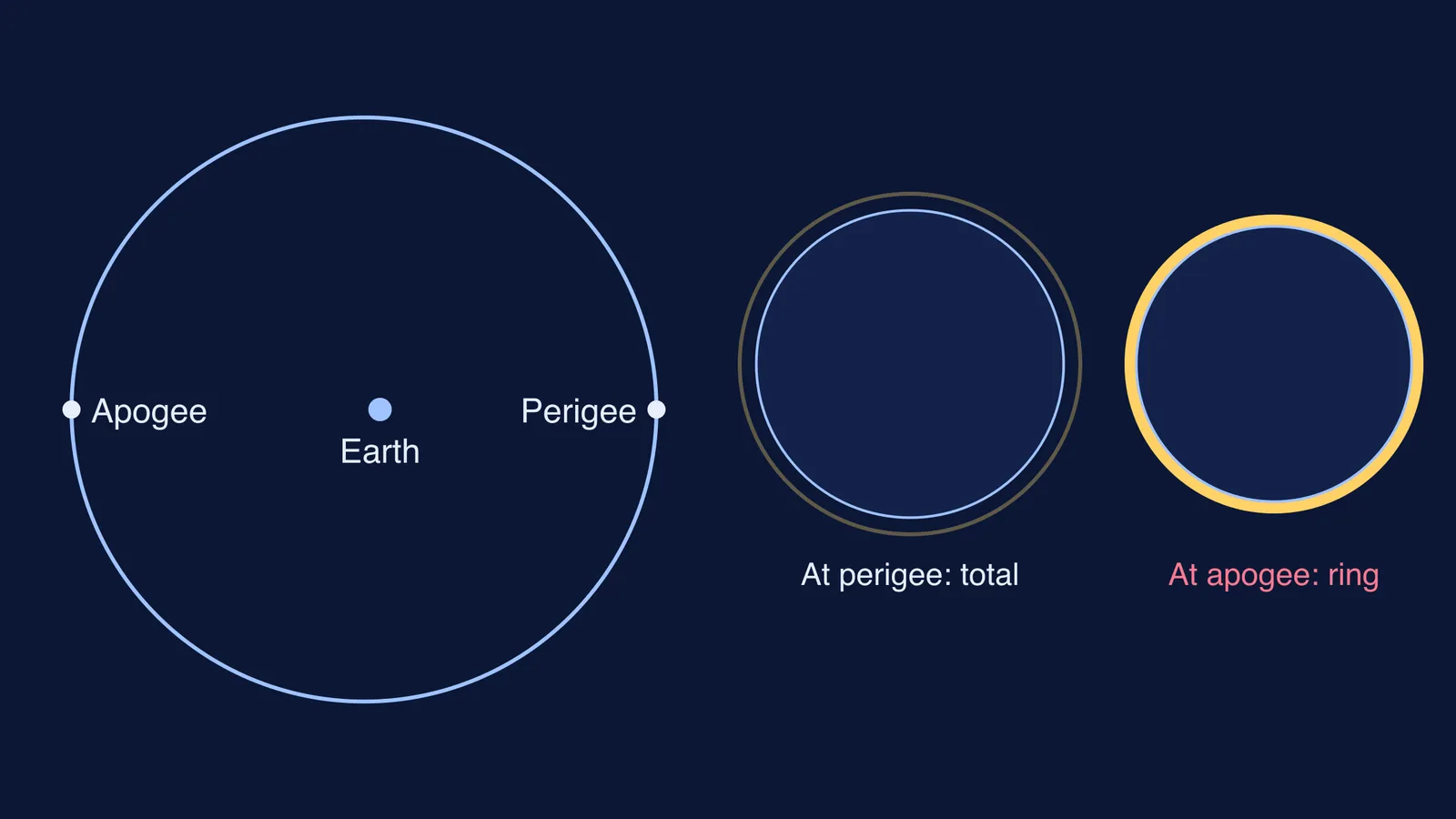
An annular solar eclipse happens when the Moon passes between the Sun and Earth while it is at or near its farthest point from Earth, as NASA's guide to eclipse types explains. Because the Moon is farther away, it appears smaller than the Sun and does not cover it completely. You see a dark disc sitting on a larger, bright disc. That ring of sunlight around the Moon is the ring of fire.
Why does the Moon sometimes look too small to cover the Sun?
Because the Moon's orbit is an ellipse, not a circle. NASA's Moon fact sheet gives a mean perigee (closest point) of 363,300 km, a mean apogee (farthest point) of 405,500 km and an orbital eccentricity of 0.0549. The same sheet notes that the actual Earth-Moon distance ranges roughly from 357,000 km to 407,000 km. Earth sits very nearly at one focus of that ellipse, the same geometry that Kepler's first law describes for planets around the Sun.
How big something looks depends on its size divided by its distance. The Sun's mean radius is 695,700 km (NASA Sun fact sheet) and the Moon's is 1,737.4 km (NASA Moon fact sheet), so the Sun is about 400 times wider. It is also about 389 times farther away: 149.6 million km against 384,400 km. The ratios nearly cancel, so small changes in distance decide the outcome.
The Sun's apparent size changes a little too. NASA's Sun fact sheet gives its apparent diameter as between 1,887 and 1,952 arcseconds, with a mean of 1,919 (one arcsecond is 1/3,600 of a degree).
Worked example: will an eclipse be total or annular?
You only need the small-angle rule: angular diameter in radians is roughly diameter divided by distance. Multiply by 206,265 to convert radians to arcseconds. All values come from the NASA Moon and Sun fact sheets.
Moon's diameter: 2 × 1,737.4 = 3,474.8 km.
At mean perigee: 3,474.8 ÷ 363,300 × 206,265 ≈ 1,973 arcseconds.
At mean apogee: 3,474.8 ÷ 405,500 × 206,265 ≈ 1,768 arcseconds.
Compare with the Sun's mean of 1,919 arcseconds. At perigee the Moon is bigger, so a total eclipse is possible. At apogee it is smaller, so you get a ring.
At apogee the Moon's diameter is 1,768 ÷ 1,919 ≈ 0.92 of the Sun's. Area goes as the square, so it hides about 0.92² ≈ 85% of the Sun's disc; the ring is the rest.
Now find the break-even distance: 3,474.8 × 206,265 ÷ 1,919 ≈ 373,500 km. Against an average-sized Sun, an eclipse with the Moon farther than this is annular. These figures are measured from Earth's centre; you stand on the surface, slightly closer to the Moon, so real predictions are a little more detailed.
The same size-over-distance idea explains why a full Moon near perigee is called a supermoon. Geometry like this is easier to see than to read: the Fermi Simulation Lab has interactive simulations for ideas of exactly that kind, and Fermi's AI tutor can draw the figure and check your understanding as it goes.
When can you see a ring of fire eclipse from India?
NASA's eclipse catalogue lists an eclipse magnitude for each event, defined as the fraction of the Sun's diameter covered by the Moon; for annular eclipses it is always less than 1 (NASA eclipse table, 2031-2040).
26 December 2019: annular, with a path across Saudi Arabia, India, Sumatra and Borneo, magnitude 0.970 and up to 3 min 39 s of ring (NASA, 2011-2020).
21 June 2020: annular across central Africa, south Asia, China and the Pacific, magnitude 0.994 and only 38 s of ring (NASA, 2011-2020).
21 May 2031: the next annular path listed across southern India (none crosses India in 2021-2030), also crossing Angola, Congo, Zambia, Tanzania, Malaysia and Indonesia, magnitude 0.959 and up to 5 min 26 s (NASA, 2031-2040).
A small project for 2031: note the magnitude of 0.959, then use step 5 above to estimate how much of the Sun's area stays uncovered (about 8%).
How do you watch an annular eclipse safely?
During an annular eclipse there is no moment when it is safe to remove protection, because part of the Sun is always showing. NASA says to always use eclipse glasses or another safe solar viewing method. Our guide on how to watch a solar eclipse safely at home walks through the options.
Mark 21 May 2031 in your calendar, and bring your eclipse glasses.


