

On this page
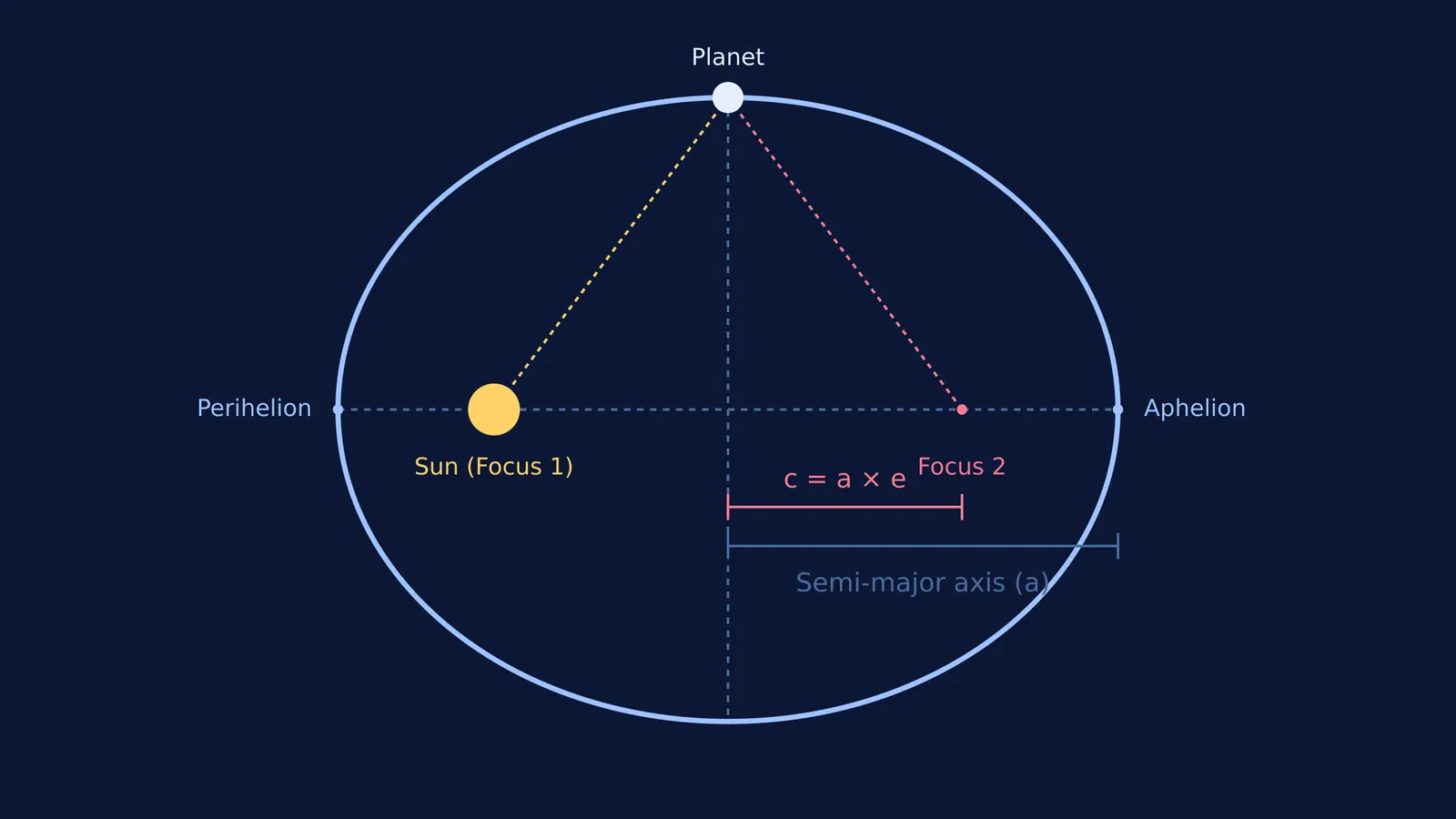
When Johannes Kepler analysed the precise astronomical records of planetary motion, he published his findings between 1609 and 1621. He discovered that Mars did not move in a perfect circle, but instead followed a slightly stretched path. This led to his most famous discovery: Kepler's first law states that the orbit of every planet is an ellipse with the Sun at one of the two foci.
How did Kepler discover this law?
Before Kepler, most astronomers believed that planets moved in perfect circles. However, this circular model did not perfectly match the positions of the planets seen in the night sky.
Kepler worked with the detailed observational data collected by the astronomer Tycho Brahe. Brahe had spent years painstakingly measuring the positions of the planets, particularly Mars. When Kepler tried to fit Brahe's precise data for Mars into a circular orbit, the predictions were slightly off. Instead of ignoring this discrepancy, Kepler abandoned the idea of circular orbits entirely. After intense calculation, he discovered that an elliptical orbit with the Sun at one focus perfectly matched the observations.
What is an ellipse and why does it have two foci?
A circle is defined by a single centre point where every point on the edge is equidistant from it. An ellipse, however, is defined by two points called foci. If you take any point on the ellipse, the sum of its distances to the two foci is always the same constant.
In a planetary orbit, the Sun is not at the geometric centre of the ellipse; it sits exactly at one focus. The other focus is completely empty. Because the Sun is off-centre, a planet's distance from the Sun changes throughout its year. The point where the planet is closest to the Sun is called perihelion, and the point where it is furthest away is called aphelion.
What does eccentricity tell you about a planet's orbit?
Eccentricity (often written as e or ε) is a dimensionless parameter that describes how much an orbit deviates from a perfect circle. For an elliptical orbit, the eccentricity is a number strictly between 0 and 1.
If the eccentricity were exactly 0, the two foci would merge into one, creating a perfect circle with the Sun at the centre.
As the eccentricity gets closer to 1, the ellipse becomes increasingly stretched and cigar-shaped.
For Earth, the orbital eccentricity is 0.017. This means our orbit is very nearly circular. Earth's distance from the Sun only varies slightly, from 147.1 million km at perihelion to 152.1 million km at aphelion. In contrast, Mercury has an eccentricity of 0.206, and Pluto's is 0.244. Their orbits are far more stretched, meaning their distance to the Sun and the sunlight they receive change dramatically over their years.
How do you calculate perihelion and aphelion?
When you solve exam problems on orbital mechanics, you will often need to calculate these closest and furthest distances. The longest axis of the ellipse is called the major axis, and half of this length is the semi-major axis (a).
If you know a planet's semi-major axis (a) and its eccentricity (e), you can find its orbital extremes:
Perihelion distance = a(1 − e)
Aphelion distance = a(1 + e)
Earth's average distance from the Sun—its semi-major axis—is 149.6 million km. Using e = 0.017, you can verify that 149.6 × (1 − 0.017) gives the perihelion distance of approximately 147.1 million km.
If you are trying to understand why gravity forces planets into this shape, the Fermi Concept Library breaks down the physics of central forces. You can also find step-by-step orbital mechanics problems in the Fermi Problem Library, where the AI tutor walks through how to apply these formulas to comets, satellites, and planets.
What is the polar equation of an elliptical orbit?
For advanced students, Kepler's first law can be expressed mathematically using polar coordinates. If we place the Sun at the origin (one focus of the ellipse), the distance r to the planet at any angle θ is given by the polar equation:
r = p / (1 + e cos θ)
Here, p is the semi-latus rectum of the ellipse, and e is the eccentricity. The angle θ, known as the true anomaly, is measured from the perihelion. When θ is 0, the cosine term is 1, and the distance is at its minimum, which corresponds to the perihelion. When θ is 180 degrees, the cosine term is -1, and the distance is at its maximum, corresponding to the aphelion.
Does the Sun's position at a focus affect a planet's speed?
Yes. Because the Sun is at one focus, the planet is pulled much more strongly by gravity at perihelion than at aphelion. This leads directly to Kepler's second law: a planet moves fastest when it is closest to the Sun and slowest when it is furthest away. The eccentric shape of the orbit is not just a geometric fact; it dictates the changing rhythm of a planet's speed across its year.
For more on orbital motion and planetary laws, read:


