

On this page
A grey squiggle drifts across a blank wall, and when you look straight at it, it slides away. That floater is a neat lesson in how your eye handles light.
What are the floating dots and threads in your eyes?
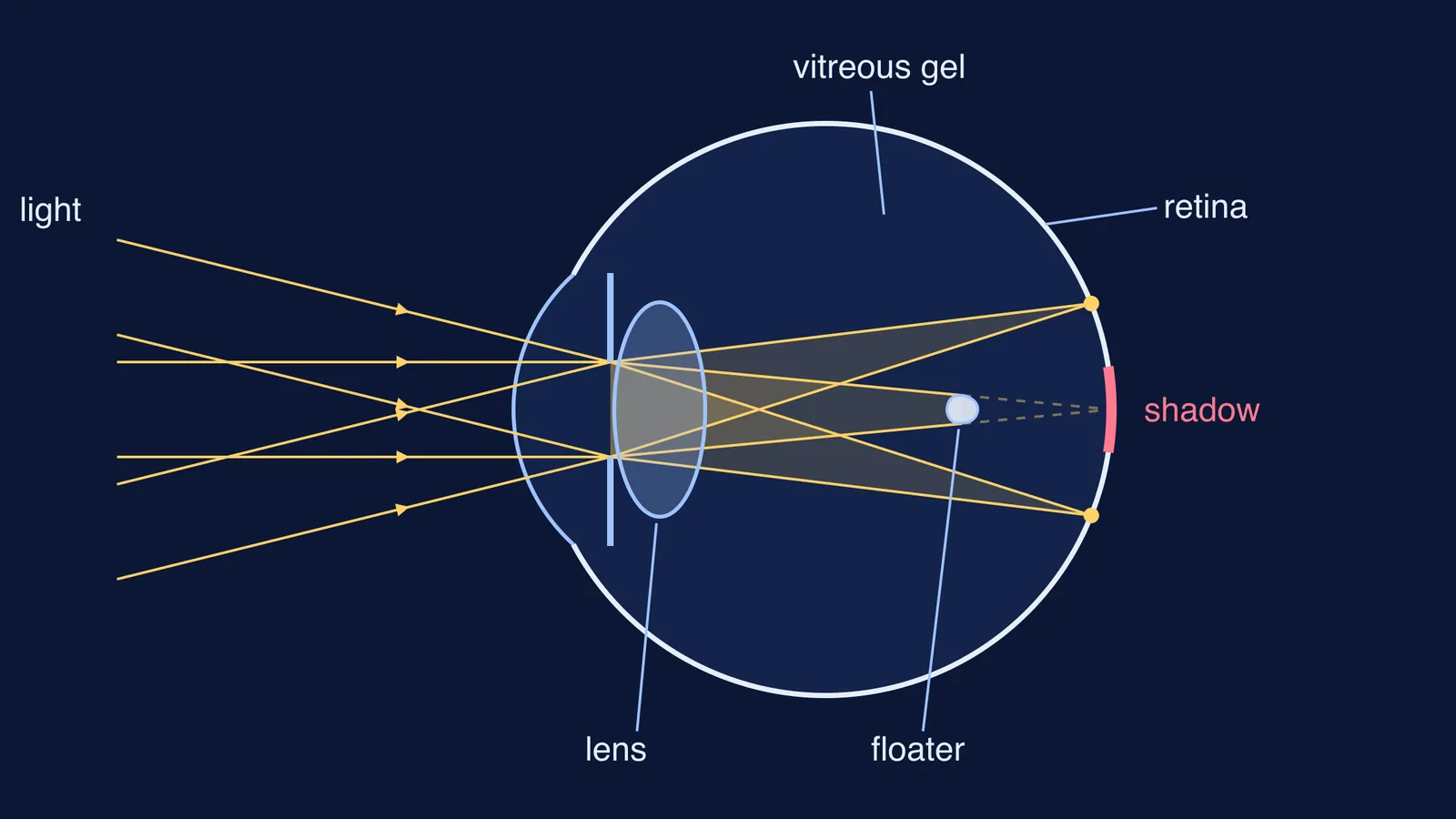
Floaters are "tiny clumps of gel or cells inside the vitreous that fills your eye", and what you see are the shadows those clumps cast on your retina, according to the American Academy of Ophthalmology. They can look like spots, threads, squiggly lines or little cobwebs, says the US National Eye Institute, which explains that with age, tiny strands of the vitreous stick together.
The vitreous is the clear jelly between the lens and the retina. It is a gel of about 99% water held in a framework of type II collagen and hyaluronic acid, and it fills about 80% of the eye's volume, according to a 2018 review by Tram and Swindle-Reilly in Frontiers in Bioengineering and Biotechnology. The review notes that the vitreous liquefies with age, one cause of floaters. If you mix up the eye's two fluids, see aqueous humour vs vitreous humour.
Floaters are very common. In a survey of 603 smartphone users published in the International Journal of Ophthalmology in 2013, 76% said they saw floaters and 33% said floaters noticeably affected their vision. It was a self-selected app survey, so treat this as a rough figure.
Why do you see a shadow and not the clump itself?
This is where the Class 10 chapter on the human eye helps. Light passes through the cornea and pupil, the lens focuses it, and an image forms on the retina. The lens focuses things outside the eye, not a speck floating just in front of the retina.
So your eye never forms an image of the clump. Each point on the retina receives a narrow cone of light from the pupil. When a clump sits inside that cone, it blocks the light and that patch of retina goes darker, which your brain reads as a shape out in the world. The diagram at the top shows three such cones; the one through the clump is blocked before it reaches the retina.
Two predictions follow:
A clump close to the retina casts a sharper shadow than one further away, just as your hand's shadow is sharper near the wall.
Floaters should show up best against something plain and bright, and the American Academy of Ophthalmology notes you usually notice them against a blank wall or a blue sky.
The retina has another oddity for the same chapter, a patch with no light receptors, which you can find with a blind spot card test.
Try it: can you make your floaters look sharper?
Look at a white wall or a clear patch of sky well away from the Sun. Never look at the Sun.
Flick your eyes to the left, stop, and watch the floaters drift.
Hold a card with a small pinhole close to one eye and look at the same surface.
Compare. Through the pinhole, the floaters should look darker and crisper.
Why step 4 works: the pinhole narrows the cone of light reaching each point of the retina, so the clump blocks a bigger share of it and the shadow's edges sharpen.
If cones of light are hard to picture from a flat textbook figure, the Fermi Simulation Lab has interactive simulations for ideas that are easier to see than to read.
Who gets more floaters?
The National Eye Institute says almost everyone develops floaters as they get older, and that people who are very nearsighted, have diabetes, or have had cataract surgery are at higher risk. In the 2013 smartphone survey, people with myopia were 3.5 times more likely, and people with hypermetropia 4.4 times more likely, to report moderate to severe floaters than people with normal vision.
When are floaters a sign of something serious?
Floaters are usually harmless, especially if you have had them for a long time and they are not getting worse, says the NHS. But some signs can mean the retina is torn or pulling away, and the National Eye Institute and the American Academy of Ophthalmology say to see an eye doctor right away if you notice:
a lot of new floaters that appear suddenly
flashes of light
a dark shadow or grey curtain over part of your vision
blurred vision or eye pain, or floaters after an eye injury or eye surgery (listed by the NHS)
A question for parents to ask: are the floaters new or suddenly more numerous, and are there flashes or a shadow? Those are the signs the health services above treat as urgent.
To place the vitreous among the other parts, read our guide to the parts of the human eye and their functions, or use the Fermi Concept Library, which gives every concept in physics and biology its own lesson.


