

On this page
If your teacher has just started "Weavers, Iron Smelters and Factory Owners", here is the chapter in one line: India once made cloth and steel the world wanted, lost much of that trade under colonial rule, and then Indians began building modern mills of their own. It follows on from how the East India Company moved from trade to territory. Below you get the key facts with sources, a cause-and-effect chain you can reuse, and a model 5-mark answer.
First, a syllabus check. NCERT's list of rationalised content for Class VIII, published in May 2022, marks Chapter 6 of Our Pasts-III (pages 65 to 80) as a full chapter dropped and not to be assessed. Your school or board may use a different book, so ask your teacher whether it is on your exam.
Why were Indian textiles famous across the world?
Indian cotton was so popular in Europe that its names entered English. Calico is named after Calicut, now Kozhikode, and chintz comes from a Hindi word meaning spotted or speckled (Chintz). Muslin is commonly traced to the city of Mosul, though some scholars point to Masulipatnam in India (Muslin).
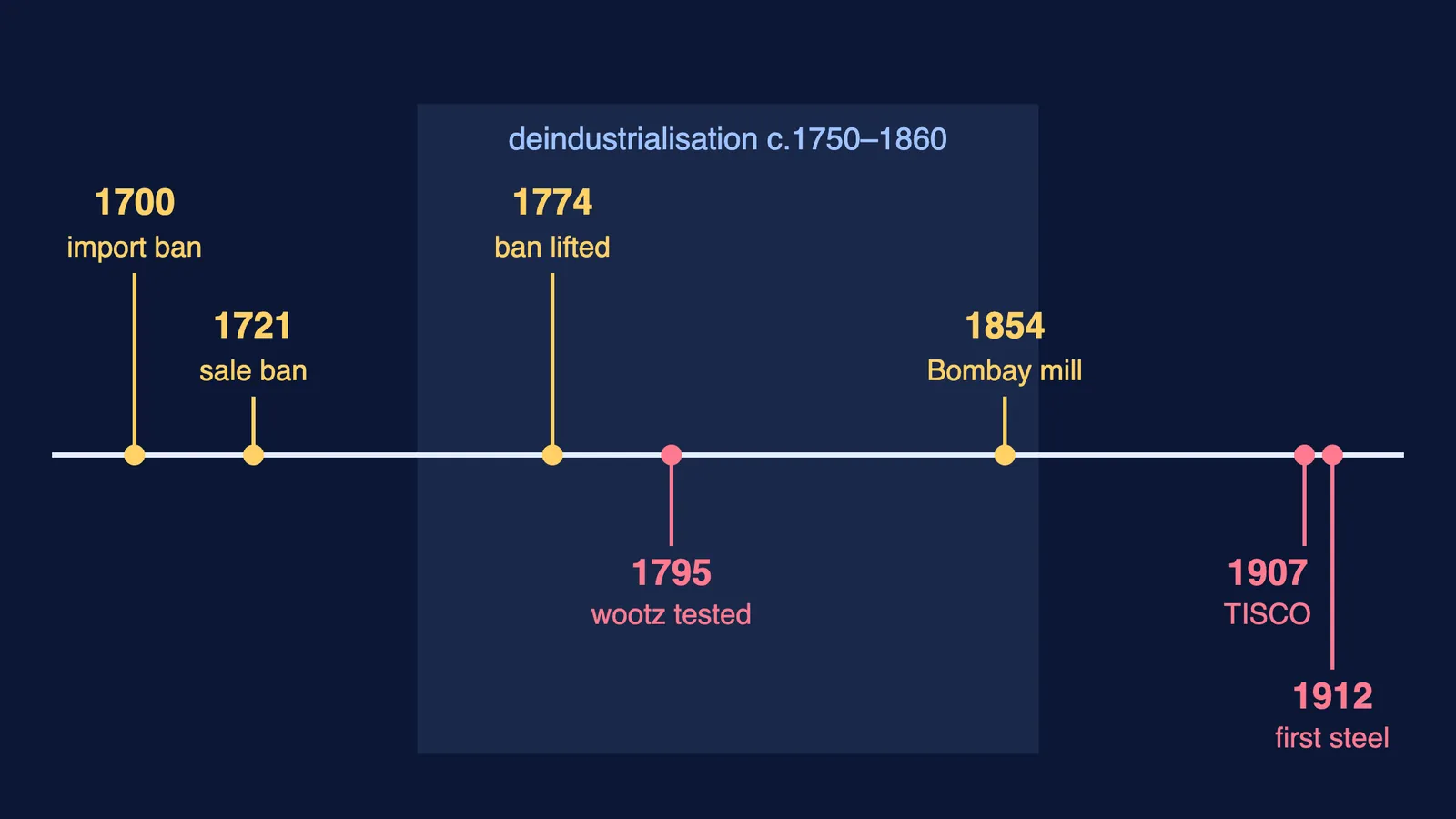
English wool and silk makers saw Indian cloth as a threat. Under the Calico Acts, Parliament banned most cotton imports in 1700 and, in 1721, banned the sale of most cotton cloth. The acts were repealed in 1774, which set off a wave of investment in British cotton mills.
Why did Indian weaving decline?
Economic historians David Clingingsmith and Jeffrey Williamson found that India, a major textile exporter in the early 18th century, had lost all of its export market and much of its home market by the mid-19th century, mostly to Britain (Explorations in Economic History, 2008). They put the steepest fall at roughly 1750 to 1860, and argue that local forces such as political break-up and more frequent droughts mattered alongside British competition.
That gives you a chain that fits most questions in this chapter:
Demand: Europe wants Indian cloth.
Protection: Britain bans it to shield its own cloth makers.
Machines: British mills make cheap cloth in bulk.
Loss: Indian weavers lose export markets, then buyers at home.
Response: Indians open their own mills.
What was wootz steel and why was it famous?
Wootz is a crucible steel with a high carbon content, developed in southern India and exported across the world (Wootz steel). Its name is traced to the Tamil word urukku, and Kannada and Telugu use ukku for steel (same source).
European scientists wanted to understand it. In a 1795 paper for the Royal Society, George Pearson quoted a letter from Dr Scott of Bombay saying wootz "admits of a harder temper than any thing known in that part of India" and was used for files, saws and cutting iron (Philosophical Transactions, 1795).
If a question asks why iron smelting declined, take the reasons your textbook gives and set them out the same way, each cause linked to its effect. The chemistry is worth a look too, since the amount of carbon in steel strongly affects how hard it can be made. If alloys feel fuzzy, the Fermi Concept Library covers every concept in physics, chemistry, biology, mathematics and computing.
When did India's first cotton mill and steel plant start?
Cotton: the Bombay Spinning and Weaving Company, Bombay's first cotton mill, was set up at Tardeo on 7 July 1854 by Cowaszee Nanabhoy Davar and began production on 7 February 1856.
Steel: the Tata Iron and Steel Company was registered on 26 August 1907 with shares issued to Indian investors, and its first steel ingot was rolled out in February 1912 (Tata Steel).
Who built it: the plant stood near the village of Sakchi, and Jamsetji Tata's son Dorabji and cousin RD Tata completed it after his death (Tata group).
In Class 10 the same story continues in The Age of Industrialisation.
How do you write a 5-mark answer on the weavers?
Question: How did British rule affect Indian weavers?
"In the early 18th century Indian cloth such as calico and chintz sold widely in Europe. English wool and silk makers protested, and Britain banned the sale of most cotton cloth in 1721. Once British mills began producing cheap machine-made cloth, Indian weavers lost their export markets and then much of their market at home. By the mid-19th century India had lost almost all of its textile exports, mostly to Britain. Meanwhile Indian-owned mills began, starting in Bombay in 1854."
Count the links: demand, protection, machines, loss, response. Five links, each backed by a fact.
A 20-minute plan for revising it:
Five minutes: write the five-link chain from memory.
Ten minutes: add one fact or date to each link (calico; 1721; 1774; mid-19th century; 1854).
Five minutes: say the model answer aloud without notes.
If you are not sure where to start with the rest of the book, Fermi's AI tutor can work out what you already know and build a plan for the session. For the next chapter, read our guide to education under British rule.


