

On this page
When you drop a stone into a still pond, circular ripples spread outwards. In optics, light behaves in a very similar way, but in three dimensions.
Understanding the shape of these light waves—known as wavefronts—is a core part of Class 12 wave optics. Getting this right helps you predict how light will behave when it hits a lens, a mirror or a prism.
What is a wavefront?
A wavefront is defined as a surface of constant phase (NCERT Wave Optics). It is the locus of all points in a medium that are vibrating in the same phase at any given instant.
The energy of the wave always travels in a direction perpendicular to this surface. The speed at which the wavefront moves outward is the phase speed of the wave.
What is Huygens' principle?
To understand how wavefronts move, you need to know how they generate new waves. Christiaan Huygens proposed a geometrical construction that helps us predict the future position of a wavefront if we know its current position.
According to Huygens' principle, every point on a given wavefront acts as a fresh source of new disturbance. These new disturbances, called secondary wavelets, spread out in all directions with the speed of light in that medium. If you draw a common tangent surface (or envelope) to all these secondary wavelets at any later time, you get the new forward position of the wavefront. This simple idea beautifully explains why wavefronts change shape when they encounter obstacles or different media.
What are the shapes of wavefronts from point and line sources?
The geometry of the light source completely decides the shape of the wave spreading away from it.
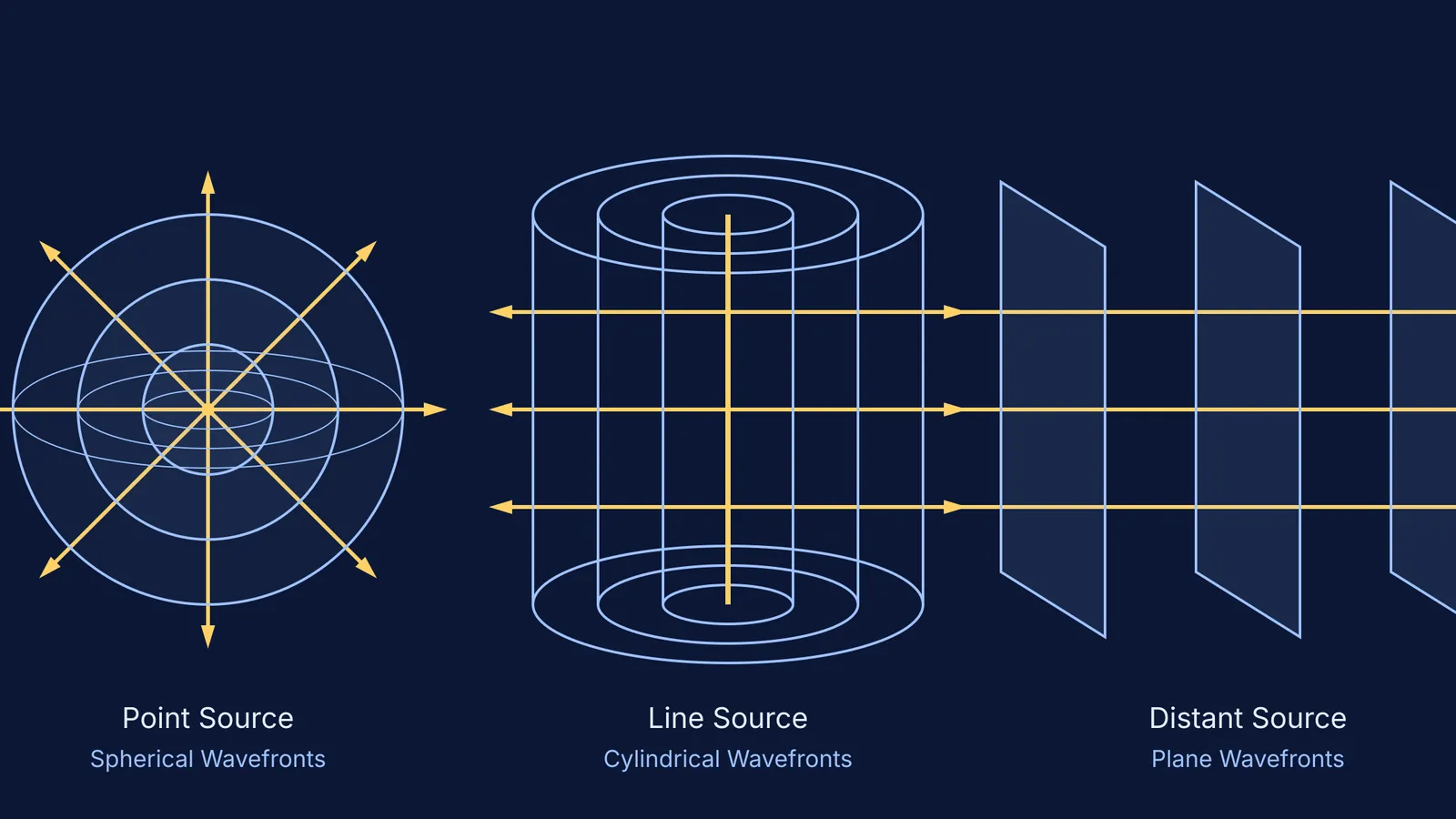
Point source: When light emerges from a tiny point source in an isotropic medium, it spreads out equally in all directions. The points at a constant distance from the source form a sphere. Therefore, a point source creates a spherical wavefront.
Line source: If you use a linear source of light, such as a glowing straight wire or a narrow rectangular slit, the points equidistant from the line form a cylinder. This means a line source produces a cylindrical wavefront.
Visualising these 3D shapes on a 2D page can be challenging. If you struggle to picture how these waves expand over time, the Fermi Simulation Lab provides interactive simulations to help you see it.
How does distance create a plane wavefront?
You do not need a flat, plane-shaped light source to make a plane wavefront. You just need distance.
As a spherical or cylindrical wavefront travels a large distance away from its source, its curvature naturally decreases. At an extremely large distance—often called infinity in optics problems—a small portion of that expanding wave appears perfectly flat. Consequently, any source at a very large distance produces a plane wavefront.
This is why sunlight reaching Earth is treated as a plane wave, even though the Sun is essentially a massive point source.
If you have concept gaps around wave optics and Huygens' principle, the Fermi Concept Library maps out every physics idea and links them together.
How do lenses and mirrors change wavefront shapes?
Optical instruments work by changing the phase of different parts of a wave. Because light travels slower in glass than in air, thicker parts of a lens delay the wave more than thinner parts.
Convex lens: When a plane wavefront strikes a thin convex lens, the central part of the wave passes through the thickest glass and is delayed the most. The edges pass through thin glass and emerge sooner. As a result, the emerging wavefront bends inward, becoming a converging spherical wavefront.
Concave mirror: When a plane wave hits a concave mirror, the edges of the wave hit the mirror first and reflect back. The centre of the wave must travel further to reach the deepest part of the mirror before reflecting. This turns the reflected wave into a converging spherical wavefront.
Prism: A prism delays the lower part of a plane wavefront (passing through the thick base) more than the upper part (passing through the thin apex). The emerging wave is still a plane wavefront, but it is tilted at a new angle.
Checklist: How to draw wavefronts in an exam
When you are asked to sketch wavefronts in your physics boards or tests, use this mental checklist:
Identify the source: Is it a point (draw circles), a slit (draw cylinders) or distant (draw straight lines)?
Draw the rays first: Rays are straight lines showing the direction of light.
Keep it perpendicular: Ensure every wavefront surface you draw is exactly 90 degrees to the rays.
Mind the spacing: For a continuous wave, draw the wavefronts at equal distances from each other to represent a constant wavelength.
If you want to practice predicting these shapes, read our guide on Spherical aberration and paraxial rays: why lenses blur the focus. You can also explore Convex lens image formation in a simulation: what to watch to see these principles in action, or dive into How the Amplitude of a Spherical Wave Varies with Distance for the mathematics behind the waves.


