

On this page
Dip a glass capillary in water and the water climbs. Now cut the tube shorter than the height the water wants to reach. Does the water spill over, drip back into the beaker, climb again and run forever? It does not, and the reason tests whether you understand surface tension or only its formula.
What does the capillary perpetual motion puzzle claim?
If the tube is shorter than the rise height h, the argument goes, the water reaches the top with lift to spare, spills, falls back past a tiny wheel and is lifted again: energy from nothing. The flaw is the first step. The water has no lift to spare, because h is not a fixed property of the tube.
Why doesn't water overflow a short capillary tube?
Just under a curved water surface, the pressure is lower than the air above it by 2T/R, where T is the surface tension and R is the radius of curvature of the meniscus. In equilibrium this pressure drop holds up the column, so ρgh = 2T/R, a relation Benny Lautrup's fluid mechanics text calls exact (Lautrup, Physics of Continuous Matter, chapter 8).
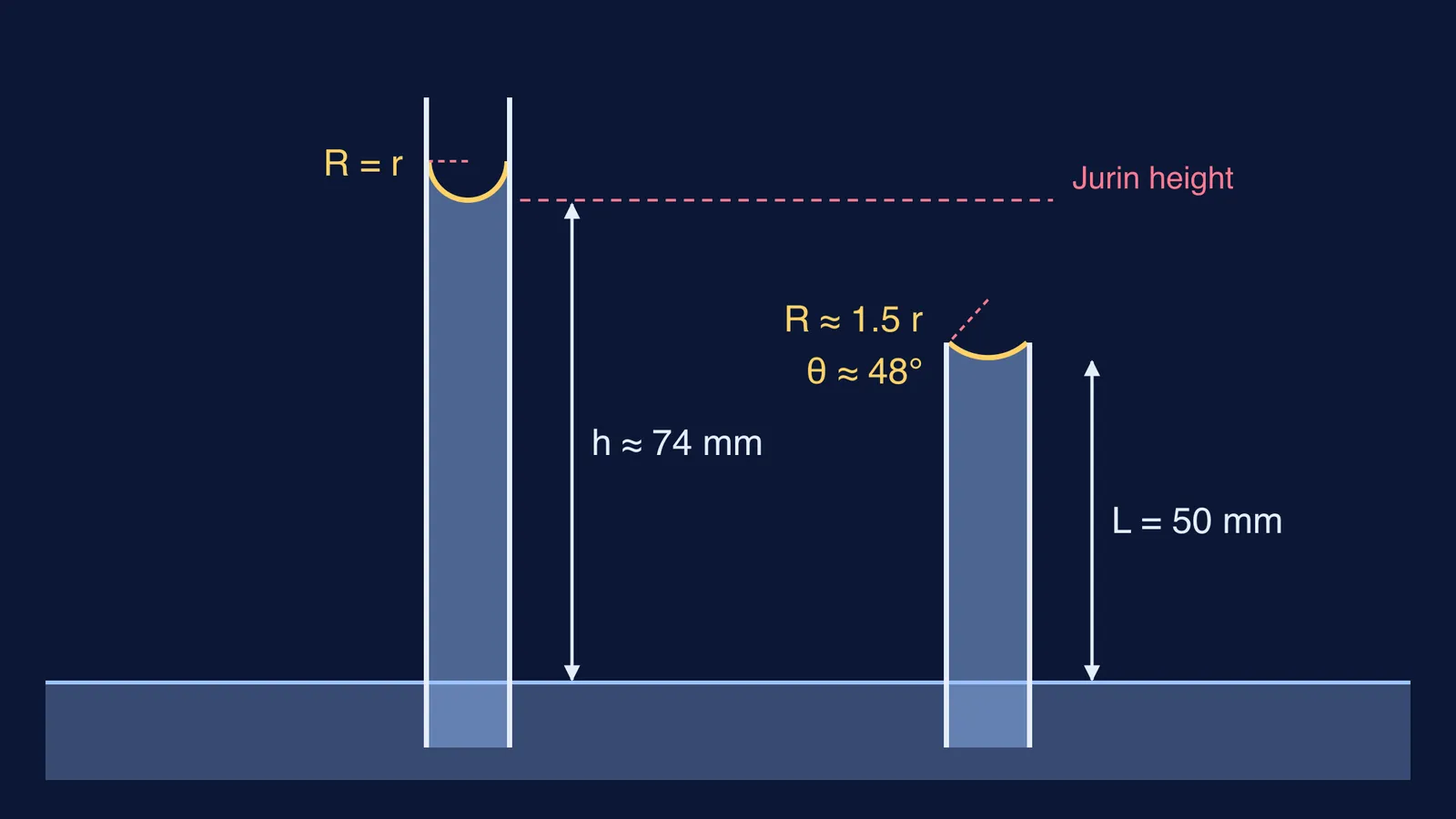
The equation contains the radius of the meniscus, not the radius of the tube. In a tall tube, water meets clean glass at a contact angle near zero, so the meniscus is a hemisphere with R equal to the tube radius r, giving the familiar Jurin formula h = 2T cos θ/(ρgr). Lautrup's worked example: in a tube 1 mm across, water rises about 30 mm.
In a short tube, the water reaches the rim and its edge gets pinned at the lip. Gravity and surface tension still have to balance, so the surface flattens instead: R grows until 2T/R equals ρgL, where L is the length of tube above the water, and the angle at the rim grows to match, with cos θ = r/R. No bulge, no drop, no fountain.
To spill, the surface would have to bulge outward, which needs the water just under it to be above air pressure. But water standing L above the beaker level is below air pressure, by ρgL. Our post on why water never overflows a capillary tube that is too short works through more versions of this question.
Where does the energy for capillary rise come from?
Take water at 20 °C with T = 0.0728 N/m, ρ = 1000 kg/m³ and a contact angle of about zero, the values used in the Wikipedia article on capillary action, and a glass tube of inner radius r = 0.2 mm.
Height: h = 2T/(ρgr) = 0.1456 / (1000 × 9.81 × 0.0002) ≈ 0.074 m, about 74 mm.
Work done by surface tension: the pull 2πrT acts through h, so W = 2πrTh ≈ 6.8 × 10⁻⁶ J. This energy comes from wet glass replacing dry glass.
Energy stored: the column has mass m = πr²hρ with its centre of mass at h/2, so U = mgh/2 ≈ 3.4 × 10⁻⁶ J.
The gap: W − U ≈ 3.4 × 10⁻⁶ J. Exactly half the work is missing.
Short tube: with only L = 50 mm sticking out, R = 2T/(ρgL) ≈ 0.30 mm, about 1.5 times the tube radius, and cos θ = 0.2/0.30 gives θ ≈ 48°. The water stops at the rim.
The half is no coincidence. Put h = 2T/(ρgr) into U = πr²ρgh²/2 and you get U = πrTh, which is W/2 for any tube. The other half becomes heat, mostly through viscous friction as the water rushes up and sloshes before settling. That heat is 2πT²/(ρg), independent of the tube radius.
Why can't any capillary trick give perpetual motion?
The lifting energy comes from wetting dry glass, and once the wall is wet it is spent. A fountain loop would lift water again and again past the same wet wall with nothing to pay for it. Capillary rise is a one-time release, like a marble rolling into a bowl and stopping.
For background, see why water's meniscus is concave and mercury's is convex and how James Jurin linked capillary rise to tube radius.
How do you answer this question in an exam or viva?
Use this four-step answer:
State the balance: ρgh = 2T/R, where R is the radius of the meniscus.
Say what changes: in a short tube the height is capped at L, so R grows to 2T/(ρgL) and the meniscus flattens.
Rule out overflow: a convex surface would need above-atmospheric pressure at height L, which is impossible.
Close with energy: wetting releases 2πrTh, half is stored as potential energy and half is lost as heat, so nothing can drive a cycle.
The usual slip is using the tube radius r where the meniscus radius R belongs.
If step 2 or 4 feels shaky, practise on worked capillarity problems in the Fermi Problem Library, where a step-by-step solver explains the reasoning rather than printing an answer. Surface tension, contact angle and pressure across a curved surface each have their own lesson in the Fermi Concept Library.


