

On this page
If you have learnt that fluorine is the most electronegative element, the boiling points of water and hydrogen fluoride look backwards. HF should have the stronger hydrogen bonds, so why does water boil so much higher? Boiling depends on the total hydrogen bonding per molecule, not on the strength of one bond.
Why does water have a higher boiling point than HF?
Start with the numbers. Water boils at 373.17 K, about 100 °C, in the NIST Chemistry WebBook. Hydrogen fluoride boils at 292.7 K, about 19.5 °C, in the NIST entry for HF.
Fluorine is the most electronegative element, as Chemguide's electronegativity page notes, so the H–F bond is very polar and a single F–H···F hydrogen bond is strong. But strength is only half the story. Chemguide's hydrogen bonding page puts the other half in one line: "In hydrogen fluoride, the problem is a shortage of hydrogens."
You may know why HF is a liquid while HCl is a gas. HF does hydrogen bond, just less than water.
How many hydrogen bonds does each molecule make?
A hydrogen bond needs two ends: a hydrogen on F, O or N (the donor) and a lone pair on another molecule (the acceptor). Count the ends each molecule can supply, then divide by two, because every bond is shared by two molecules.
Water: 2 hydrogens and 2 lone pairs on oxygen. Both kinds are used, so up to 4 ends, which is 4 ÷ 2 = 2 hydrogen bonds per molecule.
HF: 1 hydrogen and 3 lone pairs on fluorine. Only one hydrogen means each molecule donates one bond and accepts one, so 2 ends, which is 2 ÷ 2 = 1 hydrogen bond per molecule. The two spare lone pairs have no hydrogens to pair with.
Chemguide notes that each water molecule can potentially form four hydrogen bonds with its neighbours, with "exactly the right numbers" of hydrogens and lone pairs. That is why water builds a three-dimensional network, the same network that makes ice less dense than liquid water.
HF can only make chains. Solid HF was mapped by Atoji and Lipscomb in 1954, and a later modelling study by Della Valle and Gazzillo describes the crystal as zig-zag chains of HF units and reports that "acyclic zig-zag chains are abundant in the liquid".
Worked example: is each HF bond really stronger?
You can test the counting with enthalpies of vaporisation, the energy needed to turn one mole of liquid into gas.
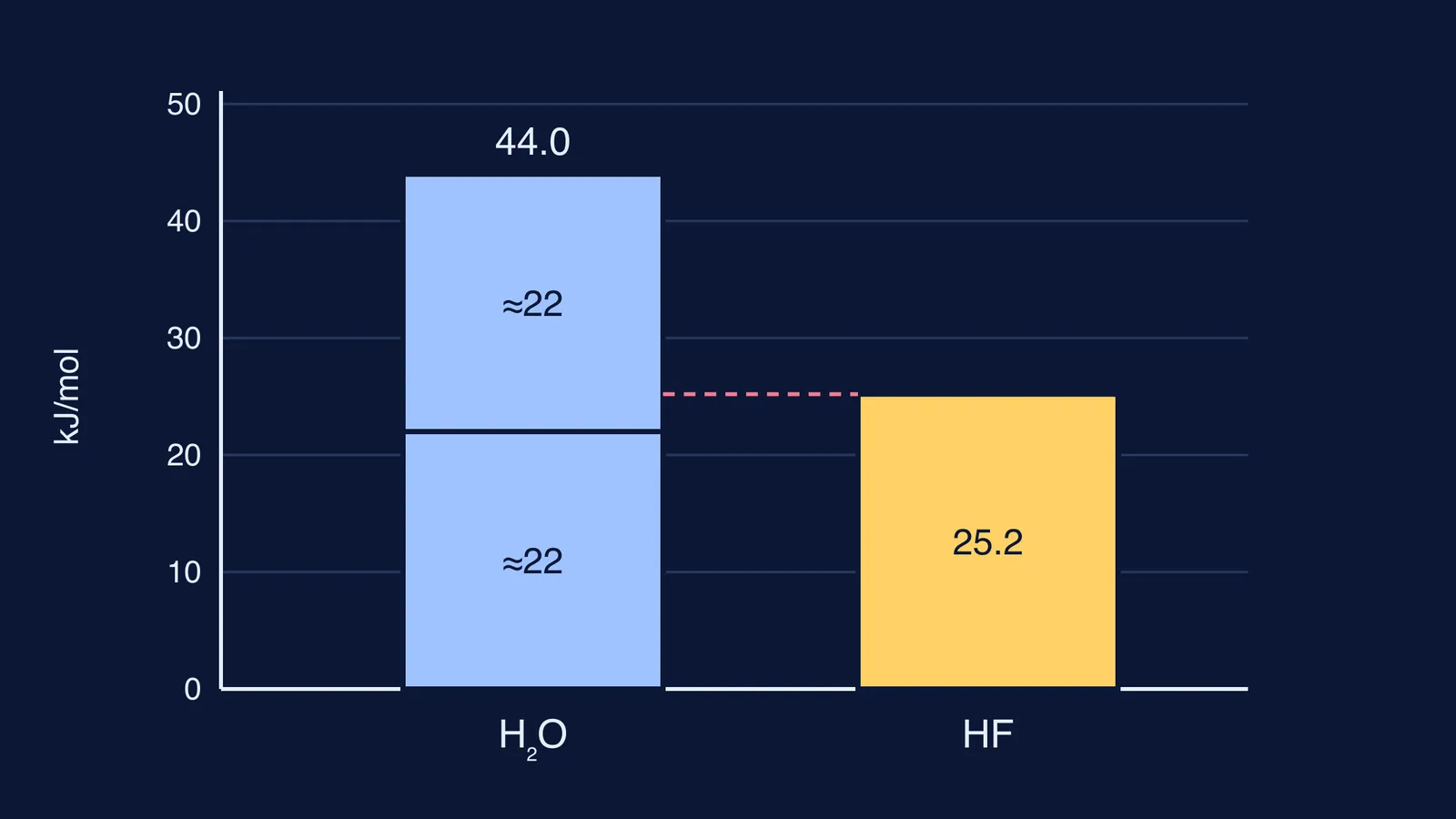
Water. NIST lists the enthalpy of formation of liquid water as −285.830 kJ/mol and of water vapour as −241.826 kJ/mol (NIST thermochemistry). The difference, 44.0 kJ/mol, is the energy to vaporise water at 25 °C.
Share per bond in water: 44.0 ÷ 2 bonds ≈ 22 kJ/mol.
HF. NIST gives an enthalpy of vaporisation of 25.2 kJ/mol, measured near 255–265 K (NIST HF data).
Share per bond in HF: 25.2 ÷ 1 bond ≈ 25 kJ/mol.
So, roughly, one HF hydrogen bond is worth a little more than one water hydrogen bond, yet a mole of water needs about 44 kJ to escape against about 25 kJ for HF. Two slightly weaker bonds beat one slightly stronger bond.
Treat these as estimates. The two values were measured at different temperatures, and vaporisation also overcomes weaker dispersion forces. HF vapour is also not fully broken up: the Della Valle and Gazzillo paper describes a "gas phase (HF)6 cyclic hexamer", so some HF bonds probably survive boiling, which would make the true per-bond value for HF a little higher.
If the donor and acceptor bookkeeping is the shaky part, the Fermi Concept Library has every concept in physics, chemistry, biology, mathematics and computing, each with its own lesson and its place in the map.
How do you write this in a board or JEE answer?
A three-line answer:
Both H2O and HF are hydrogen bonded; an individual F–H···F bond is stronger because F is more electronegative than O.
Water has two H atoms and two lone pairs, so each molecule forms on average two hydrogen bonds and a 3D network; HF has one H atom, so it forms one per molecule and only zig-zag chains.
More hydrogen bonds per molecule need more energy to break, so water boils higher.
Use the same check on any "compare boiling points" question:
Is there H attached to N, O or F? If not, hydrogen bonding is not the deciding factor.
Count hydrogens (H) and lone pairs (L) on the electronegative atom.
Bonds per molecule = the smaller of H and L. Water: smaller of 2 and 2 is 2. HF: smaller of 1 and 3 is 1.
If two molecules tie on count, compare bond strength next, then molecular size.
Try it on ammonia, then check your reasoning against our post on why NH3 boils higher than PH3. For more practice, the Fermi Problem Library has worked problems with a step-by-step solver that explains the reasoning rather than printing an answer.


