

On this page
You and a friend agree to paint a wall for ₹6,000. Your friend paints faster but leaves early. Who gets what? Time and work questions in school exams and aptitude tests ask exactly this, and a common mistake is to split the money by days.
How do you divide wages in time and work problems?
Pay follows work, not time. Wages are directly proportional to the work done, so a worker who completes more of the job gets a proportionately larger share, as PW's work, rate and time notes put it.
Work done = efficiency × time, where efficiency is the part of the job a person finishes in one day. So the wage ratio is E₁ × T₁ : E₂ × T₂ (PrepGrind's work and wages notes).
When everyone works the same number of days, the days cancel and the wage ratio is simply the efficiency ratio. When the days differ, multiply each person's efficiency by their own days first, then split the money in that ratio.
Worked example: what if one worker leaves early?
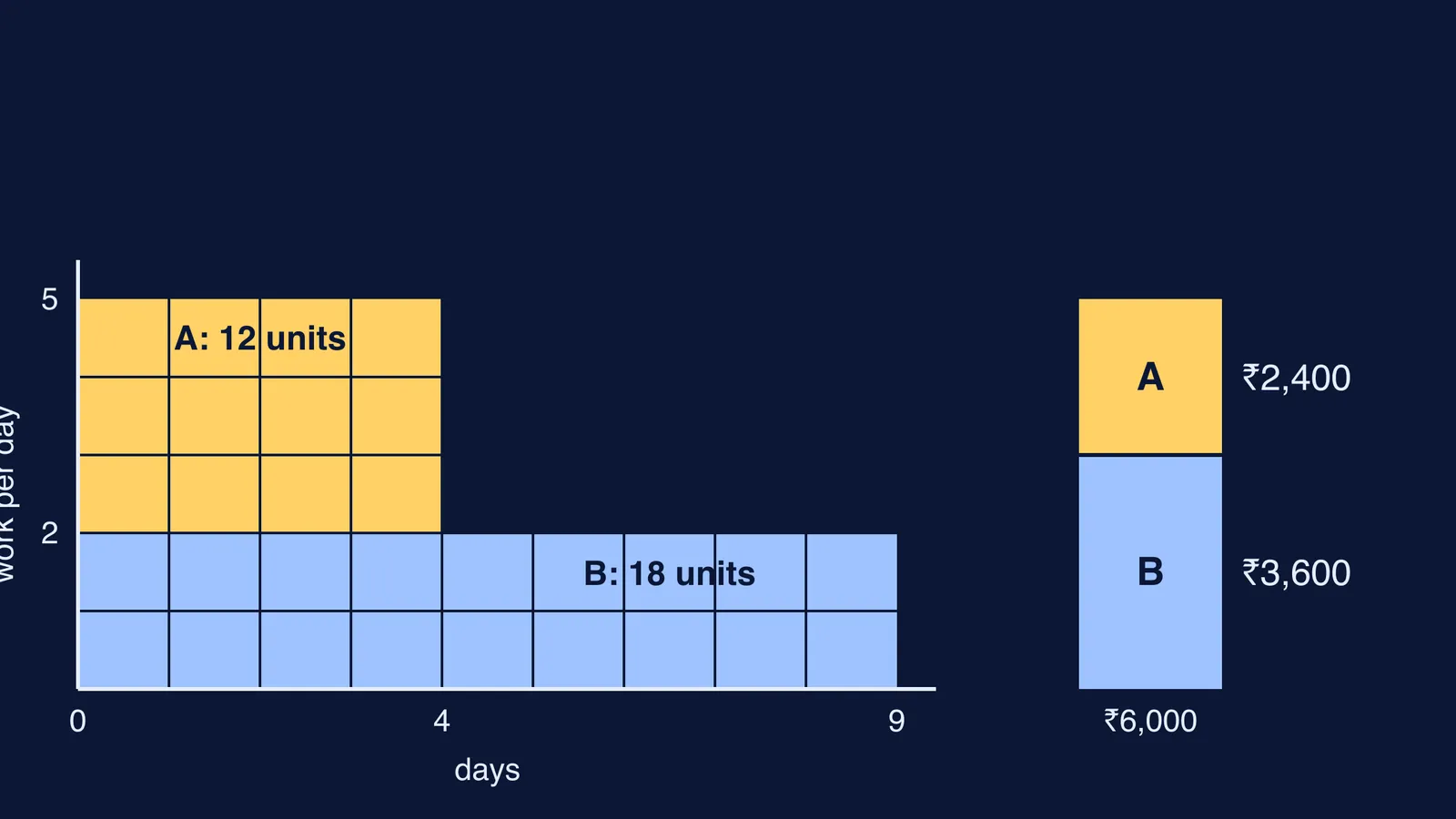
A can finish a job alone in 10 days and B in 15 days. They take it on for ₹6,000. They start together, A leaves after 4 days, and B finishes alone. How should the ₹6,000 be split?
Pick a size for the job that both numbers divide. The LCM of 10 and 15 is 30, so call the job 30 units.
Efficiencies: A does 30 ÷ 10 = 3 units a day; B does 30 ÷ 15 = 2 units a day.
Together for 4 days: (3 + 2) × 4 = 20 units. That leaves 10 units, which B does alone in 10 ÷ 2 = 5 days. So A worked 4 days and B worked 9.
Work done: A = 3 × 4 = 12 units; B = 2 × 9 = 18 units. Check: 12 + 18 = 30.
The ratio is 12 : 18 = 2 : 3. A gets 2/5 × 6,000 = ₹2,400 and B gets 3/5 × 6,000 = ₹3,600.
Now look at what the two traps give. Splitting by days (4 : 9) hands A about ₹1,846, which ignores that A works faster. Splitting by efficiency (3 : 2) hands A ₹3,600, as if A had stayed all 9 days. Only work done counts both speed and time.
If the units method is new to you, our guide to the LCM method for time and work sets it up step by step, and what it means when A is 50 percent more efficient than B shows how to turn such statements into units per day.
What if a helper joins and you must find their share?
A common twist: A alone takes 12 days and B alone 16 days. With help from C they finish in 4 days and are paid ₹4,800. What is C's share?
Size of the job: the LCM of 12 and 16 is 48 units. A does 4 units a day; B does 3.
In 4 days the team does 48 units, which is 12 units a day. So C does 12 − 4 − 3 = 5 units a day.
Over the 4 days: A does 16, B does 12 and C does 20 units, a ratio of 4 : 3 : 5.
Shares: A ₹1,600, B ₹1,200, C ₹2,000.
There is a shortcut. In 4 days A finishes 4/12 = 1/3 of the job and B finishes 4/16 = 1/4. C did the rest: 1 − 1/3 − 1/4 = 5/12. So C gets 5/12 of ₹4,800 = ₹2,000. Same answer, fewer lines.
How do you check your answer is right?
Run this check before you mark an option:
The shares add up to the total payment.
The work units add up to the whole job (30 of 30, 48 of 48).
The person who did more units gets more money, even if they worked fewer days.
Each person's work uses their own days, not the full length of the job.
The same idea of contribution × time runs through partnership questions, where profit is shared by investment multiplied by months. See how to divide profit in a partnership for the matching method.
Where can you practise wages problems?
Mixed sets help most, because the real skill is spotting whether the days are equal or not before you choose a ratio. The Fermi Problem Library has worked problems with a step-by-step solver that explains the reasoning rather than printing an answer, so you can see exactly where a share went wrong. If ratio itself feels shaky, the Fermi Concept Library gives each mathematics concept its own lesson, so you can revisit it first.
Try the first example again with A leaving after 2 days instead of 4. If you get A ₹1,200 and B ₹4,800, you have the method.


