

On this page
The Victor Meyer test is easy to learn as a colour code and just as easy to mix up under exam pressure. Once you see why each colour appears, you are far less likely to swap them. It all comes down to one question: how many hydrogens sit on the carbon that carries the nitro group?
What is the Victor Meyer test for alcohols?
The Victor Meyer test is a four-step sequence that tells primary, secondary and tertiary alcohols apart by the colour at the end. It is named after the German chemist Victor Meyer, who with J. Locher published papers in 1874 on nitrolic acids and pseudonitroles, the compounds behind the colours (Meyer and Locher, on nitrolic acids; Meyer and Locher, on pseudonitroles). He is the same Meyer you may know from finding molar mass by vapour density.
Alcohol to alkyl iodide: heat with red phosphorus and iodine. These form phosphorus triiodide in the flask, a reagent used to convert alcohols to alkyl iodides (phosphorus triiodide).
Alkyl iodide to nitroalkane: treat with silver nitrite, AgNO₂.
Nitroalkane with nitrous acid: nitrous acid is unstable, so it is made in the tube from sodium nitrite and a mineral acid, usually ice-cold (nitrous acid).
Add sodium hydroxide and look at the colour.
The 1911 Encyclopaedia Britannica entry on nitro compounds notes that alkyl iodides and silver nitrite give nitroparaffins, but that for anything larger than methyl iodide some nitrous ester forms as well. The textbook scheme is tidier than a real flask.
Why is primary red, secondary blue and tertiary colourless?
Nitrous acid attacks the carbon that carries the nitro group, the α-carbon, through the nitronate anion (nitrolic acid). Forming that anion needs a hydrogen on the α-carbon. The 1911 Britannica entry gives all three outcomes.
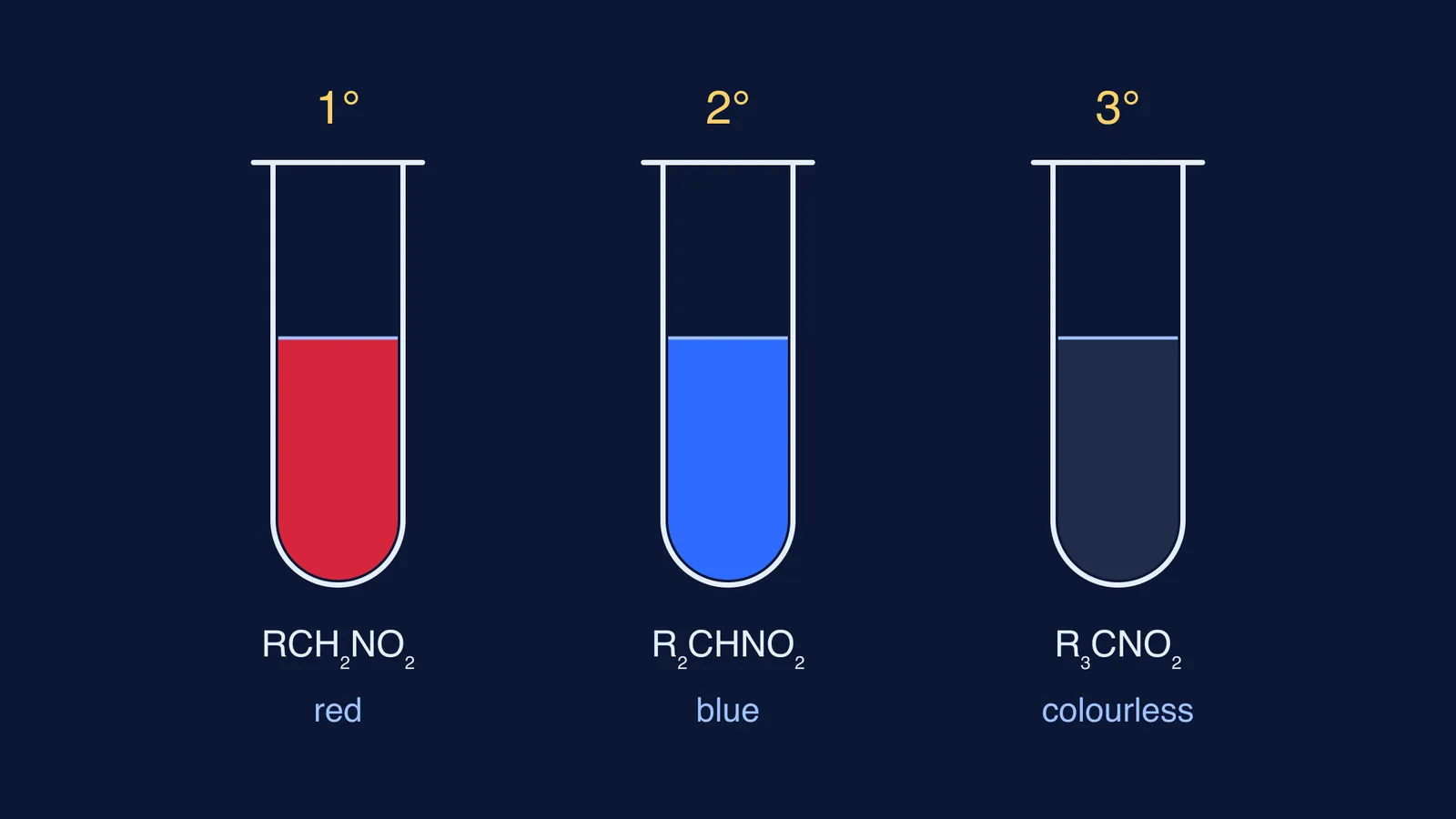
Primary, RCH₂NO₂, two α-hydrogens: one hydrogen is replaced by N=O, and the remaining hydrogen lets the group shift to an oxime, RC(NO₂)=NOH. This is a nitrolic acid. Nitrolic acids are colourless solids known for the deep red colour of their solutions in alkali.
Secondary, R₂CHNO₂, one α-hydrogen: N=O takes the only hydrogen's place, giving R₂C(NO)(NO₂), a pseudonitrole. With no hydrogen left it cannot become an oxime, and pseudonitroles show an intense blue colour when liquid or dissolved in alkali.
Tertiary, R₃CNO₂, no α-hydrogen: tertiary nitroparaffins are not acted on by nitrous acid, so nothing coloured forms.
Worked example: which propanol or butanol gives which colour?
Take three alcohols and push each one through the four steps.
Propan-1-ol (primary): CH₃CH₂CH₂OH → CH₃CH₂CH₂I → CH₃CH₂CH₂NO₂ → CH₃CH₂C(NO₂)=NOH → red in NaOH.
Propan-2-ol (secondary): (CH₃)₂CHOH → (CH₃)₂CHI → (CH₃)₂CHNO₂ → (CH₃)₂C(NO)(NO₂) → blue.
2-Methylpropan-2-ol (tertiary): (CH₃)₃COH → (CH₃)₃CI → (CH₃)₃CNO₂ → no reaction with nitrous acid → colourless.
In an answer, write the intermediate at every arrow and name the last one: nitrolic acid or pseudonitrole. That shows you know why the colour appears, not just which colour it is. If you want to test your own chain of reasoning on similar questions, the Fermi Problem Library has worked problems with a step-by-step solver that explains the reasoning rather than printing an answer.
What mistakes do students make with the Victor Meyer test?
Run through this checklist before you write the final line.
Swapping red and blue. Go back to the hydrogen count instead of guessing.
Saying tertiary alcohols react slowly. The tertiary nitroalkane does not react at all, so there is no colour to wait for.
Forgetting the alkali. Nitrolic acids are colourless solids; the red shows only in alkaline solution.
Drawing a nitrite ester, R–O–N=O, instead of a nitroalkane, R–NO₂. Nitrous acid needs hydrogens on a carbon that carries NO₂, and a nitrite ester has no such carbon.
Mixing it up with the amine test. Nitrous acid also sorts primary, secondary and tertiary amines, but there the hydrogens that matter are on nitrogen, not carbon.
For that second test, read our guide to the Lucas test for primary, secondary and tertiary alcohols. If α-hydrogens or tautomerism still feel shaky, the Fermi Concept Library covers every concept in chemistry, each with its own lesson.


