

On this page
Here is the three-line derivation of the variance of 1, 2, …, n, then the even numbers, the odd numbers and any arithmetic progression (AP) in one step each.
What is the variance of the first n natural numbers?
NCERT's Class 11 textbook defines variance as the mean of the squares of the deviations from the mean, σ² = (1/n)Σ(xᵢ − x̄)² (NCERT Class 11 Mathematics, Chapter 13: Statistics).
For the numbers 1, 2, 3, …, n, that definition gives σ² = (n² − 1)/12, and the standard deviation is σ = √((n² − 1)/12).
The same chapter sets "First n natural numbers" as Question 2 of Exercise 13.2, so expect to derive it, not just quote it.
How do you derive (n² − 1)/12 using Σr and Σr²?
Use the shortcut form of variance: the mean of the squares minus the square of the mean, σ² = Σx²/n − x̄². NCERT derives this form in the same chapter, and our post on why the Σx²/n − x̄² shortcut is faster explains it. You need two standard sums; NCERT itself uses the second, Σr² = n(n + 1)(2n + 1)/6, in this chapter.
Mean: Σr = n(n + 1)/2, so x̄ = (n + 1)/2.
Mean of squares: Σr²/n = (n + 1)(2n + 1)/6.
Subtract and take (n + 1) out as a common factor: (n + 1)(2n + 1)/6 − (n + 1)²/4 = (n + 1)[2(2n + 1) − 3(n + 1)]/12 = (n + 1)(n − 1)/12.
That is (n² − 1)/12. Check it with n = 10: Σr² = 385, so 385/10 − 5.5² = 38.5 − 30.25 = 8.25, and (100 − 1)/12 = 8.25.
What is the variance of the first n even or odd numbers?
Two rules do all the work. Adding the same constant to every observation leaves the variance unchanged, because every deviation from the mean stays the same. Multiplying every observation by k multiplies the variance by k², a rule NCERT states in a note after its Example 13 (NCERT Chapter 13). Our post on how adding or multiplying by a constant changes mean and variance works through both.
First n even numbers, 2, 4, …, 2n: each term is 2r, so σ² = 4(n² − 1)/12 = (n² − 1)/3.
First n odd numbers, 1, 3, …, 2n − 1: each term is 2r − 1. Doubling multiplies the variance by 4 and subtracting 1 changes nothing, so σ² = (n² − 1)/3 again.
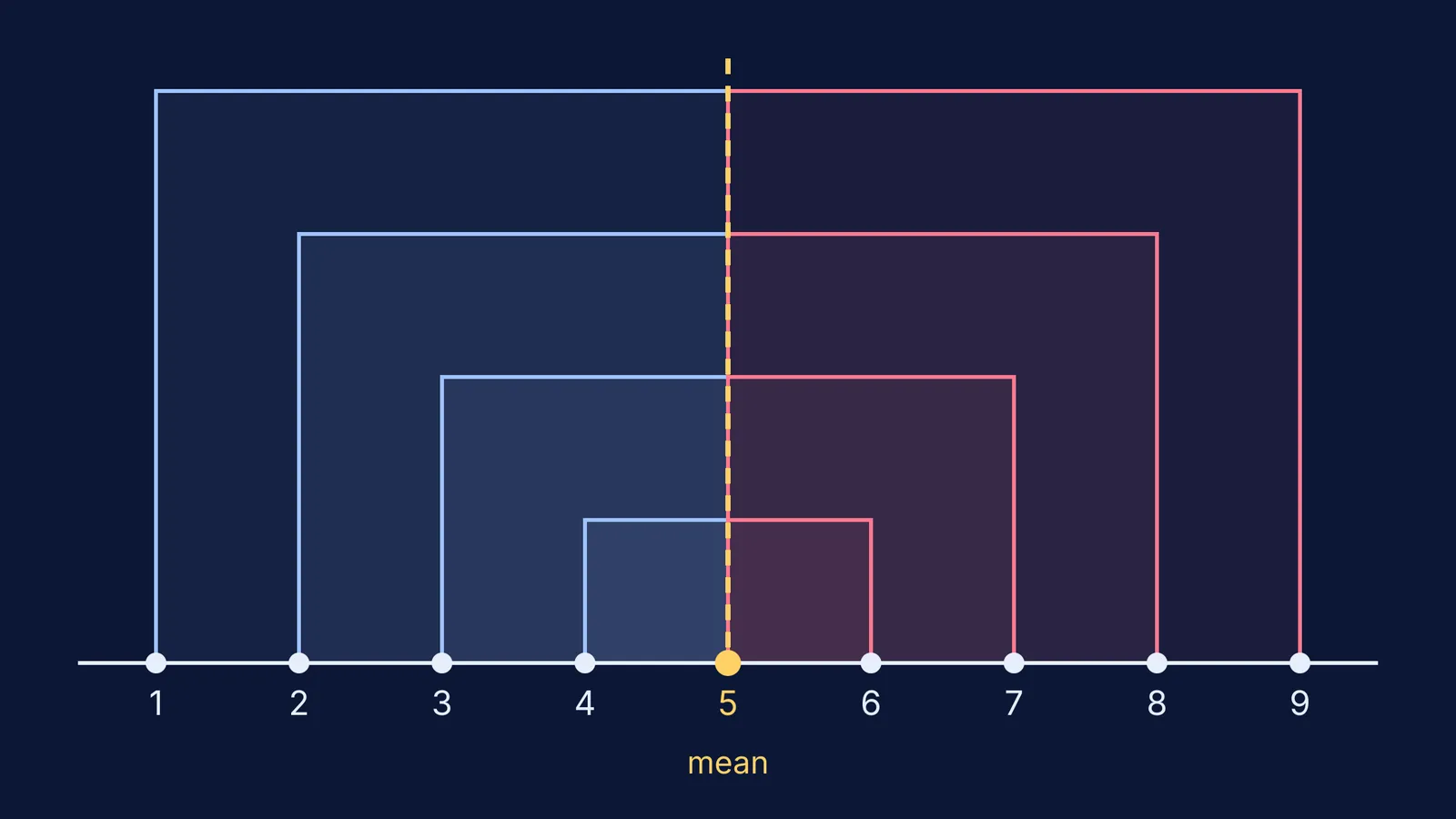
The even and odd sets have the same variance because one is the other shifted by 1. Quick check with 1, 3, 5, 7, 9: mean 5, squared deviations 16, 4, 0, 4, 16, total 40, and 40/5 = 8 = (25 − 1)/3.
How do you find the variance of any AP in one step?
Any AP a, a + d, …, a + (n − 1)d can be written as (a − d) + d·r for r = 1 to n. The shift (a − d) does not matter and the scale d squares, so:
σ² = d²(n² − 1)/12, whatever the first term a is.
The case d = 1 is the variance of a discrete uniform distribution: any n consecutive integers, equally likely, have variance (n² − 1)/12 (Discrete uniform distribution, Wikipedia). A fair die is n = 6, so its variance is 35/12.
Three worked examples, two from NCERT (Chapter 13):
First 10 multiples of 3 (Exercise 13.2, Question 3): d = 3, n = 10, so σ² = 9 × 99/12 = 74.25.
6, 8, 10, …, 24 (Example 8): d = 2, n = 10, so σ² = 4 × 99/12 = 33, the textbook's answer.
5, 9, 13, 17, 21: d = 4, n = 5, so σ² = 16 × 24/12 = 32. Direct check: deviations −8, −4, 0, 4, 8 give 160/5 = 32.
A 30-second checklist for exam questions
Sort the data. Is it an AP? Note the common difference d and the count n.
Variance = d²(n² − 1)/12. Standard deviation = |d|√((n² − 1)/12).
Sanity check with n = 2: two numbers d apart should have variance d²/4, and d²(4 − 1)/12 = d²/4.
Check the divisor. NCERT's definition divides by n. For a sample variance with n − 1, multiply by n/(n − 1) to get d²n(n + 1)/12. Here is why variance divides by n in school and n − 1 in samples.
How do you make this stick before the exam?
Derive the formula once from Σr and Σr² without looking. Then do one even-number, one odd-number and one AP question with the two rules above, checking each the long way. If a step goes wrong, the Fermi Problem Library has worked problems with a step-by-step solver that explains the reasoning rather than printing an answer. If the gap is in what variance or a deviation means, the Fermi Concept Library gives each concept its own lesson.


