

On this page
In statistics, variance measures how far a set of numbers spreads out from their average. If you look at the standard definition, you calculate the mean, subtract it from every single data point, square the results, and find their average.
But when you calculate this by hand, that standard method carries a hidden risk: the rounding trap.
Here is the shortcut formula for variance, why it is faster on raw data, and how it protects your exam calculations from compounding decimal errors.
What is the shortcut formula for variance?
The shortcut formula for the variance of a population is: Variance = (Σx² / n) − x̄² (Algorithms for calculating variance).
Instead of finding the difference between each point and the mean, you only need three things:
The sum of the raw values (Σx) to find the mean (x̄).
The sum of the squares of the raw values (Σx²).
The total number of observations (n).
If you are calculating the sample variance (often written as s²), the denominator changes to n − 1, but the numerator uses the exact same shortcut trick: [ Σx² − (Σx)² / n ] / (n − 1).
Why use the shortcut formula on raw data?
When you work with raw data—especially in timed exams like JEE or CBSE Class 11—the standard formula is slow. You have to subtract the mean from the first number, square it, subtract the mean from the second number, square it, and so on.
The shortcut formula is much faster because it groups the operations. You only square the raw numbers, which are usually simple integers, and you only subtract the mean once at the very end.
If you make a mistake in calculating the mean using the standard method, every subsequent subtraction and square will be wrong. The shortcut formula isolates the mean to a single final subtraction, lowering the chance of carrying a mistake through the whole sum. This kind of structural simplification is a core theme in mathematics, similar to recovering aₙ from a formula for Sₙ.
The rounding trap when x̄ is not a whole number
The biggest advantage of the shortcut formula is numerical stability when working by hand.
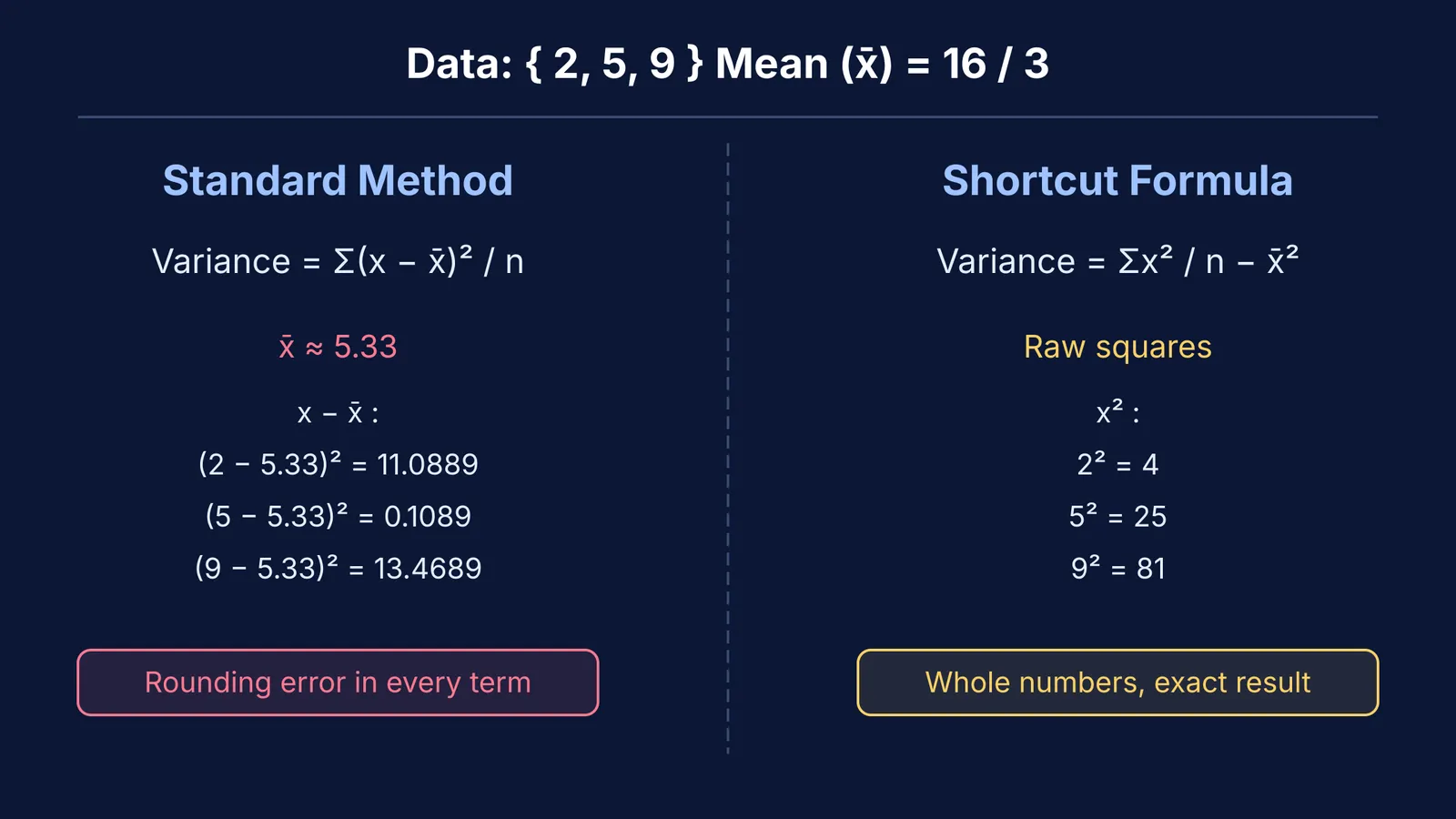
Suppose your dataset is 2, 5, and 9. The sum is 16, and there are 3 numbers, so the mean (x̄) is 16/3, or 5.333...
If you use the standard formula, you fall into the rounding trap:
First deviation: 2 − 5.33 = −3.33. Squared: 11.0889.
Second deviation: 5 − 5.33 = −0.33. Squared: 0.1089.
Third deviation: 9 − 5.33 = 3.67. Squared: 13.4689.
Because you had to round 5.333... to 5.33, every difference is slightly wrong. When you square those differences, the error compounds. Summing these imprecise squares gives you a slightly inaccurate variance, which can cost you marks in a multiple-choice paper.
Now look at the shortcut formula for the same data:
Square the raw numbers: 2² = 4, 5² = 25, 9² = 81.
Sum the squares: 4 + 25 + 81 = 110.
Subtract the square of the exact mean: (110 / 3) − (16 / 3)² = 330/9 − 256/9 = 74/9.
The result is exactly 74/9 (about 8.22). You stayed in whole numbers and fractions the entire time, entirely avoiding the rounding trap.
How to derive the shortcut formula from the standard one?
The shortcut formula is not a new rule; it is just the standard formula algebraically expanded.
Starting with the definition: Variance = Σ(x − x̄)² / n
Expand the squared binomial: Variance = Σ(x² − 2x x̄ + x̄²) / n
Because the sum operator (Σ) distributes over addition, and x̄ is a constant for the whole dataset, this simplifies to: Variance = (Σx² / n) − 2x̄(Σx / n) + (n x̄² / n)
Since Σx / n is just the mean (x̄), the middle term becomes −2x̄². The final term simplifies to x̄². Variance = (Σx² / n) − 2x̄² + x̄² Variance = (Σx² / n) − x̄²
This algebraic rearrangement takes a tedious, error-prone manual process and turns it into a clean, precise calculation.
Practising the shortcut method
Maths tricks only stick when you use them to solve real problems. Just like inserting arithmetic and geometric means between two numbers, mastering this formula requires seeing it in action.
If you are preparing for exams and want to see how this applies to grouped data and frequency tables, the Fermi Problem Library has worked statistics problems with a step-by-step solver. Rather than just printing an answer, the AI tutor explains the reasoning and shows you exactly when to deploy the shortcut formula to save time.


