

On this page
Magnetism gives you three unit names in one chapter: tesla, gauss and weber. Many slips come from converting between them. Here is how they connect, plus a worked problem.
What is the SI unit of magnetic field?
The SI unit of magnetic flux density B is the tesla (T), and 1 T = 1 Wb/m², or kg s⁻² A⁻¹ in SI base units (NIST Guide to the SI, Table 3).
When a JEE question says "magnetic field B", it means this quantity. H, the magnetic intensity, is a separate quantity with a different unit, so check which one is asked for.
How many gauss are in one tesla?
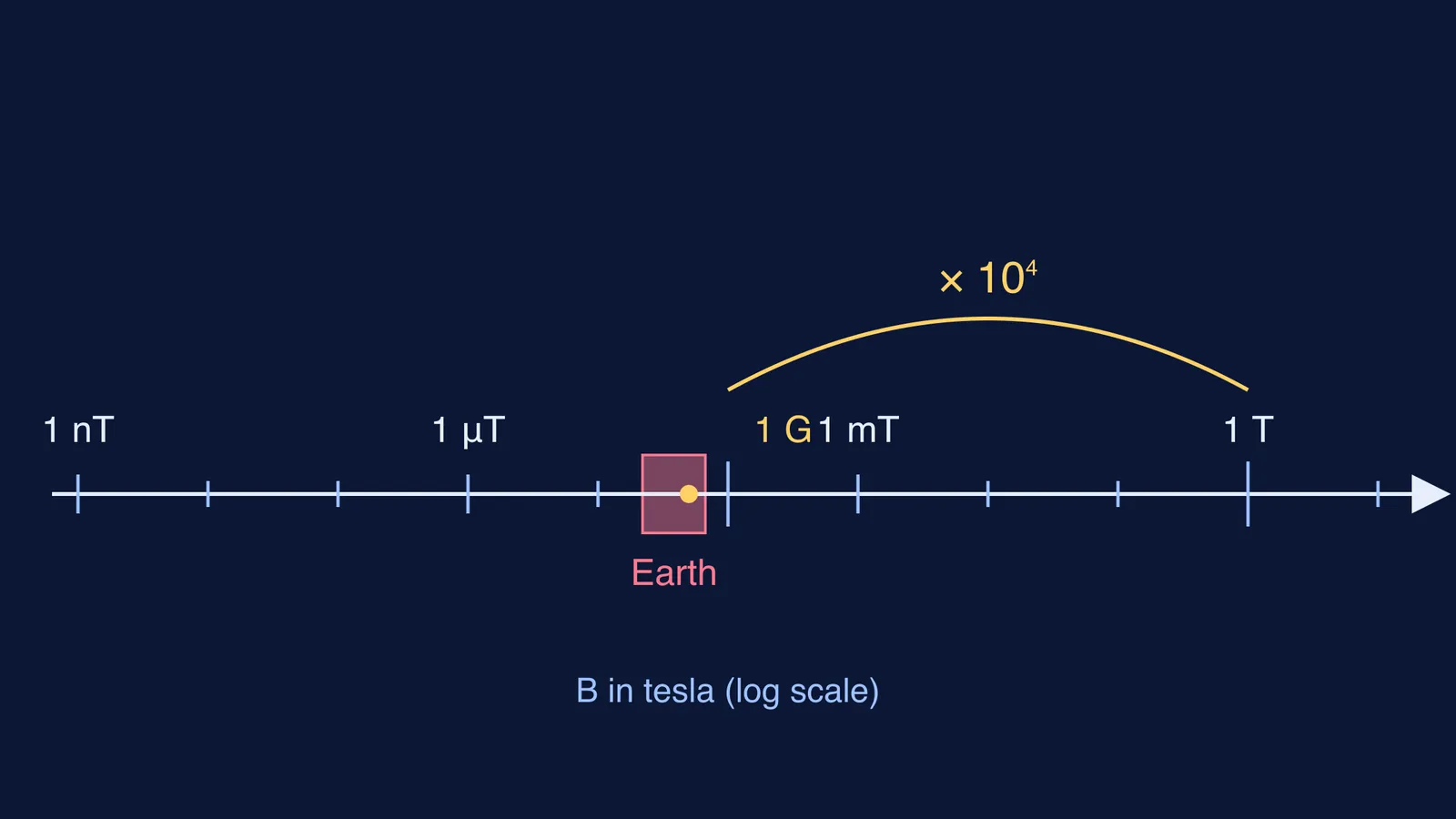
One gauss equals 10⁻⁴ tesla, so 1 T = 10⁴ G = 10,000 G (NIST Guide to the SI, Appendix B.9).
The gauss is the older CGS unit, not an SI unit, but it still turns up in questions. The same NIST table gives 1 maxwell (the CGS unit of flux) = 10⁻⁸ weber.
The rule to remember:
Tesla to gauss: multiply by 10⁴.
Gauss to tesla: multiply by 10⁻⁴.
How strong is Earth's magnetic field in tesla and gauss?
At Earth's surface the total field intensity varies from 22,000 nT to 67,000 nT, according to the British Geological Survey.
Convert that range and you get 2.2 × 10⁻⁵ T to 6.7 × 10⁻⁵ T, which is 0.22 G to 0.67 G. So "about 0.5 gauss", or 50 microtesla, is a sensible middle value to carry into an estimate. If a question gives you a value for Earth's field, use that one.
What does a weber measure, and how is it related to the tesla?
The weber (Wb) is the SI unit of magnetic flux Φ, and 1 Wb = 1 V s, or m² kg s⁻² A⁻¹ in base units (NIST Guide to the SI, Table 3).
Since the tesla is a weber per square metre, you can rearrange it: 1 Wb = 1 T m². That is exactly what the flux formula says. Φ = BA cos θ, where θ is the angle between B and the normal to the surface. If the angle part trips you up, our post on magnetic flux through a coil at an angle works through it.
The volt-second form matters in electromagnetic induction. Faraday's law sets the emf equal to the rate of change of flux linkage, so a change of 1 weber per second gives 1 volt. Reading that off a graph is covered in finding induced emf from a flux-time graph.
Worked example: flux, flux linkage and emf in a coil
A 100-turn coil of area 50 cm² sits in a uniform field of 2000 G, with the plane of the coil perpendicular to the field. Find the flux through one turn and the flux linkage. The field then falls to zero in 0.1 s; find the average emf. Use the gauss factor from the NIST conversion table.
Convert the field: 2000 G × 10⁻⁴ = 0.2 T.
Convert the area: 50 cm² × 10⁻⁴ m²/cm² = 5 × 10⁻³ m².
Find the angle: the plane is perpendicular to B, so its normal is parallel to B. θ = 0 and cos θ = 1.
Flux through one turn: Φ = 0.2 T × 5 × 10⁻³ m² = 1 × 10⁻³ Wb, or 1 mWb.
Flux linkage: NΦ = 100 × 10⁻³ Wb = 0.1 Wb.
Average emf: 0.1 Wb ÷ 0.1 s = 1 V.
Notice the two separate factors of 10⁻⁴, one from gauss and one from cm². Forget either and you are off by 10,000.
A unit checklist before you write the final answer
Run through this before you finish any magnetism numerical:
Is B in tesla? Convert gauss with × 10⁻⁴ (NIST conversion table).
Is the area in m²? cm² needs × 10⁻⁴; mm² needs × 10⁻⁶.
Is θ measured from the normal to the surface, not from the surface itself?
Does a flux answer end in Wb and a field answer in T? An answer in Wb/m² is a field.
Did you multiply by N for flux linkage?
Is the size sensible? Earth's field is tens of microtesla (British Geological Survey).
The same habit helps with other magnetic units, such as the two equivalent units of magnetic moment, A m² and J/T.
If the wrong-unit slip keeps coming back, the Fermi Problem Library has worked problems with a step-by-step solver that explains the reasoning rather than printing an answer, so you can see where each conversion sits. For the definitions, the Fermi Concept Library gives each physics concept its own lesson and its place in the map.
Try the worked example again with the normal to the coil at 60° to the field: the flux per turn should come out as 0.5 mWb.


